
Analysis finds that water-scoopers better for fighting wildfires
A three-year analysis commissioned by the U.S. Forest Service has found that the most efficient air-attack strategy to suppress wildfires would use water-scooping aircraft - not the heavy tankers that the government favors.
But Forest Service leaders plan to press ahead in acquiring more heavy tankers, which drop up to 3,000 gallons of fire-retardant chemical slurry.
Nonprofit think tank Rand Corp.'s cost-benefit analysis being released Monday morning - launched in 2009, costing $800,000 - is aimed at perfecting the nation's methods for swiftly suppressing wildfires of the sort seen this summer along Colorado's Front Range.
Fire-suppression aircraft fought blazes all over Colorado in June, including the devastating Waldo Canyon fire, which burned 346 homes and 18,247 acres in Colorado Springs, and the High Park fire, which chewed through 87,284 acres and destroyed 259 homes west of Fort Collins.
"Our proposal would be to evolve to a portfolio of firefighting aircraft that is dominated by water-bearing scoopers. You can drop more water from a scooper per hour than you can drop slurry from a tanker," said Ed Keating, an economist who ran Rand's project.
"Our perspective was to look at it from the taxpayer's perspective. Our estimates are that the most cost-effective portfolio would be dominated by water-scoopers," Keating said.
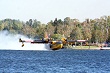
The scoopers are chubby yellow aircraft the size of commuter planes with propellers on each wing and inlets below. They swoop over water, needing a three-quarter-mile stretch several feet deep. They're deployed in Canada, Russia and other areas with abundant water near fire-prone forests.
Rand analysts said the 1,600-gallon scoopers could be had new for about $30 million each, with annual costs of $3 million, compared with $80 million for air tankers and annual costs of $7 million. Wildfire-suppression costs have increased to about $1.65 billion a year as more people live near forests.
Forest Service Chief Tom Tidwell issued a statement calling Rand's analysis "interesting" but "based in part on crucial and flawed assumptions" on costs.
The Forest Service leases firefighting aircraft from contractors. For decades, firefighting ground crews have relied on slurry bombers that "paint" terrain with retardant to contain flames so that ground crews can move closer and build fire lines.
The Forest Service hired Rand to help determine the best mix of helicopters and air tankers for a modernized fleet of firefighting aircraft. The current fleet has dwindled, and some tankers are more than 40 years old. A plan announced to Congress would add 18 to 28 new tankers as well as water-bearing helicopters and two scoopers.
"Our 50-year history has shown us that, while there's a time and place for water - and we drop a lot of it - that for our large air tankers, retardant is the way to go. You can build the line with the retardant. It has residual, positive benefits for firefighters even when the water has evaporated. In the arid West, it is just a better buy for us," said Tom Harbour, the Forest Service's director of fire and aviation management.
Rand's analysis includes a look at all fires in federal forests over a decade in relation to water bodies that would enable use of scoopers.
"We found that about two-thirds of fires have been within 10 miles of a scooper-accessible body of water," Keating said. "We were surprised at the scooper-appropriate water accessibility, even in arid parts of the country."
The increased development in forests is driving efforts to perfect wildfire suppression. Forest Service managers say tens of thousands of communities nationwide are at risk of wildfires, in part because aggressive suppression has left forests loaded with fuel.
Harbour said managers are discussing how to deal with a complex public-policy question: Given the risks of super-large catastrophic wildfires in the future, to what extent does aggressive fire suppression make sense?
The Forest Service will use mechanical tools and prescribed fire to thin forests, Harbour said.
"But there's always going to be a role for putting fires out," he said. "We're simply always going to always have places where the proximity of communities and volatile vegetation and the time of year simply doesn't mix."
Read more: Analysis finds that water-scoopers better for fighting wildfires - The Denver Post http://www.denverpost.com/environment/c ... z22AalMAiT
Analysis: water-scoopers better for fighting wildfires
Moderators: sky's the limit, sepia, Sulako, North Shore, Rudder Bug
Re: Analysis: water-scoopers better for fighting wildfires
Wow it took 3 years and $800,000 to come to that conclusion. Anybody with a couple of years experience on a scooper could tell them that.A three-year analysis commissioned by the U.S. Forest Service has found that the most efficient air-attack strategy to suppress wildfires would use water-scooping aircraft - not the heavy tankers that the government favors.
And people wonder why the US Firefighting Programs are so ineffective and continue to burn up taxpayers homes and property.But Forest Service leaders plan to press ahead in acquiring more heavy tankers, which drop up to 3,000 gallons of fire-retardant chemical slurry.
-
Siddley Hawker
- Rank 11

- Posts: 3353
- Joined: Tue Aug 10, 2004 6:56 pm
- Location: 50.13N 66.17W


Re: Analysis: water-scoopers better for fighting wildfires
Can't hurt to have more varied tools.
-
threepoint
- Rank 2

- Posts: 85
- Joined: Tue Oct 18, 2005 10:29 am
Re: Analysis: water-scoopers better for fighting wildfires
Two little insider tidbits:
First: being very familiar with the High Park fire, there was but one waterscooping source (Horsetooth Reservoir) but density altiudes, shrinking water levels and single-digit RH all conspired to render the fire unsuited to water-scooping ops. S-64 Skycranes with 2000 gallon tanks were reduced to carrying 300 gallons at the start of their fuel cycles! The Waldo Canyon fire did not have any suitable water sources nearby.
Second: why buy a single CL-415 for $30M when you could buy 11 brand-new FireBoss aircraft for the same price? The better bang for the buck, fleet flexibility and number of suitable water sources make this a no-brainer.
Sadly, that perfectly describes the USFS's approach to fixed-wing aircraft management.
First: being very familiar with the High Park fire, there was but one waterscooping source (Horsetooth Reservoir) but density altiudes, shrinking water levels and single-digit RH all conspired to render the fire unsuited to water-scooping ops. S-64 Skycranes with 2000 gallon tanks were reduced to carrying 300 gallons at the start of their fuel cycles! The Waldo Canyon fire did not have any suitable water sources nearby.
Second: why buy a single CL-415 for $30M when you could buy 11 brand-new FireBoss aircraft for the same price? The better bang for the buck, fleet flexibility and number of suitable water sources make this a no-brainer.
Sadly, that perfectly describes the USFS's approach to fixed-wing aircraft management.
Re: Analysis: water-scoopers better for fighting wildfires
Three point your right about getting 11 for one, well maybe not quite but it's been said before it takes that many to do the job of 1 415. The argument against the 415 is that is doesn't have a big enough punch to suit them so the FireBoss wouldn't even show up on the charts.
Only one water scooping source on the High Park Fire. Last I heard was you only need one?
Only one water scooping source on the High Park Fire. Last I heard was you only need one?


