Hi Badgergirl,
"Well, the town office calls in the condition of the runway to Nav Canada daily and sometimes more often if weather requires more frequent updates. Is that what you mean?"
I'm pretty sure that isn't quite what . is getting at, but you can bet he'll be back on here soon to clarify...

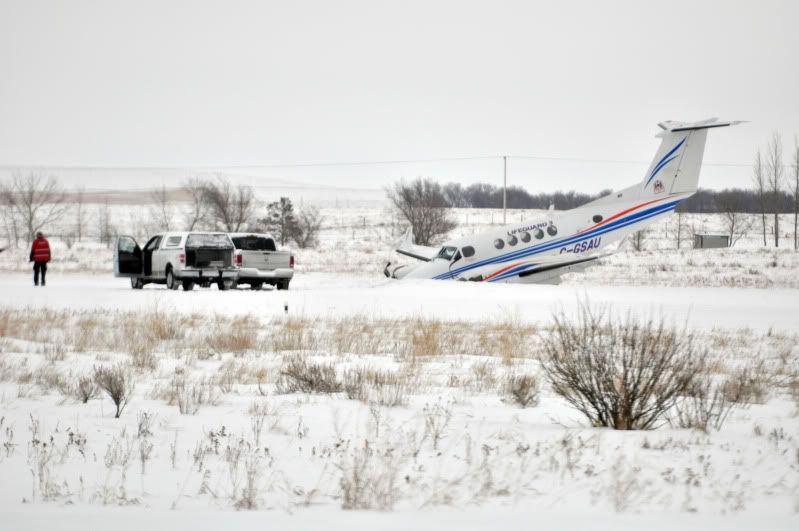
There are lots of airports across the country that aren't attended by humans, which normally would necessitate the pilot(s) to exercise due diligence before counting on being able to land successfully there. Also, an unattended airport would have other implications for approach and landing when instrument flight is a consideration. However since it seems more likely a white-out may have been the more likely cause, we'll forget about that part for the moment.
Snow on the runway can affect braking capabilities of the aircraft - most aircraft have performance charts where the pilot can look up expected landing and take-off performance for a clean runway. Often there will be a method to calculate performance degradation due to contaminated runways and headwind/tailwind component. (headwind good for stopping - tailwind bad). If there is no specific chart for contaminated runways, there will be a warning that the performance data for landing is predicated on a clean, dry runway, and the pilot will have to factor in a "best guess" based on experience and (hopefully) good judgment. That takes care of insufficient runway length. There's also the risk for slipping and sliding sideways in a crosswind and/or icy conditions.
Snow on the runway, even just enough to cover the surface and cause it to blend in with the surrounding terrain can be extremely dangerous and cause a loss of depth perception due to lack of visual reference. I haven't been into Maple Creek myself, however I see from the Canada Flight Supplement (our airport/runway bible) that runway 06-24 has lighting. If the lighting is on, or at least the light standards are poking above the snow, then the pilot has a fighting chance for visual reference. However, if you consider the aircraft is closing with the ground at a reference speed (sort of a fence at the end of the runway crossing speed) of say 103 Kts (flap) - 132 Kts (no flap) [190-244 kms], and combine this with a grey overcast day and a short runway.... well basically it means the pilot has to be as slow as possible, with very little if any landing reference, and somehow make ground contact and stop before the runway runs out. Not a great situation.
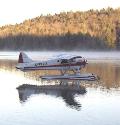
On a float plane over glassy water, or a ski plane over snow, or even a land plane over a long runway, a pilot can use some kind of side reference and a slow rate of descent to fly the aircraft to the surface. On a short runway in the flat lands in a fast airplane, this technique won't work very well.
The best defense a community airport can offer the pilot is to clear the runway after a snow - particularly if it is known a flight is inbound. And to keep Flight Service informed via regular reporting - particularly as soon as possible after a fresh snow, and again after snow removal. Pilots do generally try to make safe decisions, and exercise good judgement however there can be extra pressure if there is a perceived urgency to the flight (ie medevac to save a life). Not an excuse, but it exists nonetheless.
Anyway, I don't proclaim to have any clue what happened in this situation, and I make no judgment on the pilot - I have no information on which to even base an opinion. But hopefully this information will help you understand some of the hazards we face on the job.
Cheers,
Kirsten B.