
Hi Pelmet:
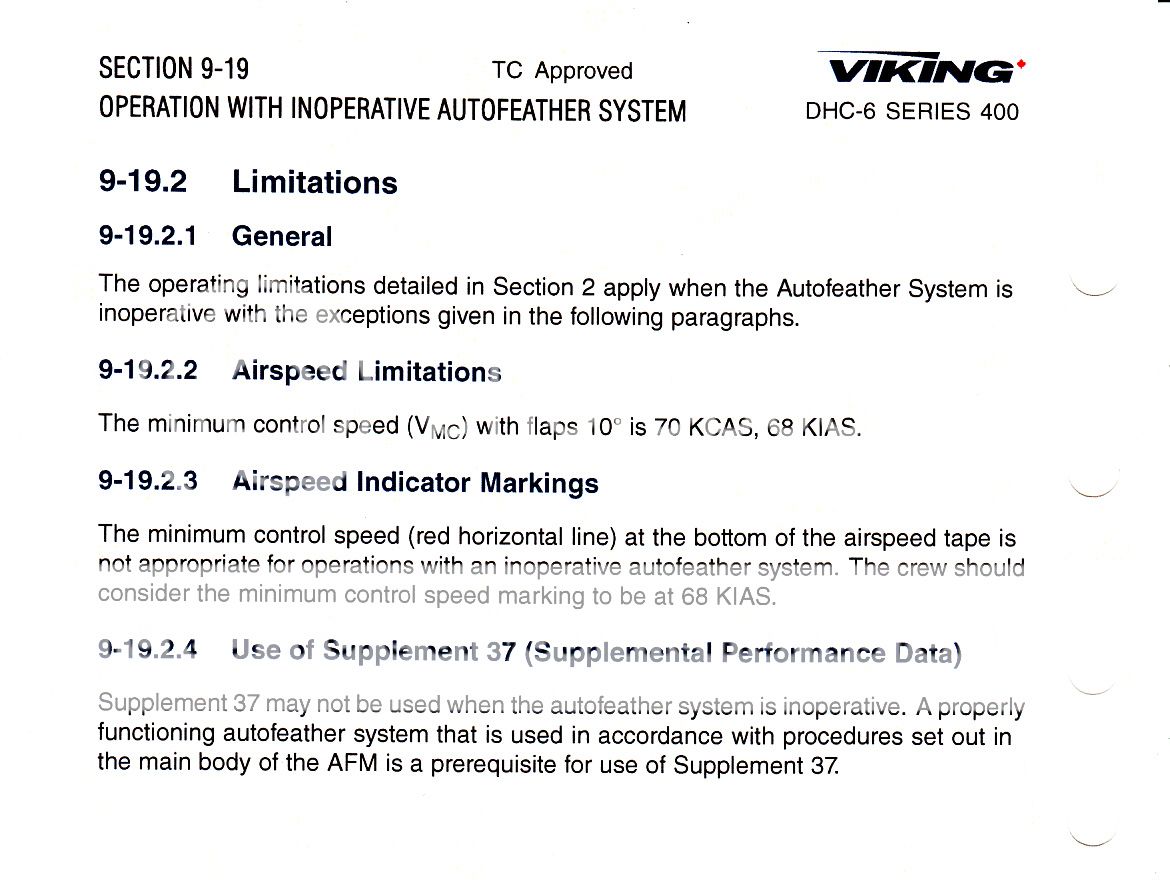
Attached below is an image of the limitations section of the supplement to the Twin Otter AFM dealing with operation when the autofeather system is inoperative. The supplement is identical for both the Series 300 and Series 400.
The Series 300 Twin Otter was originally certified in 1967 under CAR 3, which didn't address or require V1, Vr, or V2, nor did it address or require accelerate-stop distances. Only a 'liftoff' speed based on a margin above stall speed was published. Later, a supplement was published for the benefit of operators who needed to comply with SFAR 23, and that supplement contained V1, Vr, and V2 speeds, as well as accelerate-stop distances. Minimum Vr was established based on a specified margin above Vmca. Depending on the regulatory regime, both the 300 and 400 Series can be operated using either CAR 3 or SFAR 23 certification criteria.
Even later on, Supplement 36 was published to address the needs of Australian commercial operators who had to comply with unique Australian performance calculation rules applicable to Transport Category operations in that country. Finally, around 2012, supplement 37 was published to meet the needs of operators who needed to comply with EU-OPS1, CAR 704 or FAR 121 regulations. Both supplement 36 & 37 apply equally to the 300 and 400 Series.
The takeoff speeds in the various supplements didn't vary greatly from the original CAR 3 certification - the biggest difference arose from calculating a rotation speed based on a prescribed amount above Vmca, rather than a liftoff speed based on a prescribed amount above stall speed. At gross weight, there was no difference, but at weights less than 12,000 pounds, minimum rotation speed was constrained by the need to keep Vr a specified margin above Vma. Of course, the aircraft itself could not read the manual
 , which meant that it would be very difficult to keep an empty, lightweight Twin Otter on the ground until reaching the minimum 70 KIAS V1 & Vr speed set out in these supplements.
Supplement 37, the EU-OPS1 supplement, also introduced some new performance charts such as brake kinetic energy requirements. None of the new performance charts had the effect of imposing any significant operational limits on the aircraft, but EU-OPS1 regulations required that the additional performance information be provided to operators.







