That is very true; however, I have no doubt that Sydney Smoothhand would find a way to nullify its advantages!
Snowbird crash in CYKA
Moderators: lilfssister, North Shore, sky's the limit, sepia, Sulako

-
Schooner69A
- Rank 7

- Posts: 639
- Joined: Thu Nov 06, 2008 5:17 pm
- Location: The Okanagan
Re: Snowbird crash in CYKA
"The Hornet seat is a LOT better than the Tutor’s in pretty much every respect..."
That is very true; however, I have no doubt that Sydney Smoothhand would find a way to nullify its advantages!
Re: Snowbird crash in CYKA
The question shouldn’t be: “would a better seat have saved the day in kamloops?”
It should be “how many more lives could/would have been and will be saved by a better seat given the type of ejections the tutor has and is likely to have?”
It shouldn’t be asked in isolation to this one incident. But must look backwards and forwards. It may be the case that it wouldn’t have changed anything in the last accident, but that doesn’t mean it isn’t a good idea.
Having said that, I have no experience with ejections seats, nor do I know if it is feasible to do a retrofit. I don’t know the answers to the question and it may be the case that a newer seat wouldn’t have saved anyone in the past. But to come up with a informative answer, an appropriate question should be asked.
It should be “how many more lives could/would have been and will be saved by a better seat given the type of ejections the tutor has and is likely to have?”
It shouldn’t be asked in isolation to this one incident. But must look backwards and forwards. It may be the case that it wouldn’t have changed anything in the last accident, but that doesn’t mean it isn’t a good idea.
Having said that, I have no experience with ejections seats, nor do I know if it is feasible to do a retrofit. I don’t know the answers to the question and it may be the case that a newer seat wouldn’t have saved anyone in the past. But to come up with a informative answer, an appropriate question should be asked.
-
Big Pistons Forever
- Top Poster

- Posts: 5955
- Joined: Wed Feb 18, 2004 7:17 pm
- Location: West Coast
Re: Snowbird crash in CYKA
I am type rated out in a Eastern block jet trainer. The ejection seats were deactivated as per the TC limitations. I was personally OK with the risk but I would never carry a passenger.
FWIW, I would be happy to get into a Tutor today and go for a burn. The risk/reward still works for me.
Perhaps that is the reasonable middle ground. Carry on with the existing seats as the Snowbird posting is entirely voluntary but ban any passengers. The support crew can get moved in a transport airplane.
FWIW, I would be happy to get into a Tutor today and go for a burn. The risk/reward still works for me.
Perhaps that is the reasonable middle ground. Carry on with the existing seats as the Snowbird posting is entirely voluntary but ban any passengers. The support crew can get moved in a transport airplane.
Re: Snowbird crash in CYKA
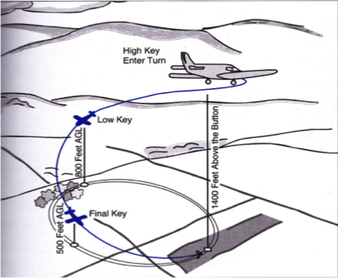
It's a different procedure for a forced approach. It's mostly theoretical for a power loss such as at Kamloops, because it is based on significant height over the field at the beginning. Not to say it can't be made to work by going to the lower keys. In this case, even making final key would have been difficult.telex wrote: ↑Tue Jun 02, 2020 9:37 pm - the idea with an engine failure in single engine military jets is to exchange airspeed for altitude to get away from the ground, buy some time to sort things out and assess whether one can return to the same runway. The idea in the Tutor is to apex at 130 kts (above the stall speed) and assess if one can get to a downwind position abeam the threshold of the take-off runway at or above 1500 ft agl; this is known as "low-key". If you can't achieve that then the idea is to jump out.
Read the thread and ye shall be rewarded.
Good judgment comes from experience. Experience often comes from bad judgment.
Re: Snowbird crash in CYKA
There is no doubt that there was not enough energy at the engine failure moment to make it to low-key. However if there was partial power and/or a relight, there likely would have been. During the zoom I am sure SB 11 would be doing the idle, airstart routine trying to get either. Evidently the engine was not coming back so it was time to get out. Had the engine provided partial power or relit it would have been a different story.
Lots going on in that 12 seconds.
Last edited by L39Guy on Fri Jun 05, 2020 10:01 pm, edited 1 time in total.
Re: Snowbird crash in CYKA
Do you think he would have been able to make final key for 22?
Going for the deck at corner
-
Schooner69A
- Rank 7

- Posts: 639
- Joined: Thu Nov 06, 2008 5:17 pm
- Location: The Okanagan
Re: Snowbird crash in CYKA
I don't know if he could have made final key or not; based on where he lost the engine, I'd hazard a "no".
It's possible that with the video available, the reconstruction boys/girls may be able to get some altitudes from it.
Given where the engine turned to jello, I do know that had I been at the controls it would not have even been an option...
It's possible that with the video available, the reconstruction boys/girls may be able to get some altitudes from it.
Given where the engine turned to jello, I do know that had I been at the controls it would not have even been an option...
Re: Snowbird crash in CYKA
Not sure if you're asking me, but that is a very good point. I'd forgotten about that short runway. What can be seen is consistent with that being the objective.
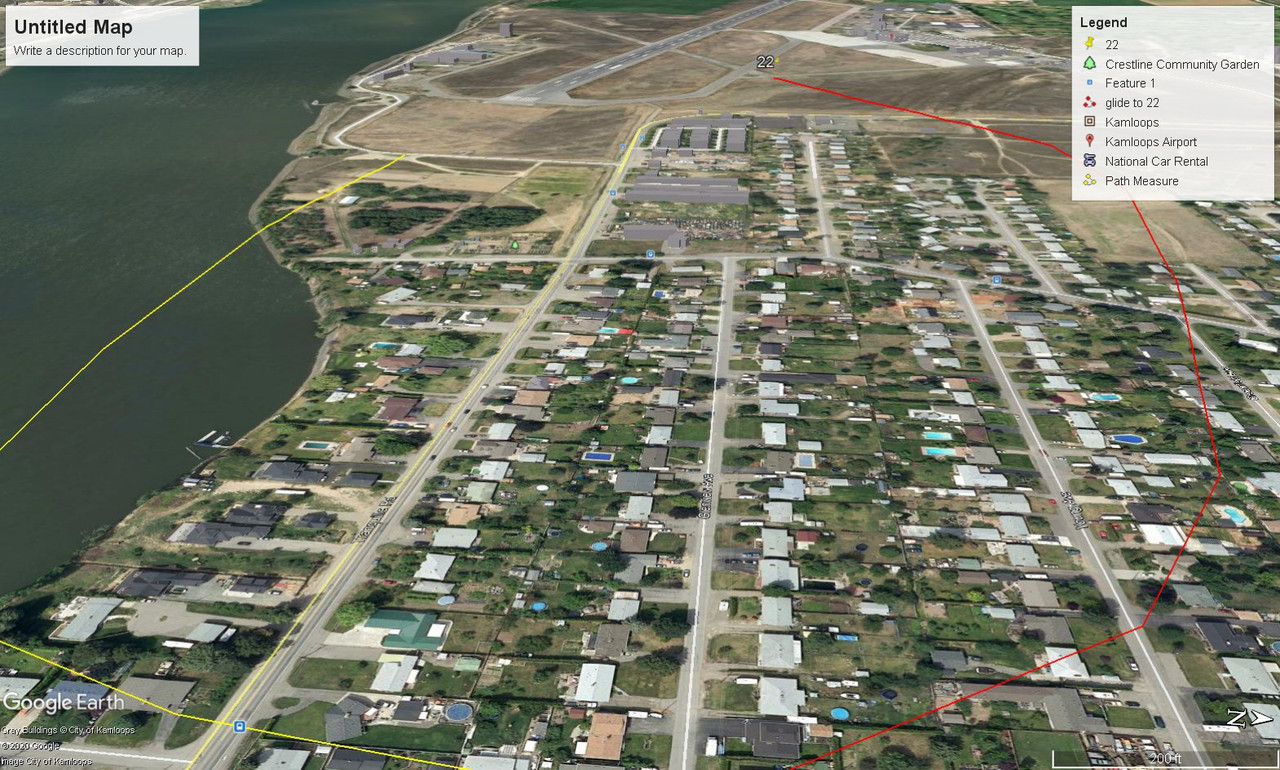
Assuming the calculation of 720 AGL is correct, this would have been the view out the port side at the time control was lost. The pop sound is right at the boundary fence, the yellow line the approximate path of the aircraft in the zoomn and turn. The red line is the path with minimal bank to final key for 22. Assuming the figure of a 1:12 glide ratio is correct, from 700 feet agl he would have gotten 8400 feet of glide. On the red path, the distance is 4900 feet to the button of 22. He would have had good options for the eject if he thought he wouldn't make it.
Well spotted, AuxBat. Do you think that might have been a briefed procedure?

Good judgment comes from experience. Experience often comes from bad judgment.
Re: Snowbird crash in CYKA
I did a calculation using aircraft dimensions and pixels, I got 720 at highest point, and 280 for the eject. AGL. It should be fairly close. The eye elevation is 1840 in the Goodle Earth image. ASL.Schooner69A wrote: ↑Fri Jun 05, 2020 4:28 pm I don't know if he could have made final key or not; based on where he lost the engine, I'd hazard a "no".
It's possible that with the video available, the reconstruction boys/girls may be able to get some altitudes from it.
Given where the engine turned to jello, I do know that had I been at the controls it would not have even been an option...
Good judgment comes from experience. Experience often comes from bad judgment.
Re: Snowbird crash in CYKA
The ejector seat is there as an added safety, a newer one may have fared better but it may have not. I don't think any upgrades are needed, they should just replace the jet if they have a concern flying it.
Thanks for the maps but have you factored wind into those? PDW would be able to get better detail on that. You're going to lose big on downwind.
It's an absolute miracle no one on the ground was killed.
The harsh reality is that when you have an emergency like that, it doesn't always end up good and people die. We will learn from it and all be better pilots because of it.
Thanks for the maps but have you factored wind into those? PDW would be able to get better detail on that. You're going to lose big on downwind.
It's an absolute miracle no one on the ground was killed.
The harsh reality is that when you have an emergency like that, it doesn't always end up good and people die. We will learn from it and all be better pilots because of it.
Re: Snowbird crash in CYKA
I did get the METARS for that time, but the 11 am and noon ones were "missing". The 10 am was 4 knots pretty well on the nose for the departure runway, so I wouldn't think an effect.Heliian wrote: ↑Fri Jun 05, 2020 7:29 pm The ejector seat is there as an added safety, a newer one may have fared better but it may have not. I don't think any upgrades are needed, they should just replace the jet if they have a concern flying it.
Thanks for the maps but have you factored wind into those? PDW would be able to get better detail on that. You're going to lose big on downwind.
It's an absolute miracle no one on the ground was killed.
The harsh reality is that when you have an emergency like that, it doesn't always end up good and people die. We will learn from it and all be better pilots because of it.
I'm questioning the technique I used to get the altitude. Assume that they were at 200 feet at the pop sound, from there it is only 10 seconds till top of climb and spin start. So 500 in 10 seconds, at best. So a ROC in zoom of 3000 fpm. Doesn't seem possible to me, doesn't match the visual on the video.
PDW? I chuckle.
Good judgment comes from experience. Experience often comes from bad judgment.
Re: Snowbird crash in CYKA
Good judgment comes from experience. Experience often comes from bad judgment.
Re: Snowbird crash in CYKA
http://www.rcaf-arc.forces.gc.ca/en/fli ... e/kae62tqg
The accident involved a CT114 Tutor aircraft from the Canadian Armed Forces Air Demonstration Team (Snowbirds) enroute to Comox, BC to reposition in support of Op INSPIRATION. The aircraft was number two of a formation of two Tutor aircraft.
Following the take-off, a loud, impact-like sound was heard by both occupants and the aircraft then experienced a loss of thrust. The pilot initiated a climb straight ahead and then elected to carry out a left-hand turn back towards the airport. The manoeuvre resulted in an aerodynamic stall halfway through the turn before the pilot gave the order to abandon the aircraft. Both occupants subsequently ejected and the aircraft was destroyed upon impact in a residential area. The passenger was fatally injured and the pilot received serious injuries. Evidence gathered during the investigation revealed that both occupants’ ejection sequences were outside of the ejection envelope.
DNA evidence collected from the engine’s internal components confirmed the ingestion of a bird as witnessed from video evidence; however, the damage it caused was insufficient to cause a catastrophic failure. Rather, it resulted in a compressor stall that was never cleared.
The investigation recommends a directive be published which outlines the aircrew’s priority where an emergency during the take-off or landing phase occurs and has the potential to result in an ejection near or over a populated area.
The investigation also recommends further training on engine-related emergencies be practiced in the takeoff/low-level environment. It is also recommended that the practice of storing items between the ejection seat and the airframe wall cease immediately.
Finally, further research is recommended into the potential options that would stabilize the CT114 ejection seat from any tendency to pitch, roll or yaw immediately following its departure from the ejection seat rails.
The accident involved a CT114 Tutor aircraft from the Canadian Armed Forces Air Demonstration Team (Snowbirds) enroute to Comox, BC to reposition in support of Op INSPIRATION. The aircraft was number two of a formation of two Tutor aircraft.
Following the take-off, a loud, impact-like sound was heard by both occupants and the aircraft then experienced a loss of thrust. The pilot initiated a climb straight ahead and then elected to carry out a left-hand turn back towards the airport. The manoeuvre resulted in an aerodynamic stall halfway through the turn before the pilot gave the order to abandon the aircraft. Both occupants subsequently ejected and the aircraft was destroyed upon impact in a residential area. The passenger was fatally injured and the pilot received serious injuries. Evidence gathered during the investigation revealed that both occupants’ ejection sequences were outside of the ejection envelope.
DNA evidence collected from the engine’s internal components confirmed the ingestion of a bird as witnessed from video evidence; however, the damage it caused was insufficient to cause a catastrophic failure. Rather, it resulted in a compressor stall that was never cleared.
The investigation recommends a directive be published which outlines the aircrew’s priority where an emergency during the take-off or landing phase occurs and has the potential to result in an ejection near or over a populated area.
The investigation also recommends further training on engine-related emergencies be practiced in the takeoff/low-level environment. It is also recommended that the practice of storing items between the ejection seat and the airframe wall cease immediately.
Finally, further research is recommended into the potential options that would stabilize the CT114 ejection seat from any tendency to pitch, roll or yaw immediately following its departure from the ejection seat rails.
Re: Snowbird crash in CYKA
A totally unfortunate incident with a very sad ending
As it turns out the investigation found that what happened was exactly what some of us said was the most likely scenario.
Of course looking back thru the thread , I see where I as well as some others were flamed by the usual know it all’s here on this page that think they are gods gift to aviation.
The old adage still hold true ; engine failure on take off - proceed straight ahead nose down - then either eject or land straight ahead depending on aircraft type
DO NOT attempt to turn back to the airport
This rule goes all the way back to the beginning of aviation
Any of you yahoo’s that dispute that are going to get someone killed.
As it turns out the investigation found that what happened was exactly what some of us said was the most likely scenario.
Of course looking back thru the thread , I see where I as well as some others were flamed by the usual know it all’s here on this page that think they are gods gift to aviation.
The old adage still hold true ; engine failure on take off - proceed straight ahead nose down - then either eject or land straight ahead depending on aircraft type
DO NOT attempt to turn back to the airport
This rule goes all the way back to the beginning of aviation
Any of you yahoo’s that dispute that are going to get someone killed.
...isn't he the best pilot you've ever seen?....Yeah he is ....except when I'm shaving.........
-
RatherBeFlying
- Rank 7

- Posts: 684
- Joined: Sat Sep 17, 2005 9:27 am
- Location: Toronto
Re: Snowbird crash in CYKA
The report does not address the capabilities of the ejection seat compared to newer aircraft - chain of command and all that.
For a low level power loss in the Tutor with the current seat, I'd put emphasis on remaining within the ejection seat envelope. Wings level at top of whatever climb is left optimises your and your passenger's chances.
And yes, it's worth trying to point it away from built up areas before leaving.
Mission planning would do well to avoid airports and runways where built up areas are unavoidable in the case of engine failure.
For a low level power loss in the Tutor with the current seat, I'd put emphasis on remaining within the ejection seat envelope. Wings level at top of whatever climb is left optimises your and your passenger's chances.
And yes, it's worth trying to point it away from built up areas before leaving.
Mission planning would do well to avoid airports and runways where built up areas are unavoidable in the case of engine failure.
Re: Snowbird crash in CYKA
My predictions were accurate. And if this was a low time civilian pilots his actions would have been questioned immediately and his name drug across this board for all to see.
A big wing lightweight trainer has no business pulling up to such attitudes with no power.
Re: Snowbird crash in CYKA
I feel that the pilot's attempt to return to the airport was mishandled and resulted in an aerodynamic stall and subsequent loss of control. That left him with no other choice than to eject and by that time the aircraft was outside of the safe ejection envelope. A slit second decision I wouldn't wish on anyone.
The Tudor was going to hit the ground regardless. It's most unfortunate he thought a return was the better option.
Re: Snowbird crash in CYKA
I have never flown a jet, nor received military training, so I respect that that training may have differences. However, I have never been taught, nor taught anyone I was training, to "turn back toward the runway" in case of an EFATO.
Re: Snowbird crash in CYKA
Exactly and with a high performance wing it would be even more risky
...isn't he the best pilot you've ever seen?....Yeah he is ....except when I'm shaving.........
Re: Snowbird crash in CYKA
Maybe that's why nobody can make the return when called upon to do it in an emergency. No training, no preparation, no drills, one should expect no success. Maybe pilots should be trained to fly their airplanes at the limits of performance, rather than keeping the wings level at all costs.
There has been study after study after study showing that turnbacks are possible with adequate altitude (and it's much less than circuit altitude in most singles). Go learn what that altitude is, and practise an engine out 45 degree banked turn back to the airport. Add one more tool to your toolbox.
Re: Snowbird crash in CYKA
And in most cases the chances of surviving by landing or at least staying ahead are increased hugely . Hence the reason pilots are taught this. It been a clear and simple rule worldwide from the dawn of aviation .AirFrame wrote: ↑Tue Mar 30, 2021 6:39 amMaybe that's why nobody can make the return when called upon to do it in an emergency. No training, no preparation, no drills, one should expect no success. Maybe pilots should be trained to fly their airplanes at the limits of performance, rather than keeping the wings level at all costs.
There has been study after study after study showing that turnbacks are possible with adequate altitude (and it's much less than circuit altitude in most singles). Go learn what that altitude is, and practise an engine out 45 degree banked turn back to the airport. Add one more tool to your toolbox.
Airspeed is life .... zooming to altitude that bleeds off precious airspeed can have dire consequences as we have seen .
If the military wants to change this fine but the facts show that even with additional training their procedure is not the better option.
...isn't he the best pilot you've ever seen?....Yeah he is ....except when I'm shaving.........
Re: Snowbird crash in CYKA
And because people want to dumb it down, they only teach one rule, land straight ahead regardless, even when a better option might exist. We train for so many possibilities in flying. Why not train for one more that might save you, your passengers, and members of the public, rather than stick your head in the sand? "He landed straight ahead, but wow, that shopping mall burned for a week..."
Any one particular example of an unsuccessful turnback attempt doesn't mean your best choice is always to stay straight. No more than any one example of a successful turnback attempt means turning back is always your best choice. The pilot has to read the situation and make a decision based on the specific circumstances and their level of training.
It's been quite a long time since I got my license, but when I was first taught about engine failures on takeoff and I was told to always land straight ahead, I asked "what if there' a building right in front of you? and fields to either side?" Of course, the answer was to TURN to the field. Okay, what if that field is off your left or right wing? Or just behind the left or right wing? How do you decide whether to hit the buildings or try for the field? Without training for it, how could you?
Re: Snowbird crash in CYKA
You were beating around the bush instead of dealing with the problem straight onAirFrame wrote: ↑Tue Mar 30, 2021 8:44 amAnd because people want to dumb it down, they only teach one rule, land straight ahead regardless, even when a better option might exist. We train for so many possibilities in flying. Why not train for one more that might save you, your passengers, and members of the public, rather than stick your head in the sand? "He landed straight ahead, but wow, that shopping mall burned for a week..."
Any one particular example of an unsuccessful turnback attempt doesn't mean your best choice is always to stay straight. No more than any one example of a successful turnback attempt means turning back is always your best choice. The pilot has to read the situation and make a decision based on the specific circumstances and their level of training.
It's been quite a long time since I got my license, but when I was first taught about engine failures on takeoff and I was told to always land straight ahead, I asked "what if there' a building right in front of you? and fields to either side?" Of course, the answer was to TURN to the field. Okay, what if that field is off your left or right wing? Or just behind the left or right wing? How do you decide whether to hit the buildings or try for the field? Without training for it, how could you?
The RCAF procedure is to trade airspeed for height in order to assess the situation and try for a relight
Considering airspeed is everything this is not a very good trade
off
As we saw the aircraft no longer had airspeed for flight and when he attempted to make it back as per procedure the aircraft stalled at insufficient altitude recover or even punch out at at
Had the pilot maintained a straight course and as much airspeed as possible, They could’ve punched out safely and both survived
Please know that I am in no way trying to criticize the pilot for his decision he did exactly what he was trying to doExcept for using the proper terminology to it eject but hey the guy was under a lot of stress at the time so I can be forgiven
I am however criticizing the entire operating procedure and will go as far as to say that is flawed in some ways
The RCIF and in particular the snowbirds I’ve seen this procedure fail before and yet they’re still using it to this day
Last edited by fleet16b on Tue Mar 30, 2021 10:06 am, edited 1 time in total.
...isn't he the best pilot you've ever seen?....Yeah he is ....except when I'm shaving.........
- RedAndWhiteBaron
- Rank 8

- Posts: 813
- Joined: Sat Jan 04, 2020 5:55 pm
- Location: In the left seat, admitting my mistakes
Re: Snowbird crash in CYKA
Well, for my part, flying out of YTZ, a straight ahead landing after an EFTAO is not an option. There's nothing down there but drowning. That said, neither is an impossible turn - and there is no place to land downtown that won't endanger the lives of others.
So, the general plan is to ditch, but as close to shore as possible. To the east, the seawall will make self extrication from the water very difficult if you ditch on the north side of the inner harbour, so, ditch as close to Ward's Island as possible. To the west, point at Hanlan's Beach, land (crash?) there if possible, otherwise ditch.
But in all cases, landing straight is not an option. You will almost certainly either drown, or die of exposure. While "land straight ahead", yes, has been a general rule for a long time, it's not always that simple.
(Haha, for those that don't know, Hanlan's Beach is clothing optional. The media reports after a ditching there would be priceless...)
I will dance the sky on laughter-silvered wings.
Re: Snowbird crash in CYKA
Sorry perhaps I was not clear , I meant the better option was to proceed ahead maintaining positive airspeed at which time you either land in a field or can punch out at safe altitudeRedAndWhiteBaron wrote: ↑Tue Mar 30, 2021 9:36 amWell, for my part, flying out of YTZ, a straight ahead landing after an EFTAO is not an option. There's nothing down there but drowning. That said, neither is an impossible turn - and there is no place to land downtown that won't endanger the lives of others.
So, the general plan is to ditch, but as close to shore as possible. To the east, the seawall will make self extrication from the water very difficult if you ditch on the north side of the inner harbour, so, ditch as close to Ward's Island as possible. To the west, point at Hanlan's Beach, land (crash?) there if possible, otherwise ditch.
But in all cases, landing straight is not an option. You will almost certainly either drown, or die of exposure. While "land straight ahead", yes, has been a general rule for a long time, it's not always that simple.
(Haha, for those that don't know, Hanlan's Beach is clothing optional. The media reports after a ditching there would be priceless...)h

All depends on the aircraft you are flying
...isn't he the best pilot you've ever seen?....Yeah he is ....except when I'm shaving.........