
Law abiding citizen that I am, I try not to break many rules, or endorse braking the rules especially when it comes to flying. But one has to learn, preferably early on in their flying carrier, the difference between what is legal, and what is safe.
Sure TC and it's rules can prevent many a dumb-ass from killing themself, but ultimately some of the rules, and their relationship to relative training are somewhat offside. For example many flight schools, who sadly only have 250hr instructors, teaching the 200hr commercial student have certain policies regarding flights in adverse weather condidtions. I have no particular numbers but often anything less than 5 or 10 miles vis and and there'd be no flying for the day. And rightly so because the instructor does - in reality - not have much more relavent experience. So, a newly licensed private pilot can legally bugger off the day after his ride and fly around in 3 miles vis from Vancouver to Calgary. Yet, he has never been exposed to this scenerio, which if this case was for real would most likely end up on the fron page somewhere. I am by no means trying to bash flight schools or 250 hr instructors...this was just an example situation.
So the same applies to floatplanes. Sometimes, desperate times call for desperate measures. Desperate times are most often interpreted as "overloaded plane on small lake", but easily could be as simple as the pilot not wanting to submit the floats and airframe to uneccesarry pounding. So is it legal to take-off with full flap in a 185, 206 or Caravan? Maybe not. But it works for the most part. And as sure as I am of this, I'm also sure that I wasn't the first or the last to use these techiques. The trick is knowing how to do them properly, safely, and with minimum risk. It may not be legal, but knowing how to do it could come in real handy one day.
Sorry to stray off the beaten track here. I don't have a major in physics, but I think goldeneagle came close.
Good topic by the way.
Dave
Full flap takeoffs: why not?
Moderators: sky's the limit, sepia, Sulako, Right Seat Captain, lilfssister, North Shore
-
Cat Driver

- Top Poster

- Posts: 18921
- Joined: Sun Feb 15, 2004 8:31 pm
What really makes me want to shoot myself in pure frustration is the paranoia and fear of TC so evident in the instructors group.
Don't you guys understand that that kind of thinking will kill you because you are being programmed to act and think like robots?
Don't you guys understand that that kind of thinking will kill you because you are being programmed to act and think like robots?
The hardest thing about flying is knowing when to say no
After over a half a century of flying no one ever died because of my decision not to fly.
After over a half a century of flying no one ever died because of my decision not to fly.

Fear of TC is not a real driver here. Insturctors don't teach t/o with full flap because the POH says don't do it that way. Sure, an experienced pilot can in unusual circumstances do things that the situation requires to, say, get airborne. But when you are dealing with someone that has all of 15 hours you keep it simple. Working outside the box is something you can only start thinking of doing when you have mastered the basics and the book.
What kind of instructor would I be if I told a student 'well yes the manual says do it like this, but don't pay attention to it. You can really use full flaps to t/o on a really short field if you have to'. I suspect I would have just signed their death sentence. Pilots will have plenty of time to figure out the fancy stuff as time goes by.
About the closest I have need to come to this is milking the flaps a bit on a rough water t/o between bounces on wave tops. It works real well, but this is not the first thing I would teach s float student.
Some times it really seens like this is a place where people show off - "look at me I can do this and its not in the book - I'm better than the last poster" Sheesh
What kind of instructor would I be if I told a student 'well yes the manual says do it like this, but don't pay attention to it. You can really use full flaps to t/o on a really short field if you have to'. I suspect I would have just signed their death sentence. Pilots will have plenty of time to figure out the fancy stuff as time goes by.
About the closest I have need to come to this is milking the flaps a bit on a rough water t/o between bounces on wave tops. It works real well, but this is not the first thing I would teach s float student.
Some times it really seens like this is a place where people show off - "look at me I can do this and its not in the book - I'm better than the last poster" Sheesh
Wahunga!
-
Cat Driver
- Top Poster
- Posts: 18921
- Joined: Sun Feb 15, 2004 8:31 pm
Spokes:
Seems I am missing something here, I was not ever suggesting you use full flaps in a Cessna to aid take off on floats.
My comments were that 20 degrees will help break water on the C150, C172 , C 180, C 185 and the C206.
Someone said teach by the book and use 10 degrees, I then commented that 20 degrees are better.
Anyhow the more I comment on how to teach the more frustrating it becomes as the conversation always gets skewed and the subject with it.
Not all instructors are marginal, but it seems very few understand how to teach sea plane flying and even fewer that can teach conventional gear skills.
Most instructors fear TC that is a fact.
TC operates like a religion they hoodwink the masses into believing they are all powerful and rule through fear.
The truth is TC has become a safe haven for incompetents, bullies and pycopaths. Until that culture is removed from their ranks they should be looked on with scorn, not feared.
Cat
Seems I am missing something here, I was not ever suggesting you use full flaps in a Cessna to aid take off on floats.
My comments were that 20 degrees will help break water on the C150, C172 , C 180, C 185 and the C206.
Someone said teach by the book and use 10 degrees, I then commented that 20 degrees are better.
Anyhow the more I comment on how to teach the more frustrating it becomes as the conversation always gets skewed and the subject with it.
Not all instructors are marginal, but it seems very few understand how to teach sea plane flying and even fewer that can teach conventional gear skills.
Most instructors fear TC that is a fact.
TC operates like a religion they hoodwink the masses into believing they are all powerful and rule through fear.
The truth is TC has become a safe haven for incompetents, bullies and pycopaths. Until that culture is removed from their ranks they should be looked on with scorn, not feared.
Cat
The hardest thing about flying is knowing when to say no
After over a half a century of flying no one ever died because of my decision not to fly.
After over a half a century of flying no one ever died because of my decision not to fly.
-
justplanecrazy
- Rank 8

- Posts: 815
- Joined: Wed Feb 25, 2004 1:57 pm
A good trick for figuring out what your max lift to drag ratio is, is to take the ailerons and fully deflect them. Then line up the flaps to that angle. The ailerons are designed for the most efficent camber for the wing at max deflection so matching the flap will give you roughly the best lift to drag for that particular wing.
As far as teaching what's in the book vs. what works best, it depends on the reasoning behind it. Cessna says not to do forwards slips with full flaps as well on the 172 I believe. I'm not sure what the exact reason is but I believe it might have something to do with disturbed flow over the tailplane creating a possible tail stall. Could be a really dangerous result especially seeing as you'd be doing the manouver most times on short final and a sudden nose down attitude would be very dangerous. Because of that I point out the book says not to do it, and yes you might be giving them a death sentence if you tell them to ignore it.
Something as simple as recommended flaps for lift off is purely a performance standard. If you've found a better method, teach it. How the hell are they going to die from using 20 degrees of flaps???? If you teach strictly from a book and not through reasoning, your student will never learn how to think for himself.
As far as teaching what's in the book vs. what works best, it depends on the reasoning behind it. Cessna says not to do forwards slips with full flaps as well on the 172 I believe. I'm not sure what the exact reason is but I believe it might have something to do with disturbed flow over the tailplane creating a possible tail stall. Could be a really dangerous result especially seeing as you'd be doing the manouver most times on short final and a sudden nose down attitude would be very dangerous. Because of that I point out the book says not to do it, and yes you might be giving them a death sentence if you tell them to ignore it.
Something as simple as recommended flaps for lift off is purely a performance standard. If you've found a better method, teach it. How the hell are they going to die from using 20 degrees of flaps???? If you teach strictly from a book and not through reasoning, your student will never learn how to think for himself.
We have no effective screening methods to make sure pilots are sane.
— Dr. Herbert Haynes, Federal Aviation Authority.
— Dr. Herbert Haynes, Federal Aviation Authority.
Argh ... not this nonsense again. This is NOT a controllability issue ... what can happen, under rare conditions with full flaps in a sideslip in a 172, is that the elevator can osciallate which causes the yoke to move in and out.Cessna says not to do forwards slips with full flaps as well on the 172 I believe
Unfortunately in the past this has panicked more than one pilot, and this is not good. So Cessna tells us to "avoid" slips with flaps, not because the airplane might have a problem, but because the PILOT might have a problem.
THIS IS NOT A CONTROLLABILITY ISSUE.
It is unfortunate but true that I have over 1000 hours on C172, and I have no qualms whatsoever slipping with flaps, full or otherwise, in that aircraft.
Feed some keywords into google and start reading.
-
justplanecrazy
- Rank 8
- Posts: 815
- Joined: Wed Feb 25, 2004 1:57 pm
Full flap slips it is, you ruined my point Hedley. Now that I think about it, my CFI from flight school had called Cessna to ask about this and they said it was due to a disturbing noise and vibration but it wasn't a safety issue.
Then this is yet another example as to why you shouldn't fly and teach strictly from the POH. If a student is told to fly by the POH only and not think for himself, it can be even more dangerous and he won't know what to do in a situation not outlined in the book. Take this for example, he gets an engine failure and is too high with flaps, he won't slip because the POH says not to with flaps. Instead, he'll take a header into the fence to avoid what is apparently a slight vibration and noise from the tailplane. Same as ending up in the trees on that small alpine lake because he couldn't get off in time with 10 degrees of flaps. Teach him what works not what is written. Just because its written doesn't make it law or gospel.
Just make sure that you know why things in the POH are in the POH and learn to judge what needs to be followed and what doesn't. Some planes don't react well to spins, don't take this as a performance suggestion, it is telling you that you'll have a hell of a time getting out of a spin and might die if you spin this aircraft. Again, suggesting 10 degrees flaps vs. 20 is not going to kill you, spinning certain aircraft or exceeding VNE might.
Then this is yet another example as to why you shouldn't fly and teach strictly from the POH. If a student is told to fly by the POH only and not think for himself, it can be even more dangerous and he won't know what to do in a situation not outlined in the book. Take this for example, he gets an engine failure and is too high with flaps, he won't slip because the POH says not to with flaps. Instead, he'll take a header into the fence to avoid what is apparently a slight vibration and noise from the tailplane. Same as ending up in the trees on that small alpine lake because he couldn't get off in time with 10 degrees of flaps. Teach him what works not what is written. Just because its written doesn't make it law or gospel.
Just make sure that you know why things in the POH are in the POH and learn to judge what needs to be followed and what doesn't. Some planes don't react well to spins, don't take this as a performance suggestion, it is telling you that you'll have a hell of a time getting out of a spin and might die if you spin this aircraft. Again, suggesting 10 degrees flaps vs. 20 is not going to kill you, spinning certain aircraft or exceeding VNE might.
We have no effective screening methods to make sure pilots are sane.
— Dr. Herbert Haynes, Federal Aviation Authority.
— Dr. Herbert Haynes, Federal Aviation Authority.
-
Cat Driver
- Top Poster
- Posts: 18921
- Joined: Sun Feb 15, 2004 8:31 pm
Flight instruction overall in Canada has degenerated into a complete joke.
And the main reason is this.
" Most instructors fear TC that is a fact.
TC operates like a religion they hoodwink the masses into believing they are all powerful and rule through fear.
The truth is TC has become a safe haven for incompetents, bullies and pycopaths. Until that culture is removed from their ranks they should be looked on with scorn, not feared. "
And until changes are made within the ranks of TC you will continue to see more robotic instructors unable to think on any level that may bring them into the focus of the morons who are in charge of flight training at TC.
Am I the only person in Canadian aviation who is unafraid to stand up and try and bring about much needed changes to this pathetic industry?
. .
And the main reason is this.
" Most instructors fear TC that is a fact.
TC operates like a religion they hoodwink the masses into believing they are all powerful and rule through fear.
The truth is TC has become a safe haven for incompetents, bullies and pycopaths. Until that culture is removed from their ranks they should be looked on with scorn, not feared. "
And until changes are made within the ranks of TC you will continue to see more robotic instructors unable to think on any level that may bring them into the focus of the morons who are in charge of flight training at TC.
Am I the only person in Canadian aviation who is unafraid to stand up and try and bring about much needed changes to this pathetic industry?
. .
The hardest thing about flying is knowing when to say no
After over a half a century of flying no one ever died because of my decision not to fly.
After over a half a century of flying no one ever died because of my decision not to fly.
First off: sorry Cat. I guess that day I read one too many "I do it my way because I am way better than everyone else" posts and vented a bit. Shouldn't really do that here.
Its funny how these threads mutate. Full flap forward slip? how did we get there?
Full flaps for t/o? Well I guess there is always someone who wants to be a test pilot. But Like I said above, when you are learning to fly, don't go outside the POH. It will teach you how to deal with 99% of the situations you are in. A new pilot should not be trying to fly into situations where they feel tempted to try something that is not recomended.
Afraid of TC? Too old for that (well, not that old). But I can understand how a young new instructor might be. I have alot of respect for our TC overseer. I do like him, but I do not always agree with him. What am I gonna do about it? I chose to work in ithis system, I suppose that until I am in a position to change things I have to live with this system. Right now I enjoy instructing enough to do so.
Its funny how these threads mutate. Full flap forward slip? how did we get there?
Full flaps for t/o? Well I guess there is always someone who wants to be a test pilot. But Like I said above, when you are learning to fly, don't go outside the POH. It will teach you how to deal with 99% of the situations you are in. A new pilot should not be trying to fly into situations where they feel tempted to try something that is not recomended.
Afraid of TC? Too old for that (well, not that old). But I can understand how a young new instructor might be. I have alot of respect for our TC overseer. I do like him, but I do not always agree with him. What am I gonna do about it? I chose to work in ithis system, I suppose that until I am in a position to change things I have to live with this system. Right now I enjoy instructing enough to do so.
Wahunga!
-
Cat Driver
- Top Poster
- Posts: 18921
- Joined: Sun Feb 15, 2004 8:31 pm
Spokes, it is not my intention to dictate to others how to teach flying.
I do however have some suggestions and have learned from experience that flying is not a dicipline that can be strictly regulated on paper with no ability to teach tecniques that work in the airplane being flown, as long as said tecniques are not outside of the aircraft structural or other limits as outlined in the type certificate.
For instance if we had held to the X/wind numbers in airplanes like the DC3 how many landings would have been abandoned in the North where we operated them for decades. Remember the X/wind number is " demonstrated " not limiting.
Same thing with teaching someone to fly a Cessna 172 on floats they will lift off the water with 20 degrees of flap far sooner than using zero or 10 degrees.
Therefore why would anyone want to tear the living hell out of the engine roaring along with 10 degrees of flap just because they think it is against the rules???
As to your association with your TC master, I am happy for you that you have one you can work with.
Me I choose to teach outside of any contact with TC and if " any " TC inspector from flight training ever comes near me I will advise him / her that they are tresspassing and I can not be forced to associate with thugs working for a crimminal orginazation.
So that about takes care of me needing to be concerned with how good or bad any of their inspectors are.
Cat
I do however have some suggestions and have learned from experience that flying is not a dicipline that can be strictly regulated on paper with no ability to teach tecniques that work in the airplane being flown, as long as said tecniques are not outside of the aircraft structural or other limits as outlined in the type certificate.
For instance if we had held to the X/wind numbers in airplanes like the DC3 how many landings would have been abandoned in the North where we operated them for decades. Remember the X/wind number is " demonstrated " not limiting.
Same thing with teaching someone to fly a Cessna 172 on floats they will lift off the water with 20 degrees of flap far sooner than using zero or 10 degrees.
Therefore why would anyone want to tear the living hell out of the engine roaring along with 10 degrees of flap just because they think it is against the rules???
As to your association with your TC master, I am happy for you that you have one you can work with.
Me I choose to teach outside of any contact with TC and if " any " TC inspector from flight training ever comes near me I will advise him / her that they are tresspassing and I can not be forced to associate with thugs working for a crimminal orginazation.
So that about takes care of me needing to be concerned with how good or bad any of their inspectors are.
Cat
The hardest thing about flying is knowing when to say no
After over a half a century of flying no one ever died because of my decision not to fly.
After over a half a century of flying no one ever died because of my decision not to fly.
-
Cat Driver
- Top Poster
- Posts: 18921
- Joined: Sun Feb 15, 2004 8:31 pm
" Where do you draw the line? "
If you are not capable of using common sense and learning from others and flying an airplane at its optimum performance limits, such as using the best flap setting to break the water tension, drag penalty due to aerodynamic lift v.s. water hydrodynamics I guess I can't help you.
How do you manage to mix something like exceeding a structural speed restriction regarding flaps with using max lift setting on takeoff on floats....or flying over gross weight?
And furthermore CPL-ATC where do you find me ever suggesting anyone fly in an unsafe or illegal manner?
Do you think that using that flap setting will somehow endanger the flight characteristics of a Cessna 172?
I guess It's time for me to quit posting in the flight training forum again as it seems I am getting no where with these discussions.
So carry on guys, when I get bored all I need do is go to a lake or airport and watch the experts fly by the book.
And thank God its not my airplane they are flying.
By the way, can someone show me proof that using 20 degrees of flap on a C172 during take off on floats will cancel your insurance coverage?
"Cat, your tone earlier on seemed to suggest that a lot of today's pilots and instructors are drones for simply flying according to the book. "
Well I'm not sure exactly why so many are so poor at teaching, but their end product leads me to believe they do not understand what they are teaching....and that includes the products that are turned out in the multi engine field, I just run and hide watching some of the approaches and landings being performed with small twins.
Cat
If you are not capable of using common sense and learning from others and flying an airplane at its optimum performance limits, such as using the best flap setting to break the water tension, drag penalty due to aerodynamic lift v.s. water hydrodynamics I guess I can't help you.
How do you manage to mix something like exceeding a structural speed restriction regarding flaps with using max lift setting on takeoff on floats....or flying over gross weight?
And furthermore CPL-ATC where do you find me ever suggesting anyone fly in an unsafe or illegal manner?
Do you think that using that flap setting will somehow endanger the flight characteristics of a Cessna 172?
I guess It's time for me to quit posting in the flight training forum again as it seems I am getting no where with these discussions.
So carry on guys, when I get bored all I need do is go to a lake or airport and watch the experts fly by the book.
And thank God its not my airplane they are flying.
By the way, can someone show me proof that using 20 degrees of flap on a C172 during take off on floats will cancel your insurance coverage?
"Cat, your tone earlier on seemed to suggest that a lot of today's pilots and instructors are drones for simply flying according to the book. "
Well I'm not sure exactly why so many are so poor at teaching, but their end product leads me to believe they do not understand what they are teaching....and that includes the products that are turned out in the multi engine field, I just run and hide watching some of the approaches and landings being performed with small twins.
Cat
The hardest thing about flying is knowing when to say no
After over a half a century of flying no one ever died because of my decision not to fly.
After over a half a century of flying no one ever died because of my decision not to fly.
-
justplanecrazy
- Rank 8
- Posts: 815
- Joined: Wed Feb 25, 2004 1:57 pm
I'm bored and Cat's probably stuffing turkey so I'm going to steel this one.
This is where common sense and good instruction come in. When an aircraft is certified, it is tested to determine its limitations with a saftey buffer. VNE is a speed that shouldn't be exceeded, flap speeds shouldn't be exceeded, pulling more g's than an aircraft is certified for should not take place, doing manouvers that are stated shall not be performed is not acceptable.
On the other hand there is a lot of generalization in the POH. ie: emergency procedures: Airspeeds for emergency operation. Its not going to kill you to go faster than 60kias with an engine failure. On the other hand if you're trying to make a field with a strong head wind, then it might kill you if you do go 60kias.
Basically, never exceed certified limitations. 10 degrees flaps best shortfield configuration is not a certified limitation, it is a suggested best performance configuration that is all. VNE, max gross, VFO, weight and balance are certified limits where the plane must be operated inside that envelope to be safe. Operating outside of that envelope will always put yourself in the danger zone.
Normal procedures, emergency procedures, best performance procedures, and handling procedures are all recomondations. It is what Cessna's test pilots found to be the best generalisation of how the aircraft should be operated. Winds, altitude, weights, old tired wings and engines, glass vs. rough water, passengers vs. cargo, types of floats, etc. all play a role in how the aircraft is best handled.
To teach a generalization is ok but to know something different for your aircraft but still teach the generalization or not explain a generalization because you shall not deviate from the POH is crap. If you'r plane runs 500' further with 10 degrees vs. 20 degrees, tell the student the POH recommend 10 degrees but this plane tends to like 20 better so we'll use 20. Same as the best glide speed of 60. The best glide is 60 but if you have a headwind, you want to increase your speed a little and if you have a tailwind, slow it down a little for your true best glide. If you're doing a precautionairy in winds 40 gusting 60, don't come in at 55kias because the POH says so.
Teach the limitations of an aircraft in a POH as gospel, don't teach the recommended procedures as gospel. Explain when you'd deviate from them and why, if you don't you'll be placing your student in far more danger than simply teaching the whole POH as gospel.
As far as the full flap slips are concerned, Cessna themselves told us that it wasn't a safety issue and until we knew that as a fact, we would make sure that the students were aware of this and would not do it. After we made sure to tell the students why it is ok to do this. In other words if you're unsure why something is stated in a POH, call the manufacturer and ask why. If your mechanic tells you a trick to get a stalled engine started when it doesn't want to, teach the students this. If he tells you its safe to operate an aircraft outside of the certified limitations, smile and nod and get a new mechanic.
Hope that helps.
This is where common sense and good instruction come in. When an aircraft is certified, it is tested to determine its limitations with a saftey buffer. VNE is a speed that shouldn't be exceeded, flap speeds shouldn't be exceeded, pulling more g's than an aircraft is certified for should not take place, doing manouvers that are stated shall not be performed is not acceptable.
On the other hand there is a lot of generalization in the POH. ie: emergency procedures: Airspeeds for emergency operation. Its not going to kill you to go faster than 60kias with an engine failure. On the other hand if you're trying to make a field with a strong head wind, then it might kill you if you do go 60kias.
Basically, never exceed certified limitations. 10 degrees flaps best shortfield configuration is not a certified limitation, it is a suggested best performance configuration that is all. VNE, max gross, VFO, weight and balance are certified limits where the plane must be operated inside that envelope to be safe. Operating outside of that envelope will always put yourself in the danger zone.
Normal procedures, emergency procedures, best performance procedures, and handling procedures are all recomondations. It is what Cessna's test pilots found to be the best generalisation of how the aircraft should be operated. Winds, altitude, weights, old tired wings and engines, glass vs. rough water, passengers vs. cargo, types of floats, etc. all play a role in how the aircraft is best handled.
To teach a generalization is ok but to know something different for your aircraft but still teach the generalization or not explain a generalization because you shall not deviate from the POH is crap. If you'r plane runs 500' further with 10 degrees vs. 20 degrees, tell the student the POH recommend 10 degrees but this plane tends to like 20 better so we'll use 20. Same as the best glide speed of 60. The best glide is 60 but if you have a headwind, you want to increase your speed a little and if you have a tailwind, slow it down a little for your true best glide. If you're doing a precautionairy in winds 40 gusting 60, don't come in at 55kias because the POH says so.
Teach the limitations of an aircraft in a POH as gospel, don't teach the recommended procedures as gospel. Explain when you'd deviate from them and why, if you don't you'll be placing your student in far more danger than simply teaching the whole POH as gospel.
As far as the full flap slips are concerned, Cessna themselves told us that it wasn't a safety issue and until we knew that as a fact, we would make sure that the students were aware of this and would not do it. After we made sure to tell the students why it is ok to do this. In other words if you're unsure why something is stated in a POH, call the manufacturer and ask why. If your mechanic tells you a trick to get a stalled engine started when it doesn't want to, teach the students this. If he tells you its safe to operate an aircraft outside of the certified limitations, smile and nod and get a new mechanic.
Hope that helps.
We have no effective screening methods to make sure pilots are sane.
— Dr. Herbert Haynes, Federal Aviation Authority.
— Dr. Herbert Haynes, Federal Aviation Authority.
-
justplanecrazy
- Rank 8
- Posts: 815
- Joined: Wed Feb 25, 2004 1:57 pm
-
Cat Driver
- Top Poster
- Posts: 18921
- Joined: Sun Feb 15, 2004 8:31 pm
How could I possibly disagree with common sense J.P.C ?? 
But just to stir the ants again allow me to vent one of my favourite subjects regarding how some pilots fly light twin engine airplanes such as the Navajo.
I was flying with two pilots as a passenger in a Cessna 310 some years ago and was watching their method of flying the approach and landing on a relatively short paved runway.
When I asked them why they held on to VYSE right down to the flare for the landing they both told me that it was to ensure best single engine rate of climb in the event of a go around.
When I asked them why they landed flat on all three wheels at once they said it was to make sure the airplane did not stall.
Both of these pilots wanted to fly a couple of bigger airplanes the company owned a DC3 for one.
Unfortunately these poor creatures had been programmed to fly like zombies by their school ( A government subsized so called flight college ) I just felt that trying to deprogram them was to risky and they never knew why they did not get upgraded.
Like I have been saying the training industry has been on a downward spiral for decades, poor instructors will turn out a poor product and the process is self feeding downward.
Here is another suggestion, put locks on the doors of TC flight training.
Let any TC inspector who wishes to teach and do flight tests do so in the commercial market where they will succeed or fail on merit.
Let me into Tower C and the office of the Regional Director Civil Aviation Pacific Region for a visit with the people who are responsible for the mess that is TCCA in Canada and give me two things.
The authority to fire them and ban them from ever getting a job in aviation.
A guarantee that nothing I say or do can be used against me in court so I can leave them with a reminder of what happens to bullies.
Cat
But just to stir the ants again allow me to vent one of my favourite subjects regarding how some pilots fly light twin engine airplanes such as the Navajo.
I was flying with two pilots as a passenger in a Cessna 310 some years ago and was watching their method of flying the approach and landing on a relatively short paved runway.
When I asked them why they held on to VYSE right down to the flare for the landing they both told me that it was to ensure best single engine rate of climb in the event of a go around.
When I asked them why they landed flat on all three wheels at once they said it was to make sure the airplane did not stall.
Both of these pilots wanted to fly a couple of bigger airplanes the company owned a DC3 for one.
Unfortunately these poor creatures had been programmed to fly like zombies by their school ( A government subsized so called flight college ) I just felt that trying to deprogram them was to risky and they never knew why they did not get upgraded.
Like I have been saying the training industry has been on a downward spiral for decades, poor instructors will turn out a poor product and the process is self feeding downward.
Here is another suggestion, put locks on the doors of TC flight training.
Let any TC inspector who wishes to teach and do flight tests do so in the commercial market where they will succeed or fail on merit.
Let me into Tower C and the office of the Regional Director Civil Aviation Pacific Region for a visit with the people who are responsible for the mess that is TCCA in Canada and give me two things.
The authority to fire them and ban them from ever getting a job in aviation.
A guarantee that nothing I say or do can be used against me in court so I can leave them with a reminder of what happens to bullies.
Cat
The hardest thing about flying is knowing when to say no
After over a half a century of flying no one ever died because of my decision not to fly.
After over a half a century of flying no one ever died because of my decision not to fly.
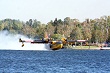
Getting back to the original post, we used to regularly fly aircraft off the water using full flaps. I still do it today while scooping water with the CL-415 on rough water or the glassy water days. Just click on full flaps to get yourself airborne and then back to 15 degrees once airborne. It was standard operating procedures to use full flaps during take off with a fully loaded Beech 18 in rough water. I would suspect most TC people would shudder at that, considering you would be airborne at about 35 kts below VMC which again would have went against any POH.
The thing you have to consider is what is safer, pounding a fully loaded aircraft through 3 foot waves at a high speed waiting for the speed as per the POH or getting it airborne as quickly as possible to avoid possible structural damage. Once airborne you just held it flat let it accelerate in ground effect and bled off the flaps. Should an emergency, such as an engine failure occur all you had to do was reduce the power and land. I have taught this sort of stuff numerous times, but the one thing to remember is never try and climb with full flaps. Hold it low over the water, in ground effect and let it accelerate while bleeding off the flaps. It sure saves on the beating the floats have to take. This technique also works great on rough or wet muddy runways.
There is no advantage to using this technique in aircraft such as Beaver and Otters because of their massive flap travel. In Cessna's on floats again no advantage but what really works good in rough water or hot sticky days is to work the flap handle between 20 and 30 degrees to help lift it out of the water, but never attempt to climb out of ground effect in that configuration.
I can't say whether it allows you to get over a 50 ft obstacle any quicker as that was never the reason for doing it. It should only be used to get the aircraft airborne out of a more hostile enviroment. Should you be relying on this sort of stuff to get you over the trees then maybe it's time to re-evaluate your decision making ability.
The thing you have to consider is what is safer, pounding a fully loaded aircraft through 3 foot waves at a high speed waiting for the speed as per the POH or getting it airborne as quickly as possible to avoid possible structural damage. Once airborne you just held it flat let it accelerate in ground effect and bled off the flaps. Should an emergency, such as an engine failure occur all you had to do was reduce the power and land. I have taught this sort of stuff numerous times, but the one thing to remember is never try and climb with full flaps. Hold it low over the water, in ground effect and let it accelerate while bleeding off the flaps. It sure saves on the beating the floats have to take. This technique also works great on rough or wet muddy runways.
There is no advantage to using this technique in aircraft such as Beaver and Otters because of their massive flap travel. In Cessna's on floats again no advantage but what really works good in rough water or hot sticky days is to work the flap handle between 20 and 30 degrees to help lift it out of the water, but never attempt to climb out of ground effect in that configuration.
I can't say whether it allows you to get over a 50 ft obstacle any quicker as that was never the reason for doing it. It should only be used to get the aircraft airborne out of a more hostile enviroment. Should you be relying on this sort of stuff to get you over the trees then maybe it's time to re-evaluate your decision making ability.
Last edited by CLguy on Mon Oct 09, 2006 11:52 am, edited 1 time in total.
You Can Love An Airplane All You Want, But Remember, It Will Never Love You Back!
-
justplanecrazy
- Rank 8
- Posts: 815
- Joined: Wed Feb 25, 2004 1:57 pm
??????When I asked them why they landed flat on all three wheels at once they said it was to make sure the airplane did not stall.


The whole industry seems to be taking a turn away from teaching students how to think for themselves to trying to spell out every action for every situation in a book. You see this everywhere even ATC. They've developed so many twisted and complex rules to try and cover every possible scenario. Even if you can confirm that there is 100% no risk, you still can't deviate from the book. I'm not sure why we're going this path but it sure has slowed down air traffic and made pilots robotic mutants afraid to add another 10 degrees of flaps on take-off. If you think something like that is a safety issue, you don't understand any of the basic concepts of flight and should not be flying and definately not instructing.
I wonder who is better off, our new age 60 hour private pilots or the old 15 hour private pilots with knowledgeable real world pilots instructing them. Today we have larger seperation standards then before, about to have higher approach minimums, more hours required to get a job, more hours required to get a licence. All this despite large gains in technology making it much easier to fly. By 2100 it'll take a year to get a private licence 5 to get your commercial and then all the planes will be built to taxi only to their destination cause to fly them would be really unsafe.
Anyways, I guess we're way off topic now and I thought I'd just copy and paste a point I made earlier that I found to be very usefull for any plane you're not 100% familiar with or where the book doesn't have a recommended flap setting to start off experimenting with.
justplanecrazy wrote:A good trick for figuring out what your max lift to drag ratio is, is to take the ailerons and fully deflect them. Then line up the flaps to that angle. The ailerons are designed for the most efficent camber for the wing at max deflection so matching the flap will give you roughly the best lift to drag for that particular wing.
We have no effective screening methods to make sure pilots are sane.
— Dr. Herbert Haynes, Federal Aviation Authority.
— Dr. Herbert Haynes, Federal Aviation Authority.
-
Cat Driver
- Top Poster
- Posts: 18921
- Joined: Sun Feb 15, 2004 8:31 pm
Hey ' CLguy and J.P.C.
It is refreshing to have you guys to reinforce in my mind that there are still people who have not been swallowed up in the black hole of bureaucratic stupidity that will eventually lead to total chaos in aviation.
In Europe it is getting to the place that you can not walk to your airplane without a hi-viz vest on even if there is not another living creature moving on the airport, and of course without marshallers we would be unable to park the airplane and have to walk to the terminal once we stopped after landing.
What escapes me is how in fu.k do these idiots who make these rules think we got the airplanes from A to B without someone marshalling us??
Anyhow I am slowly recovering from my industry induced mental illness caused by flying in todays """ S A F E """ environment.
Soon I will be able to teach outside of the regulators reach, and can't wait for the day to come.
Cat
It is refreshing to have you guys to reinforce in my mind that there are still people who have not been swallowed up in the black hole of bureaucratic stupidity that will eventually lead to total chaos in aviation.
In Europe it is getting to the place that you can not walk to your airplane without a hi-viz vest on even if there is not another living creature moving on the airport, and of course without marshallers we would be unable to park the airplane and have to walk to the terminal once we stopped after landing.
What escapes me is how in fu.k do these idiots who make these rules think we got the airplanes from A to B without someone marshalling us??
Anyhow I am slowly recovering from my industry induced mental illness caused by flying in todays """ S A F E """ environment.
Soon I will be able to teach outside of the regulators reach, and can't wait for the day to come.
Cat
The hardest thing about flying is knowing when to say no
After over a half a century of flying no one ever died because of my decision not to fly.
After over a half a century of flying no one ever died because of my decision not to fly.
You've probably never heard of an "Extra" aerobatic aircraft, orTeach the limitations of an aircraft in a POH as gospel
of it's proprietor, Walther Extra, who has told more than one person
who has purchased one of his superb aircraft, as he hands them the
POH:
"Ziss is for de FAA. Aircraft is MUCH better dan dat!".
But then again, you probably know more about aircraft certification
than someone who has done it.
How many aircraft have you shepherded through the certification
process?
In my experience, POH's are written by salesmen and lawyers.
Engineering input is really neither requested nor tolerated by
the suits - might get in the way, ya know.
-
justplanecrazy
- Rank 8
- Posts: 815
- Joined: Wed Feb 25, 2004 1:57 pm
Well Hedley I have never shepherded an aircraft through certification and don't know as much as someone who has. The only thing I know is that every plane has its limits and to stay within the limits outlined in the POH ensures you are within the operating envelope.Hedley wrote:You've probably never heard of an "Extra" aerobatic aircraft, orTeach the limitations of an aircraft in a POH as gospel
of it's proprietor, Walther Extra, who has told more than one person
who has purchased one of his superb aircraft, as he hands them the
POH:
"Ziss is for de FAA. Aircraft is MUCH better dan dat!".
But then again, you probably know more about aircraft certification
than someone who has done it.
How many aircraft have you shepherded through the certification
process?
In my experience, POH's are written by salesmen and lawyers.
Engineering input is really neither requested nor tolerated by
the suits - might get in the way, ya know.
I know nothing about how to safely determine how far out of that envelope I can operate without ending up a black street across a wheat field and neither does a student. To not teach a student that the operating limits defined in the POH have to be followed is complete stupidity. By limits, I'm only refering to Vne, Vfe, Max gross, Weight and balance etc. Are you really suggesting for me to tell him that max gross is this but I've had it 400Ib's heavier than that and way further aft then recommended and it flew without any problems so just load it however you want. Or should I tell him that I heard of someone who exceeded Vne and didn't rip the wings off so its just a BS suggestion?
I've seen someone roll, loop and try to fly inverted in a C150. It's not certified for that and it past the next inspection but does that mean that you can keep doing it safely? Certification processes don't test an aircraft structurally to failure and then certify it at those limitations. They see where the failure happens and then set out operating limitations that are significantly lower than the failure point in order to have a rather large safety buffer. That would be why your friend Whalter can rightfully claim that "Ziss is for de FAA. Aircraft is MUCH better dan dat!". No as soon as you cross Vne the wings won't fall off but there is a point where they will and staying within the operating limits outlined in the POH will ensure that you don't find out when that point is. I highly doubt that they come out with those limits without any engineer's input.
no never heard of an extra before... isn't that a lottery or something

We have no effective screening methods to make sure pilots are sane.
— Dr. Herbert Haynes, Federal Aviation Authority.
— Dr. Herbert Haynes, Federal Aviation Authority.
-
co-joe
- Rank 11
- Posts: 4784
- Joined: Mon Feb 16, 2004 2:33 am
- Location: YYC 230 degree radial at about 10 DME
Oh Cat now don't go tellin the kids that deviating from book procedures is in any way a good idea.
Yes there may be times to stray from published numbers, but not good reasons to do so. If you told me that we couldn't take off successfuly from a field with 10 flap, but that 20 would work based on your experience, you know what I'd do?
I'd wait for cooler temperatures, lighten the load until 10 flap would work, or hitch hike home.
Last week a guy told me he used to fly twin bonanzas a TONNE over gross! Ok it's possible but I'm not gonna try it. Fack no.
Anyway last month at Sim the PF accidentally tried a V1 cut without reading the checklist and subsequently attempted a single engine climb out, with a negative auto feather, and the flaps still at full. Guess what? After a GPWS warning or two, we crashed and died.
Read the checklist, and stick to book numbers. End of story/rant, except to say sometimes CPL_ATC it's perfectly OK to tell your student "because I said so!".
CJ
Yes there may be times to stray from published numbers, but not good reasons to do so. If you told me that we couldn't take off successfuly from a field with 10 flap, but that 20 would work based on your experience, you know what I'd do?
I'd wait for cooler temperatures, lighten the load until 10 flap would work, or hitch hike home.
Last week a guy told me he used to fly twin bonanzas a TONNE over gross! Ok it's possible but I'm not gonna try it. Fack no.
Anyway last month at Sim the PF accidentally tried a V1 cut without reading the checklist and subsequently attempted a single engine climb out, with a negative auto feather, and the flaps still at full. Guess what? After a GPWS warning or two, we crashed and died.
Read the checklist, and stick to book numbers. End of story/rant, except to say sometimes CPL_ATC it's perfectly OK to tell your student "because I said so!".
CJ
The ignorance of pilots is truly frightening. Even the FAA routinely approves flights of 30% over published max gross for trans-atlantic ferry flights. I guess everyone here has done a lot of those recently too, huh
A higher weight won't kill you ... it will merely increase your stall speed, with associated effects on your takeoff distance, climb rate, cruise speed, etc. Not that anyone here could figure that out.
Here's another thing that you probably don't know, either ... the important thing is that your C of G is within an aerodynamically acceptable range. Let me guess, you haven't a clue as to what that is, either, do you?
Here's an example closer to home, and even on topic: 1975 C172, max 2300 lbs. And the reason why is overshoot performance ... WITH FULL FLAPS! There is a little kit, where if you promise to never use 40 degrees of flaps, and instead use 30 degrees of flaps max, like the later 172's, your maximum gross weight goes up to 2400 (or 2450, I forget, and don't really care).
The ignorance of pilots is truly astounding. Despite the fact that they are in the business of applied physics, they seem to know far more about paper, which is odd because AIRCRAFT CAN'T READ, and they know virtually nothing about physics
If you are a truly ignorant pilot, and all you do is obey paper, sooner or later you will die in a crash, because the paper doesn't cover the complexity of the real world.
All you have to do is wait a while, or cross an invisible line somewhere, and all the paper rules change. What used to be legal and safe is now illegal and dangerous, and vice versa.
Fly a few more decades and tens of thousands of hours, and perhaps you might have a clue, JPC.
A higher weight won't kill you ... it will merely increase your stall speed, with associated effects on your takeoff distance, climb rate, cruise speed, etc. Not that anyone here could figure that out.
Here's another thing that you probably don't know, either ... the important thing is that your C of G is within an aerodynamically acceptable range. Let me guess, you haven't a clue as to what that is, either, do you?
Here's an example closer to home, and even on topic: 1975 C172, max 2300 lbs. And the reason why is overshoot performance ... WITH FULL FLAPS! There is a little kit, where if you promise to never use 40 degrees of flaps, and instead use 30 degrees of flaps max, like the later 172's, your maximum gross weight goes up to 2400 (or 2450, I forget, and don't really care).
The ignorance of pilots is truly astounding. Despite the fact that they are in the business of applied physics, they seem to know far more about paper, which is odd because AIRCRAFT CAN'T READ, and they know virtually nothing about physics
If you are a truly ignorant pilot, and all you do is obey paper, sooner or later you will die in a crash, because the paper doesn't cover the complexity of the real world.
All you have to do is wait a while, or cross an invisible line somewhere, and all the paper rules change. What used to be legal and safe is now illegal and dangerous, and vice versa.
Fly a few more decades and tens of thousands of hours, and perhaps you might have a clue, JPC.
Someone here recently posted that it was ok to crash, as long as all your paper was in order - presumably so that you posthumously "look good" at the inquest. I am not making this up.
I would rather be alive, and avoid a crash, even if my paperwork was out of order. I understand I am in the minority on this matter, these days.
This "robot pilot" mentality is frightening. They have delegated their authority as PIC to all sorts of people on the ground, clamouring for control, but the PIC still holds all the responsibility.
When you divorce authority and responsibility, you get a Monty Python sketch.
A good example of this was a BA 747 which departed Los Angeles and lost an engine. Dispatch told him (for their own financial reasons) to continue the flight to London on 3 engines - he actually didn't make it that far, he had to land in Scotland as he was low on fuel. The FAA is charging the pilot (not dispatch) with careless and reckless for flying all the way across North America and the Atlantic Ocean with an engine out.
I wouldn't make a very good airline pilot, I guess. I lose an engine, I'm going to land as soon as it is safe to do so, regardless of what the SOP's or people on the ground think.
I would rather be alive, and avoid a crash, even if my paperwork was out of order. I understand I am in the minority on this matter, these days.
This "robot pilot" mentality is frightening. They have delegated their authority as PIC to all sorts of people on the ground, clamouring for control, but the PIC still holds all the responsibility.
When you divorce authority and responsibility, you get a Monty Python sketch.
A good example of this was a BA 747 which departed Los Angeles and lost an engine. Dispatch told him (for their own financial reasons) to continue the flight to London on 3 engines - he actually didn't make it that far, he had to land in Scotland as he was low on fuel. The FAA is charging the pilot (not dispatch) with careless and reckless for flying all the way across North America and the Atlantic Ocean with an engine out.
I wouldn't make a very good airline pilot, I guess. I lose an engine, I'm going to land as soon as it is safe to do so, regardless of what the SOP's or people on the ground think.
-
Cat Driver
- Top Poster
- Posts: 18921
- Joined: Sun Feb 15, 2004 8:31 pm
"
Oh Cat now don't go tellin the kids that deviating from book procedures is in any way a good idea.
Yes there may be times to stray from published numbers, but not good reasons to do so. If you told me that we couldn't take off successfuly from a field with 10 flap, but that 20 would work based on your experience, you know what I'd do? "
I haven't the faintest idea how you teach nor what you would do co_joe.
However my comments here are directed at one specific situation, so tell me what you would do in this instance.
You are pounding along on the water in a Cessna 172 on floats and the thing just will not get airborne using 10 degrees of flap, but it will break water using 20 degrees of flap.
( A ) Do you just pound the living hell out of it becaues you think the book prevents you from going from 10 degrees to 20 degrees to produce the lift required to break water drag?
( B ) Do you reject the take off and wait for better conditions?
( C ) Do you use 20 degrees of flap and once airborne reconfigure in ground effect and fly away?
Your answer may allow me to decide if you are qualified to council me regarding how to teach flying, not to mention if I would let you fly any aircraft I own.
Cat
Oh Cat now don't go tellin the kids that deviating from book procedures is in any way a good idea.
Yes there may be times to stray from published numbers, but not good reasons to do so. If you told me that we couldn't take off successfuly from a field with 10 flap, but that 20 would work based on your experience, you know what I'd do? "
I haven't the faintest idea how you teach nor what you would do co_joe.
However my comments here are directed at one specific situation, so tell me what you would do in this instance.
You are pounding along on the water in a Cessna 172 on floats and the thing just will not get airborne using 10 degrees of flap, but it will break water using 20 degrees of flap.
( A ) Do you just pound the living hell out of it becaues you think the book prevents you from going from 10 degrees to 20 degrees to produce the lift required to break water drag?
( B ) Do you reject the take off and wait for better conditions?
( C ) Do you use 20 degrees of flap and once airborne reconfigure in ground effect and fly away?
Your answer may allow me to decide if you are qualified to council me regarding how to teach flying, not to mention if I would let you fly any aircraft I own.
Cat
The hardest thing about flying is knowing when to say no
After over a half a century of flying no one ever died because of my decision not to fly.
After over a half a century of flying no one ever died because of my decision not to fly.
-
Cat Driver
- Top Poster
- Posts: 18921
- Joined: Sun Feb 15, 2004 8:31 pm
" The ignorance of pilots is truly frightening. Even the FAA routinely approves flights of 30% over published max gross for trans-atlantic ferry flights. I guess everyone here has done a lot of those recently too, huh "
Hedley, I last flew on an overweight permit issued by TC in a Canadian airplane operating under a Canadian public transport OC from Dakar Senegal to Fernando de Norona five thousand pounds over the certified all up weight.
Why we even transited the active ITCZ over gross, how come I'm still alive?
Cat
The hardest thing about flying is knowing when to say no
After over a half a century of flying no one ever died because of my decision not to fly.
After over a half a century of flying no one ever died because of my decision not to fly.



