Greetings,
I've got a couple of IO-520s coming out of overhaul soon, does anyone have any good break-in procedures or recommended practices?
Always appreciated!
Neil
IO-520s coming out of overhaul - Break in techniques?
Moderators: lilfssister, North Shore, sky's the limit, sepia, Sulako, I WAS Birddog
-
neilaroberts
- Rank 2

- Posts: 61
- Joined: Sun Feb 26, 2006 2:42 pm
It's all about seating the rings. You do that with cylinder pressure, which gets behind the rings in the piston lands and pushes the rings against the cylinder walls.
Is the fuel injection set up by the overhaul shop? I would hope so, but I have seem some in the past that have NOT been.
The way I break in an engine (or when I replace a cylinder, same thing) is ...
0) Mineral oil (obviously)
1) ground run with the cowls off for one minute, then shut down. Look for leaks.
2) cowls on. Taxi out. As soon as temps are green, get the throttle forward and leave it there.
3) monitor engine temps. this is important. Clinb out shallow - keep lots of air going throught the engines. Watch the CHT and oil temp.
4) run maximum permissible manifold pressure (see POH). Vary RPM from time to time.
5) note the sudden decrease in oil temperature
6) after 2 or 3 hours of this, the engine is pretty well broken in.
7) I might suggest circling around the airport at say 2,000 AGL for at least the first 30 min - you might want to land unexpectedly.
Is the fuel injection set up by the overhaul shop? I would hope so, but I have seem some in the past that have NOT been.
The way I break in an engine (or when I replace a cylinder, same thing) is ...
0) Mineral oil (obviously)
1) ground run with the cowls off for one minute, then shut down. Look for leaks.
2) cowls on. Taxi out. As soon as temps are green, get the throttle forward and leave it there.
3) monitor engine temps. this is important. Clinb out shallow - keep lots of air going throught the engines. Watch the CHT and oil temp.
4) run maximum permissible manifold pressure (see POH). Vary RPM from time to time.
5) note the sudden decrease in oil temperature
6) after 2 or 3 hours of this, the engine is pretty well broken in.
7) I might suggest circling around the airport at say 2,000 AGL for at least the first 30 min - you might want to land unexpectedly.
I have to jump in on this one.
Do not, and I mean never, not even for 15 seconds run a piston engine with the cowls off. Talk to the Contintental people. they will tell you it starts damagaing the engine almost instantly as the air flow is not there.
RAM even makes a little cloth kit to put on in the place of the cowling to do engine runs. Put the cowls on. run it up. Pull the cowls off to check for leaks. Yes I know it takes a little time. And an engine costs about $30.00 an hour for every hour of its life you shorten.
And I know Hedley, I hear lots of AME's say no problem. These guys are the psychic AME's who can tell all about hot spots, poor expansion etc, just because....ah well....ah.... oh yeah, because they have done it before and the engine didnt immediately fly apart. Something about the convergence of the central limit theorem ( I love all those big words)
Now , on to your questiion. The good folks at Continental's tech dept, will provide you with a little booklet on how to break in your engine. Follow it to the letter. I am not going to make any suggestions here because that is up to the engine people, and there is some good advice been given.
If you are in Western Canada, and your engine overhauled at a private shop, I have dealt with Progressive for years and years. Their people are first class. They have seen it all before and will give you a pile of good advice.
As an aside, and this is just personal preference. I would use Phillips oil.
You may want others but I would avoid shell oils. And I re- iterate, this is just a personal preference not a bait to start a debate on oils.
Do not, and I mean never, not even for 15 seconds run a piston engine with the cowls off. Talk to the Contintental people. they will tell you it starts damagaing the engine almost instantly as the air flow is not there.
RAM even makes a little cloth kit to put on in the place of the cowling to do engine runs. Put the cowls on. run it up. Pull the cowls off to check for leaks. Yes I know it takes a little time. And an engine costs about $30.00 an hour for every hour of its life you shorten.
And I know Hedley, I hear lots of AME's say no problem. These guys are the psychic AME's who can tell all about hot spots, poor expansion etc, just because....ah well....ah.... oh yeah, because they have done it before and the engine didnt immediately fly apart. Something about the convergence of the central limit theorem ( I love all those big words)
Now , on to your questiion. The good folks at Continental's tech dept, will provide you with a little booklet on how to break in your engine. Follow it to the letter. I am not going to make any suggestions here because that is up to the engine people, and there is some good advice been given.
If you are in Western Canada, and your engine overhauled at a private shop, I have dealt with Progressive for years and years. Their people are first class. They have seen it all before and will give you a pile of good advice.
As an aside, and this is just personal preference. I would use Phillips oil.
You may want others but I would avoid shell oils. And I re- iterate, this is just a personal preference not a bait to start a debate on oils.
Last edited by trey kule on Tue Mar 13, 2007 11:46 am, edited 3 times in total.
-
ScudRunner
- Rank 11

- Posts: 3239
- Joined: Tue Jun 08, 2004 11:58 am


Don't know your particular setup but change the oil hoses or flush them if they're recent, esspecialy if the O/H is due to the engine eating itself up internally (ie metal particles in oil or things that went "clunk"). Same with fuel hoses.
If changing for new hoses, flush them too, or atleast blow them out! Seems that a lot of people asume that just because they're new then they must be clean.
And like Hedley said, check if the fuel system was set up properly.
Also not a bad time to calibrate your temp gages, rpm, MP.
Check what comes out at first oil change.
If changing for new hoses, flush them too, or atleast blow them out! Seems that a lot of people asume that just because they're new then they must be clean.
And like Hedley said, check if the fuel system was set up properly.
Also not a bad time to calibrate your temp gages, rpm, MP.
Check what comes out at first oil change.
edited due to incorrect info.. TT
TCM S/B M89-7r1 (last one at bottom) at this page should give you all the correct information ou need...
http://tcmlink.com/servicebulletins.cfm
TCM S/B M89-7r1 (last one at bottom) at this page should give you all the correct information ou need...
http://tcmlink.com/servicebulletins.cfm
Thx TK, I had never heard that before. I like to run an engine at idle for one minute with the cowls off to check for leaks, visual check for vibrations, etc. I figure I'd rather learn about it on the ground than in the air!never, not even for 15 seconds run a piston engine with the cowls off
I agree that if you're gonna wind it up and make some heat (eg dyno pull) something to direct the air would be a really good idea for the cylinders. But you really shouldn't be hammering the throttle in the first minute anyways - you know that. Gonna scuff the pistons if nothing else.
FWIW don't those funny flat swamp boats in Florida run horizontally-opposed aircraft engines, completely open without cowling in extreme heat?

There's a banner towing company in Florida that runs a weird looking supercub WITHOUT COWLS
OK, it does have little J3 style eyebrows but does that make enough airflow??
I guess they fly it like that for a reason.
http://www.airliners.net/open.file?id=0 ... 300&size=L
OK, it does have little J3 style eyebrows but does that make enough airflow??
I guess they fly it like that for a reason.
http://www.airliners.net/open.file?id=0 ... 300&size=L
Hedley wrote:
FWIW don't those funny flat swamp boats in Florida run horizontally-opposed aircraft engines, completely open without cowling in extreme heat?
It does seem a little odd. Perhaps I should elaborate. I first became aware of the cowl issue when I happened to be lurking around a shop and they were putting these little red cloth coverings on an engine. Asked them what that was for, and they explained they were RAM engines and RAM provided them so as the engines would never be run without cowling.
It has to do, if I remember correctly with the baffling and seals. The airflow does not flow evenly and thus hot spots get created almost instantly.
So I called RAM and the good people at Progressive Air. The Progressive people said effectively Yeh, we know everyone does it but its not a good idea. The RAM people were much more adamant.
Now, with that in mind I started watching AMEs. run up engines, " for a few seconds". Well, if you actually just stand around and watch you will see, I believe, that 'a few seconds' tends to be several minutes.
And it is the uneven heating that apparently does the damage, not overheating.
Now, nothing will happen immediately. It takes awhile for damage like this to take effect, so can it be done? Of course it can. But arguments aside, it is worth the call to RAM to discuss this with them
I chose to be adamant because you may be quite right that 15 seconds wont hurt anything. But I am willing to bet that if you stepped aside and actually timed how long you ran the motors, it would be several minutes.
As to the cubs, beats me. Their engines making it to TBO and beyond?
Anyway, maybe I am wrong or things have changed. But FWIW, any plane of mine being worked on will have the cowls in place before its started. Only takes a couple of minutes and makes the whole debate a non issue.
Anyway, my two cents for the morning.
[/quote]
FWIW don't those funny flat swamp boats in Florida run horizontally-opposed aircraft engines, completely open without cowling in extreme heat?
It does seem a little odd. Perhaps I should elaborate. I first became aware of the cowl issue when I happened to be lurking around a shop and they were putting these little red cloth coverings on an engine. Asked them what that was for, and they explained they were RAM engines and RAM provided them so as the engines would never be run without cowling.
It has to do, if I remember correctly with the baffling and seals. The airflow does not flow evenly and thus hot spots get created almost instantly.
So I called RAM and the good people at Progressive Air. The Progressive people said effectively Yeh, we know everyone does it but its not a good idea. The RAM people were much more adamant.
Now, with that in mind I started watching AMEs. run up engines, " for a few seconds". Well, if you actually just stand around and watch you will see, I believe, that 'a few seconds' tends to be several minutes.
And it is the uneven heating that apparently does the damage, not overheating.
Now, nothing will happen immediately. It takes awhile for damage like this to take effect, so can it be done? Of course it can. But arguments aside, it is worth the call to RAM to discuss this with them
I chose to be adamant because you may be quite right that 15 seconds wont hurt anything. But I am willing to bet that if you stepped aside and actually timed how long you ran the motors, it would be several minutes.
As to the cubs, beats me. Their engines making it to TBO and beyond?
Anyway, maybe I am wrong or things have changed. But FWIW, any plane of mine being worked on will have the cowls in place before its started. Only takes a couple of minutes and makes the whole debate a non issue.
Anyway, my two cents for the morning.
[/quote]
The airboat thing got my attention. Googled it. Now with information drawn from the highly respected and unassialable interet here goes.
Before 1980 about 80% of airboats were powered by aircraft engines, usually a lycomonig six cylander.
Since then, and as of today, 90% are powered by automotive (marinized) engines. The aircraft engines were apparently not all that reliable but they provided good torque at low RPMs.
I got some old pictures which seem to show some kind of flow control, at least on some, and on others NADA. I dont know if this contributed to shortening of engine life or not as apparently there are some other issues with engines in the marine envirorment.
As to the cubs. Still working on that.
Before 1980 about 80% of airboats were powered by aircraft engines, usually a lycomonig six cylander.
Since then, and as of today, 90% are powered by automotive (marinized) engines. The aircraft engines were apparently not all that reliable but they provided good torque at low RPMs.
I got some old pictures which seem to show some kind of flow control, at least on some, and on others NADA. I dont know if this contributed to shortening of engine life or not as apparently there are some other issues with engines in the marine envirorment.
As to the cubs. Still working on that.
-
neilaroberts
- Rank 2
- Posts: 61
- Joined: Sun Feb 26, 2006 2:42 pm
Well it can and it does. If it didn't, your engine would not wear out now, would it.Shouldn't be coming out from any of the machines areas and toleranced surfaces however.
If you can get a chance at looking at a sample from the first oil change after O/H you will notice that it "shimers" a lot more in the sunlight than from subsequent oil changes.
Most of those metal particles will be from the bearing journals, gears, cams, rockers and rings/cylinders wearing in.
Not as well as a trained lab technician which brings me to this.A trained eye can quickly tell the differences.
Theres' a number of companies specializing in doing oil sample analysis.
You mail them a sample taken at oil change (freshly shut down engine and taken midstream during draining, same way for each sample) and they will mail you back a report of what and how much of it was in the oil.
If you do it regularly they will include a graph of trends for each parameter measured. If you see an upwards trend of a certain metal,
then you call the tech rep and they will tell you what is made with it. Now you have the info to prevent a possible failure.
It's up to you to decide if the cost/benefit is worth it.
Some of the companies that offer the service, that I recall, are Blackstone Labs, Avlab and one of the oil manufacturers or champion, don't remember. Ask around.
Yeah I know you meant chunks Rowdy. The casting flash comment gave it away but wanted to rub it in a bit 
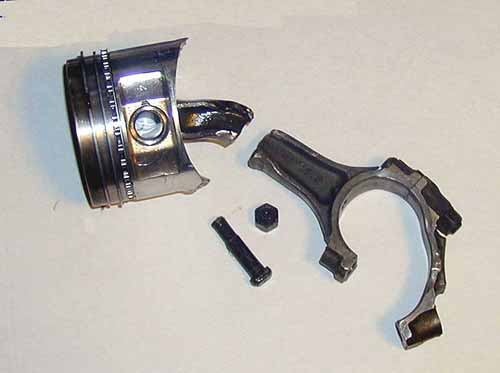
Speaking of chunks. When I was starting in this crazy industry, washing bellies and changing oils as an aprentice, I found a few pieces of the scraper ring from a TSIO-540 on a Malibu Mirage. Yup actual chunks big ennough to identify. Man those things went through engines if ran to get the specs in the sales brochure!
Speaking of chunks. When I was starting in this crazy industry, washing bellies and changing oils as an aprentice, I found a few pieces of the scraper ring from a TSIO-540 on a Malibu Mirage. Yup actual chunks big ennough to identify. Man those things went through engines if ran to get the specs in the sales brochure!
I toy with some turbocharged engines on the side (couple of street rods and such) and have seen some pretty amazing catastrophic failures. Pistons with the crowns lifted right off.. ringlands sitting in the oil pans.. blocks ventilated by rods..
I still think by far the most entertaining were the rods that came out of an engine that hydrolocked. Prettttyyy good bends in all 4 rods. Not to mention the weird damage done to the compressor blades in the turbo.
I'll see if I can find some pictures
I still think by far the most entertaining were the rods that came out of an engine that hydrolocked. Prettttyyy good bends in all 4 rods. Not to mention the weird damage done to the compressor blades in the turbo.
I'll see if I can find some pictures
-
The Other Kind
- Rank 4

- Posts: 286
- Joined: Sat Mar 25, 2006 5:40 pm



[/quote]You mail them a sample taken at oil change (freshly shut down engine and taken midstream during draining, same way for each sample) and they will mail you back a report of what and how much of it was in the oil.
If you do it regularly they will include a graph of trends for each parameter measured. If you see an upwards trend of a certain metal,
then you call the tech rep and they will tell you what is made with it. Now you have the info to prevent a possible failure.
It's up to you to decide if the cost/benefit is worth it.
Some of the companies that offer the service, that I recall, are Blackstone Labs, Avlab and one of the oil manufacturers or champion, don't remember. Ask around.[/quote]
Has anyone out there ever opened up an engine, or removed one for overhaul, because of one of these labs reports and
the elevated amounts of different metals in the oil? I ask because several AMEs have told me that they have no
confidence in oil analysis and that a compression check and a thorough examination of the oil screen always shows problems
before the analysis does. In my case, this is exactly what happened. The thrust bearing in my 0-470 was worn to the point
where the crank was rubbing on the case but the oil analysis was still coming up good.
If you do it regularly they will include a graph of trends for each parameter measured. If you see an upwards trend of a certain metal,
then you call the tech rep and they will tell you what is made with it. Now you have the info to prevent a possible failure.
It's up to you to decide if the cost/benefit is worth it.
Some of the companies that offer the service, that I recall, are Blackstone Labs, Avlab and one of the oil manufacturers or champion, don't remember. Ask around.[/quote]
Has anyone out there ever opened up an engine, or removed one for overhaul, because of one of these labs reports and
the elevated amounts of different metals in the oil? I ask because several AMEs have told me that they have no
confidence in oil analysis and that a compression check and a thorough examination of the oil screen always shows problems
before the analysis does. In my case, this is exactly what happened. The thrust bearing in my 0-470 was worn to the point
where the crank was rubbing on the case but the oil analysis was still coming up good.
Just because you're paranoid doesn't mean they're not after you!
Received a significant spike in one of the metals. Tech rep said it was probaby turbo bearings. Took a look at the turbo and there was a LOT of wobble on the turbine. Turbo was changed before seizing or contaminating the rest of the engine. So it payed for itself in that case.
Probably not worth it on a small simple engine but a bigger more complicated one could benefit a lot more from it.
Probably not worth it on a small simple engine but a bigger more complicated one could benefit a lot more from it.

