

Hey guys,
A buddy has a 150 that runs on auto gas...what's the deal with that in terms of engine longevity, safety etc?
C150 on Auto gas
Moderators: sky's the limit, sepia, Sulako, lilfssister, North Shore, I WAS Birddog
-
Speedbird Junior
- Rank 2

- Posts: 80
- Joined: Tue Apr 18, 2006 10:14 pm
- Location: The motherland..becoming a JAA convert..
Auto gasoline (also known as Mogas) has a higher volatility and water content than avgas, so it increases the chances substantially of vapour locking and carb icing. There are normally some restrictions on what altitude you can operate up to (at least in Europe there is) and above what ambient air temperatures you can use it at.
It also affects seals and hoses. All Mogas usage has to be entered in the maintenance log under EASA regulations in Europe.
It also affects seals and hoses. All Mogas usage has to be entered in the maintenance log under EASA regulations in Europe.
Four in trail of my big brother....
Also dont fill up with Autogas if your plane is going to sit for a while. Its better to have it sit with 100LL. Ive been using it for 10 years with no problems but I usually run a mix of both. Also be careful not to get any with Ethanol!! Its bad stuff for airplanes apparently. You can get a test kit to test for ethanol. Shell premium gas does not have any ethanol.

Actually, the 100LL has 'way too much lead for the poor O-200 in the buck-fifty - you will learn about the "rope trick" as you try to scrape the lead salts out of the gummed-up exhaust valve guides.
Mogas starts a lot better in the winter. Not sure it's the best choice above 10,000 feet, but you don't see many buck fifties that high.
Mogas starts a lot better in the winter. Not sure it's the best choice above 10,000 feet, but you don't see many buck fifties that high.
-
invertedattitude

- Rank 10

- Posts: 2353
- Joined: Tue Jul 06, 2004 1:12 pm
-
co-joe
- Rank 11

- Posts: 4803
- Joined: Mon Feb 16, 2004 2:33 am
- Location: YYC 230 degree radial at about 10 DME
I ran a 150 year round on high octane Mogas and it ran great. Better than it did on 100LL. Definitely had more carb ice though, and it leaned a little differently. Those engines were designed to run on auto gas, just make sure you check the drains for water as auto gas isn't stored/transported to the same specs.
It wouldn't hurt to let your AME know as well, he/she might have some advice.
It wouldn't hurt to let your AME know as well, he/she might have some advice.

I'm not sure that this is true or not, but I heard that a commercial operation (ie. flight school) could not operate on MOGAS over 5000' (I think) or slightly hirer.
My old man's been putting MOGAS in his PA-28 for years, but does put in an oil additive (not sure which one) to help save the seals..
My old man's been putting MOGAS in his PA-28 for years, but does put in an oil additive (not sure which one) to help save the seals..


-
ScudRunner
- Rank 11
- Posts: 3239
- Joined: Tue Jun 08, 2004 11:58 am
I believe your right, I recal an old owner/operator telling me that his competition saw him filling his plane with mogas then called TC only to have TC show up and find he had the Opspec. Don't quote me as the source was a crusty old chain smoking trapper who was full of alot stuff.I'm not sure that this is true or not, but I heard that a commercial operation (ie. flight school) could not operate on MOGAS over 5000' (I think) or slightly hirer.
The STC for mogas in the 0-200 came out on 1982. Airplanes with that engine have been running for 25 years. I flew a C150 out of High River, Alta on car gas for a couple of years. Never had a problem.
I was really surprised to see that you cannot use car gas in Switzerland, given the STC and experience in North America.
I was really surprised to see that you cannot use car gas in Switzerland, given the STC and experience in North America.
bmc



I ran one, and now my C-172 with a O-300 with regular unleaded.
In the winter I add fuel de-icer.
No problem. I flew to 12000 without a problem.
Save you money.
Plugs stay clean.
I think that advance on mags has to be reduced to 24 degrees, but I am not sure...
In the winter I add fuel de-icer.
No problem. I flew to 12000 without a problem.
Save you money.
Plugs stay clean.
I think that advance on mags has to be reduced to 24 degrees, but I am not sure...
Success in life is when the cognac that you drink is older than the women you drink it with.
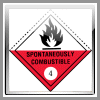
Many airport operators will not allow owners to store avgas or mogas on airport property so you cannot put a barrel of the stuff in your T hangar. Most major fuel companies will not sell mogas from pumps because of liability concerns. That means you have to shlup jerry cans from your car/truck to the airplane. You are transporting dangerous goods so do not get pulled over by the cops.
The average pilot, despite the somewhat swaggering exterior, is very much capable of such feelings as love, affection, intimacy and caring.
These feelings just don't involve anyone else.
These feelings just don't involve anyone else.
Gas is like underwear. Use what fits you best.
Mogas is cheaper (you can claim the road tax back) but you're never really sure what you're getting, or what seals you really have in your fuel system.
The mogas evaporates easier, which helps starting in winter, but does raise the possibility of vapour lock at higher altitudes. Note that low wing aircraft are often more susceptible to vapour lock than high wing aircraft because high wing aircraft have the tanks mounted higher, and usually don't require a fuel boost pump (at least not with a carburetor).
The lower lead content of mogas is a real plus. Not having sticking exhaust valves gummed up with lead salts is a real bonus - I know a guy who is fighting with that right now.
The octane of 100LL is far in excess of what is required for any low-compression engine you're going to find in a trainer. If you're running 50 inches of manifold pressure (20 lbs boost) on takeoff, well then you need the higher octane of 100LL. But with your 7:1 compression ratio of your trainer, 100/130 octane is ridiculous overkill.
Mogas is cheaper (you can claim the road tax back) but you're never really sure what you're getting, or what seals you really have in your fuel system.
The mogas evaporates easier, which helps starting in winter, but does raise the possibility of vapour lock at higher altitudes. Note that low wing aircraft are often more susceptible to vapour lock than high wing aircraft because high wing aircraft have the tanks mounted higher, and usually don't require a fuel boost pump (at least not with a carburetor).
The lower lead content of mogas is a real plus. Not having sticking exhaust valves gummed up with lead salts is a real bonus - I know a guy who is fighting with that right now.
The octane of 100LL is far in excess of what is required for any low-compression engine you're going to find in a trainer. If you're running 50 inches of manifold pressure (20 lbs boost) on takeoff, well then you need the higher octane of 100LL. But with your 7:1 compression ratio of your trainer, 100/130 octane is ridiculous overkill.


