What really defines a direct drive engine?
direct drive engine?
Moderators: sky's the limit, sepia, Sulako, Right Seat Captain, lilfssister, North Shore

direct drive engine?
I tried wikipedia it but no luck 
What really defines a direct drive engine?
Last edited by loopa on Tue Jul 07, 2009 1:00 pm, edited 1 time in total.
-
iflyforpie
- Top Poster

- Posts: 8132
- Joined: Tue Apr 15, 2008 12:25 pm
- Location: Winterfell...
Re: direct drive engine?
An engine with no reduction gears or belts between the crankshaft and propeller.
Most GA engines are direct drive. The O-200 on the 150, the O-320 on the 172, right up to the TIO-540s on the Navajo.
Geared engines are rare because of their increased complexity and decreased reliability. But they are making a comeback in GA with the Rotax engines, which have so far been very reliable.
Most GA engines are direct drive. The O-200 on the 150, the O-320 on the 172, right up to the TIO-540s on the Navajo.
Geared engines are rare because of their increased complexity and decreased reliability. But they are making a comeback in GA with the Rotax engines, which have so far been very reliable.
Geez did I say that....? Or just think it....?
Re: direct drive engine?
Oh I see,
why would there be reduction gears and belts between the crankshaft and propellers ?
Re: direct drive engine?
To make more power. For example, with a 2:1 reduction,
you can run an engine at 5000 rpm and make a LOT more
power than it can at 2500 rpm.
You can't run the prop very fast without getting the prop
tips supersonic, which will create enough noise complaints
to get you into court, plus creating lift (thrust) with supersonic
shock waves is tricky (but doable).
So, you want the prop to run slow, and the engine to run
fast. Both the C421B and the hotrod Harvard that I fly,
have geared engines, and they're fantastic.
you can run an engine at 5000 rpm and make a LOT more
power than it can at 2500 rpm.
You can't run the prop very fast without getting the prop
tips supersonic, which will create enough noise complaints
to get you into court, plus creating lift (thrust) with supersonic
shock waves is tricky (but doable).
So, you want the prop to run slow, and the engine to run
fast. Both the C421B and the hotrod Harvard that I fly,
have geared engines, and they're fantastic.
Re: direct drive engine?
Hedley wrote:To make more power. For example, with a 2:1 reduction,
you can run an engine at 5000 rpm and make a LOT more
power than it can at 2500 rpm.
You can't run the prop very fast without getting the prop
tips supersonic, which will create enough noise complaints
to get you into court, plus creating lift (thrust) with supersonic
shock waves is tricky (but doable).
So, you want the prop to run slow, and the engine to run
fast. Both the C421B and the hotrod Harvard that I fly,
have geared engines, and they're fantastic.
Thanks
Re: direct drive engine?
You run a 1340 H1G in a Harvard?Hedley wrote: Both the C421B and the hotrod Harvard that I fly,
have geared engines, and they're fantastic.
Interesting. They were all originally direct drive as per the Norseman, weren't they?
The fastest way to turn money into smoke and noise..
Re: direct drive engine?
I doubt you've ever seen anything like it.
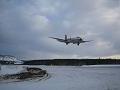
It started out life as a Harvard Mk 4 at CanCar.
20+ years ago, it was modified by George Baker
with clipped wings (3 feet off each side), retractable
P-51 tailwheel, custom fairings, custom cowling, 46
inches of manifold pressure, enormous geared 3 blade
propeller that barely clears the pavement by a foot when
the tail is on the ground, etc. Scavenge. Pre-oiler.
Short stacks. Too many more mods to list. AFAIK it may
be the lowest time Harvard still flying.
Flies much better than a stock Harvard/T-6/SNJ
but it makes the purists shriek and run away
because it's not yellow and boring.
The huge, slow prop barely makes any noise when
it goes by - all you hear is engine.
It started out life as a Harvard Mk 4 at CanCar.
20+ years ago, it was modified by George Baker
with clipped wings (3 feet off each side), retractable
P-51 tailwheel, custom fairings, custom cowling, 46
inches of manifold pressure, enormous geared 3 blade
propeller that barely clears the pavement by a foot when
the tail is on the ground, etc. Scavenge. Pre-oiler.
Short stacks. Too many more mods to list. AFAIK it may
be the lowest time Harvard still flying.
Flies much better than a stock Harvard/T-6/SNJ
but it makes the purists shriek and run away
because it's not yellow and boring.
The huge, slow prop barely makes any noise when
it goes by - all you hear is engine.
Re: direct drive engine?
I would love to see some pics of it. Are there any posted on the net somewhere?Hedley wrote:I doubt you've ever seen anything like it.
It started out life as a Harvard Mk 4 at CanCar.
20+ years ago, it was modified by George Baker
with clipped wings (3 feet off each side), retractable
P-51 tailwheel, custom fairings, custom cowling, 46
inches of manifold pressure, enormous geared 3 blade
propeller that barely clears the pavement by a foot when
the tail is on the ground, etc. Scavenge. Pre-oiler.
Short stacks. Too many more mods to list. AFAIK it may
be the lowest time Harvard still flying.
Flies much better than a stock Harvard/T-6/SNJ
but it makes the purists shriek and run away
because it's not yellow and boring.
The huge, slow prop barely makes any noise when
it goes by - all you hear is engine.
Re: direct drive engine?
Here's a horrible dissimilar "formation" takeoff
(same direction, same day), with the 700hp
hotrod Harvard lead, and me in the R-985
Stearman on wing, trying in vain to keep up:
http://www.pittspecials.com/movies/hs_to.wmv
The huge, polished 3-blade prop is inches from
the ground when the tail comes up. I get nervous
wheel landing it - I'm thinking the whole time,
about the main oleo compressing - but despite
the clipped wings - six feet less wingspan - it
doesn't really approach much differently than
a stock Harvard/T-6/SNJ, and despite all the
horror stories I'd been told about landing it, it
was a pussycat in the flare and rollout.
All the bullsh1t stories about how tricky these
modified airplanes are to land are just that - bullsh1t.
I would be quite happy to send my 16 yr old kid
up solo in either of them, to check himself out
in them.
(same direction, same day), with the 700hp
hotrod Harvard lead, and me in the R-985
Stearman on wing, trying in vain to keep up:
http://www.pittspecials.com/movies/hs_to.wmv
The huge, polished 3-blade prop is inches from
the ground when the tail comes up. I get nervous
wheel landing it - I'm thinking the whole time,
about the main oleo compressing - but despite
the clipped wings - six feet less wingspan - it
doesn't really approach much differently than
a stock Harvard/T-6/SNJ, and despite all the
horror stories I'd been told about landing it, it
was a pussycat in the flare and rollout.
All the bullsh1t stories about how tricky these
modified airplanes are to land are just that - bullsh1t.
I would be quite happy to send my 16 yr old kid
up solo in either of them, to check himself out
in them.
Re: direct drive engine?
There's a pic here: http://www.billaustinaircraft-yacht.com ... ndex.shtml
I note it is refered to as a Wiraway which I think was an Austrailian stop-gap fighter employed in early WWII, made primarilly out of Harvard parts.
You're right Hedley. Interesting sound with no prop noise. Like a Single Otter but much crisper sounding exhaust.
Neat airplane.
I note it is refered to as a Wiraway which I think was an Austrailian stop-gap fighter employed in early WWII, made primarilly out of Harvard parts.
You're right Hedley. Interesting sound with no prop noise. Like a Single Otter but much crisper sounding exhaust.
Neat airplane.
The fastest way to turn money into smoke and noise..
Re: direct drive engine?
I know Bill Austin real well.
George Baker did two "Wirraway" conversions, back
in the mid 80's if memory serves. This is one of them,
the other is overseas somewhere.
The C of R says "Can car Harvard Mk4" on it, so to me
at least, it's a hotrod Harvard
George Baker did two "Wirraway" conversions, back
in the mid 80's if memory serves. This is one of them,
the other is overseas somewhere.
The C of R says "Can car Harvard Mk4" on it, so to me
at least, it's a hotrod Harvard
Re: direct drive engine?
I have to stick my foot in my mouth a bit here. The Wirraway was intended only as a training airplane but accidently got pressed into service in WWII as fighter; briefly.
http://en.wikipedia.org/wiki/CAC_Wirraway
I was thinking of the Commonwealth Boomerang which used 'Harvard' components but an entirely different fuselage and an R-1830. (That's a geared engine, just in keeping with this thread..)
http://en.wikipedia.org/wiki/CAC_Wirraway
I was thinking of the Commonwealth Boomerang which used 'Harvard' components but an entirely different fuselage and an R-1830. (That's a geared engine, just in keeping with this thread..)
- Attachments
-
- CAC Boomerang.jpg (136.21 KiB) Viewed 3895 times
The fastest way to turn money into smoke and noise..
Re: direct drive engine?
This subject came up the other day.
One of the most efficient aircraft engines with the lowest SFC for its horsepower was the Pobjoy engine.
It took them ages to perfect its gear reduction but it turned out to be an extremely reliable engine.
I go through the formula to work out the tip speed of a light aircraft propeller.
Phi x Diameter X RPM with give you an idea... A Cessna 152 at full bore turns its propeller at a tip speed approaching .74 Mach!
Since there are terrible losses due to compressibility, propellers turning at such speeds absorb a lot of power that is never turned into thrust.
Don't forget noise is energy too. I read once that 55% of a turbojet's energy output was noise!
I often wonder at the Cessna 185's climbing out of here with huge noise, high revs, whether they would actually climb better with the prop brought back.
How much 'over square' can you go with these engines?
Pilots who claim they never go over square can never have flown a fixed pitch propeller!
The Diamond DA40-180 AFM has many over square numbers, even 27" or so and 2,000 RPM, and originally in the book you selected full throttle and 2,400 RPM for best climb power.
It is very important to read the supplements in the DA40 AFM, that's where the up to date info is. Why Diamond don't update their AFMs beats me. Cessna do!
Efficient propellers are slow turning propellers.
The Gipsy engine of 145hp could put more of its power into thrust as it was a long stroke engine turning a big propeller at lower revs (this is torque) than the little lightweight four bangers we fly behind today.
One of the most efficient aircraft engines with the lowest SFC for its horsepower was the Pobjoy engine.
It took them ages to perfect its gear reduction but it turned out to be an extremely reliable engine.
I go through the formula to work out the tip speed of a light aircraft propeller.
Phi x Diameter X RPM with give you an idea... A Cessna 152 at full bore turns its propeller at a tip speed approaching .74 Mach!
Since there are terrible losses due to compressibility, propellers turning at such speeds absorb a lot of power that is never turned into thrust.
Don't forget noise is energy too. I read once that 55% of a turbojet's energy output was noise!
I often wonder at the Cessna 185's climbing out of here with huge noise, high revs, whether they would actually climb better with the prop brought back.
How much 'over square' can you go with these engines?
Pilots who claim they never go over square can never have flown a fixed pitch propeller!
The Diamond DA40-180 AFM has many over square numbers, even 27" or so and 2,000 RPM, and originally in the book you selected full throttle and 2,400 RPM for best climb power.
It is very important to read the supplements in the DA40 AFM, that's where the up to date info is. Why Diamond don't update their AFMs beats me. Cessna do!
Efficient propellers are slow turning propellers.
The Gipsy engine of 145hp could put more of its power into thrust as it was a long stroke engine turning a big propeller at lower revs (this is torque) than the little lightweight four bangers we fly behind today.
-
iflyforpie
- Top Poster

- Posts: 8132
- Joined: Tue Apr 15, 2008 12:25 pm
- Location: Winterfell...
Re: direct drive engine?
MichaelP wrote:This subject came up the other day.
One of the most efficient aircraft engines with the lowest SFC for its horsepower was the Pobjoy engine.
It took them ages to perfect its gear reduction but it turned out to be an extremely reliable engine.
I go through the formula to work out the tip speed of a light aircraft propeller.
Phi x Diameter X RPM with give you an idea... A Cessna 152 at full bore turns its propeller at a tip speed approaching .74 Mach!
Since there are terrible losses due to compressibility, propellers turning at such speeds absorb a lot of power that is never turned into thrust.
Don't forget noise is energy too. I read once that 55% of a turbojet's energy output was noise!
I often wonder at the Cessna 185's climbing out of here with huge noise, high revs, whether they would actually climb better with the prop brought back.
How much 'over square' can you go with these engines?
Pilots who claim they never go over square can never have flown a fixed pitch propeller!
The Diamond DA40-180 AFM has many over square numbers, even 27" or so and 2,000 RPM, and originally in the book you selected full throttle and 2,400 RPM for best climb power.
It is very important to read the supplements in the DA40 AFM, that's where the up to date info is. Why Diamond don't update their AFMs beats me. Cessna do!
Efficient propellers are slow turning propellers.
The Gipsy engine of 145hp could put more of its power into thrust as it was a long stroke engine turning a big propeller at lower revs (this is torque) than the little lightweight four bangers we fly behind today.
Over square--and the terrible things that follow--is a myth. Ask any Beaver pilot that cruises around at 28/18.
Square power settings are simply designed to make things easy in light, direct-drive, normally-aspirated aircraft engines. The maximum RPM of ~2700 is pretty close to the maximum MP you can get on a standard day. So it follows by logic that the first two numbers will roughly correspond for lower power settings, allowing the engine the correct amount of charge for its speed without lugging it.
So 25 square for climb, 23 square for cruise, and 15 inches for approach works for most small CS aircraft.
But each engine is different and has different power settings in the book that should be followed. High throttle setting and low RPM is harder on the engine, but gives you the best fuel economy and vice-versa for low throttle and high RPM.
Lycomings tend to be more tolerant of 'oversquare' settings. On the 540 in the Cherokee SIX, you leave the throttle wide open and reduce the RPM for climb. Continentals are the opposite. We operate the Continental 520 in the 206 at 1 inch 'undersquare' and manage to go beyond TBO without changing jugs.
The important thing is you don't exceed the limitations in the POH and you use an appropriate cruise power setting for long durations.
Geez did I say that....? Or just think it....?
Re: direct drive engine?
Always correct procedure regardless of what some instructor ideas are.The important thing is you don't exceed the limitations in the POH and you use an appropriate cruise power setting for long durations.
BUT
What I would be very interested in is what percentage of the power is turned into thrust for different propeller speeds.
It seems that an awful lot of power is turned into transonic noise and absorbed by compressibility when a 185 takes off with max RPM.
If it was possible to reduce the RPM while maintaining the maximum power would the propeller be much more efficient?
What about a scaled down version of the broad chord smaller diameter propeller as is fitted to the Lockheed P3, and 188 Electra?

Re: direct drive engine?
Heh. We see 40 inches of manifold pressure on the 520'sWe operate the Continental 520 in the 206 at 1 inch 'undersquare'
in the 421 on takeoff
As long as your gasoline has the octane to avoid bad things
happening on the compression strike (detonation, pre-ignition,
etc) I'm not sure it's really going to hurt it a lot.
It doesn't usually hurt an engine to produce rated power.
Within limits, torque and rpm are not going to hurt an
engine.
What hurts an engine producing power is when you over-temp
it: EGT too high, CHT too high, oil temp too high, etc. High
temps shorten the life of the metal.
Another thing that really can hurt an engine is cold starts
without pre-heat.
Finally, the worst thing you can do to an engine is to
not run it. Everyone loves lowtime SMOH but internal
corrosion has probably killed as many engines as
over-temping.
- Shiny Side Up
- Top Poster

- Posts: 5335
- Joined: Tue Feb 17, 2004 5:02 pm
- Location: Group W bench
Re: direct drive engine?
If not more. This is probably the most commited crime in general aviation. Poor neglected airplanes. I really wish more people knew that they would have less trouble with their machines if they ran them more. There's tons of pilots hanging out around any given small airport who would jump at the chance to take an airplane for a circuit or two, or even just run her up for a bit if you can't be around to fly it regularly. If people only knew how much a few gallons of avgas would save them a few thousand on an annual or save them a major overhaul. Too few people realise that fuel is the cheap part of keeping an airplane airworthy.Finally, the worst thing you can do to an engine is to
not run it. Everyone loves lowtime SMOH but internal
corrosion has probably killed as many engines as
over-temping.
We can't stop here! This is BAT country!
-
iflyforpie
- Top Poster

- Posts: 8132
- Joined: Tue Apr 15, 2008 12:25 pm
- Location: Winterfell...
Re: direct drive engine?
You can't reduce RPM and make the same power, all other things being equal. Going from 2700 to 2850 on my IO-520 bumps the HP up from 285 to 300.MichaelP wrote:What I would be very interested in is what percentage of the power is turned into thrust for different propeller speeds.
It seems that an awful lot of power is turned into transonic noise and absorbed by compressibility when a 185 takes off with max RPM.
If it was possible to reduce the RPM while maintaining the maximum power would the propeller be much more efficient?
On cold days, yes that prop is snapping and carrying away all kinds of energy in the form of noise, but it is not reducing my power. It's just not converting the power as efficiently. But cold days it doesn't matter, I've got tons of power to throw away. It is when it is hot--and the speed of sound is higher--that I need that power put to the air. Three bladed props cure some of the noise problems.
The GTSIO-520 has very little in common other than displacement and general configuration to the IO-520-F. It is also geared so the max RPM is closer to the MP. Most turbocharged engines also have lower compression pistons, intercoolers, or both to prevent detonation.Heh. We see 40 inches of manifold pressure on the 520's
in the 421 on takeoff
The book says I can run at 24.5" and 2200 RPM, but it just sounds terrible. Usually at the altitudes we fly, we are WOT at less that 20" anyways.
Geez did I say that....? Or just think it....?
-
Big Pistons Forever
- Top Poster

- Posts: 5956
- Joined: Wed Feb 18, 2004 7:17 pm
- Location: West Coast
Re: direct drive engine?
I think the bigger issue with direct drive non turbo'd engines is high RPM and very low MP's. At altitude you want the RPM well back so that there is sufficent BMEP to keep the rings properly seated. If WOT is 20 in I would want to be running around 2200 RPM. The other thing I notice is the aviation penchant for round numbers. Personally I set an RPM around the value I want that gives the smothest operation. I find it amazing how a slight increase or decrease in RPM can make a signicant difference in how the engine feels.
-
iflyforpie
- Top Poster

- Posts: 8132
- Joined: Tue Apr 15, 2008 12:25 pm
- Location: Winterfell...
Re: direct drive engine?
A high (or rather, a proper) BMEP is primarily important in engine break-in. The rings must be forced against the cylinder wall at a high enough pressure to seat, but not such a high pressure that the oil on the cylinder wall becomes too hot and glazes.Big Pistons Forever wrote:I think the bigger issue with direct drive non turbo'd engines is high RPM and very low MP's. At altitude you want the RPM well back so that there is sufficent BMEP to keep the rings properly seated. If WOT is 20 in I would want to be running around 2200 RPM. The other thing I notice is the aviation penchant for round numbers. Personally I set an RPM around the value I want that gives the smothest operation. I find it amazing how a slight increase or decrease in RPM can make a signicant difference in how the engine feels.
It is the 'fit' between cylinder wall and piston ring that we are trying get. After break in, the rings are already seated--regardless of the BMEP. On cold leak-down checks, the blow-by to the case is minimal on a healthy engine . A high BMEP will cause the rings to wear more and generate more heat.
Our book says we can run to 2500 at 20", but 2300 is what 'feels' the best and has been proven by trouble-free service for our particular aircraft.
Geez did I say that....? Or just think it....?
Re: direct drive engine?
I'm not so sure about that.You can't reduce RPM and make the same power
What is important to us is the amount of power the propeller is delivering in the form of thrust.
Another 15 hp power output from the engine is useless to us if the additional RPM causes an increase in the compression ahead of the blade such that 20 hp of additional power is required.
Teaching pilots to run smooth engines is important regardless of the POH RPM setting. Tachs are not so accurate.
-
Big Pistons Forever
- Top Poster

- Posts: 5956
- Joined: Wed Feb 18, 2004 7:17 pm
- Location: West Coast
Re: direct drive engine?
At 20 in MP it is impossible to generate very high cylinder pressures at any RPM because the total power being generated is so low. I have been told by a very expereinced engine man that very low MP and high RPM (particularly at high altitudes) can cause the rings to float against the cylinder wall and therefore wear prematurely. I guess my round engine time has also given me a strong bias against low MP high RPM operation as it is deadly for big round engines. I also think all things being equal more trips up and down the cylinder (ie higher RPM) is going to wear the engine more than a consistantly lower RPM setting regime. But the proof is in the actual results and it seems your settings are producing a happy engine for you.iflyforpie wrote:
A high (or rather, a proper) BMEP is primarily important in engine break-in. The rings must be forced against the cylinder wall at a high enough pressure to seat, but not such a high pressure that the oil on the cylinder wall becomes too hot and glazes.
It is the 'fit' between cylinder wall and piston ring that we are trying get. After break in, the rings are already seated--regardless of the BMEP. On cold leak-down checks, the blow-by to the case is minimal on a healthy engine . A high BMEP will cause the rings to wear more and generate more heat.
Our book says we can run to 2500 at 20", but 2300 is what 'feels' the best and has been proven by trouble-free service for our particular aircraft.
Re: direct drive engine?
With people getting into the tach time payment idea it became common for pilots to fly low revs in order to reduce the tach time.
Tach time = actual time at around 2,200 RPM as far as I can tell so if you slogged around at 2,000 RPM or so you could fly more time than tach and save money!
Then there was the fuel crisis in the 70's and I was told to fly to Shoreham using maximum 2,100 RPM... The aeroplane flew drunkenly at this power setting, not good at all...
Then I owned aeroplanes with O-200 engines...These were at my expense.
I charged takeoff to landing with the tach as a guide.
I did not mind my engines being warmed up before flight.
Then in flight, no less than 2,350 RPM when cruising, 75% is 2,550 RPM and I wanted those engines revved!
I raced these engines myself, full throttle in an air race... 2,750 RPM.
The engines made time, and even exceeded their TBO comfortably... 2,796 engine hours and the torn down O-200 was still in limits!
But of course one major reason for this was the fact that a wooden propeller was bolted on the front.
So I don't mind the engine revs... How can I, I sit behind a smooth Rotax 912 turning 5,500 RPM in the climb!
But the propeller is 2.4 times less RPM than that, 2,400 RPM in the climb in the Katana... Can you hear me?
Headsets off, I can still hear me
The DA40 flown to the original book numbers, full throttle and 2,400 RPM in the climb, still performed well while keeping within European noise limits. You pay a fee at some airports for excess noise!
Whereas engines need revs, propellers need to turn as slow as possible to be more efficient.
Tach time = actual time at around 2,200 RPM as far as I can tell so if you slogged around at 2,000 RPM or so you could fly more time than tach and save money!
Then there was the fuel crisis in the 70's and I was told to fly to Shoreham using maximum 2,100 RPM... The aeroplane flew drunkenly at this power setting, not good at all...
Then I owned aeroplanes with O-200 engines...These were at my expense.
I charged takeoff to landing with the tach as a guide.
I did not mind my engines being warmed up before flight.
Then in flight, no less than 2,350 RPM when cruising, 75% is 2,550 RPM and I wanted those engines revved!
I raced these engines myself, full throttle in an air race... 2,750 RPM.
The engines made time, and even exceeded their TBO comfortably... 2,796 engine hours and the torn down O-200 was still in limits!
But of course one major reason for this was the fact that a wooden propeller was bolted on the front.
So I don't mind the engine revs... How can I, I sit behind a smooth Rotax 912 turning 5,500 RPM in the climb!
But the propeller is 2.4 times less RPM than that, 2,400 RPM in the climb in the Katana... Can you hear me?
Headsets off, I can still hear me
The DA40 flown to the original book numbers, full throttle and 2,400 RPM in the climb, still performed well while keeping within European noise limits. You pay a fee at some airports for excess noise!
Whereas engines need revs, propellers need to turn as slow as possible to be more efficient.
Re: direct drive engine?
There's another way to do that.fly low revs in order to reduce the tach time
Think.
Re: direct drive engine?
Don't mention the war!Bomber Command must have one hell of a bill!
Maybe, but remember my position, I can't be setting a bad example by telling anyone this.There's another way to do that.

Today pilots do a lot more hours for their PPL training partly because they pay for Hobbs time and they are damn well going to log that time!
I usually log five or ten minutes less than my students as I grew up with chock to chock, brakes off to brakes on, and I don't think it's correct to log twenty minutes waiting at the hold line before I get my clearance...
That's just me, the way I was originally taught.
I hate Hobbs meters with a passion, they are not good for engines and are counter to safety sometimes. I did not have them in my aircraft!