Mountain Course
Moderators: sky's the limit, sepia, Sulako, Right Seat Captain, lilfssister, North Shore
-
angry inch
- Rank 7

- Posts: 520
- Joined: Fri Jan 07, 2005 10:18 pm
- Location: the wet coast
Mountain Course
A while back a friend of mine was unable to conduct a flight because he had not taken a "mountain course". The gov't branch doing the charter said they required it. Where does one take a mountain course, and what exactly does it consist of??
-
200hr Wonder
- Rank 10

- Posts: 2212
- Joined: Tue Apr 26, 2005 1:52 pm
- Location: CYVR
- Contact:
Re: Mountain Course
There is no such thing in the Transport world as a Mountain Course per say. There are many mountain checkouts for pilots to make flying schools happy. Was this a commercial pilot conducting a charter flight? That is how it sounds to me.
Cheers,
200hr Wonder
200hr Wonder
-
angry inch
- Rank 7
- Posts: 520
- Joined: Fri Jan 07, 2005 10:18 pm
- Location: the wet coast
Re: Mountain Course
Yes it was a commercial pilot conducting a charter flight. I think some helicopter companies do mountain courses, but I don't know what they entail.

Re: Mountain Course
The only true mountain courses I know of are done in the French Alps where you can get an altiport rating among other things.
The mountain 'check outs' here are largely a bit of a farce.
I've flown with a few instructors who do not know how to use the lift available to you or how to do a canyon turn and yet they have done mountain checks in their own schools.
I don't call it a mountain check, I call it mountain experience and if I manage to give you the tools to hopefully get you out of trouble I have done a small part of my job.
The biggest part of the job is encouraging good Pilot Decision Making, or not getting into trouble in the first place!
IMHO a mountain check should be done in four seasons, three times of the day, and in many different weather conditions.
So a true mountain check would take 40 - 50 hours and so most people do it for themselves... It's flying experience I suppose.
I flew the Jura and the Alps without a mountain 'check' but I survived.
One week the CFI was telling us how and instructor on the staff was great at mountain checks, fully agreed with, and a week or so later that same instructor was on a mountain check that ended in a spectacular crash
We all have to be very careful.
As an example; it's one thing to discuss a forced landing in the mountains perhaps, and another to practice it. Practising forced landings in the mountains is hazardous. Flying late in the afternoon when you can't see the mountainside in the shadow is also hazardous... Instructors who give mountain checks have a huge responsibility.
We have to be very careful.
I suppose what one can do if one needs a mountain check for a commercial operation is perhaps to hire an off duty Conair waterbomber pilot and run your own course.
This will take investment from the commercial operator and this is difficult because most pilots don't stick around for them to realise their investment

The mountain 'check outs' here are largely a bit of a farce.
I've flown with a few instructors who do not know how to use the lift available to you or how to do a canyon turn and yet they have done mountain checks in their own schools.
I don't call it a mountain check, I call it mountain experience and if I manage to give you the tools to hopefully get you out of trouble I have done a small part of my job.
The biggest part of the job is encouraging good Pilot Decision Making, or not getting into trouble in the first place!
IMHO a mountain check should be done in four seasons, three times of the day, and in many different weather conditions.
So a true mountain check would take 40 - 50 hours and so most people do it for themselves... It's flying experience I suppose.
I flew the Jura and the Alps without a mountain 'check'
but I survived.One week the CFI was telling us how and instructor on the staff was great at mountain checks, fully agreed with, and a week or so later that same instructor was on a mountain check that ended in a spectacular crash
We all have to be very careful.
As an example; it's one thing to discuss a forced landing in the mountains perhaps, and another to practice it. Practising forced landings in the mountains is hazardous. Flying late in the afternoon when you can't see the mountainside in the shadow is also hazardous... Instructors who give mountain checks have a huge responsibility.
We have to be very careful.
I suppose what one can do if one needs a mountain check for a commercial operation is perhaps to hire an off duty Conair waterbomber pilot and run your own course.
This will take investment from the commercial operator and this is difficult because most pilots don't stick around for them to realise their investment
-
Shiny Side Up

- Top Poster

- Posts: 5335
- Joined: Tue Feb 17, 2004 5:02 pm
- Location: Group W bench
Re: Mountain Course
Sometimes Michael when you post stuff like this it makes me wish we still didn't have the Queen on our money and had a proper revolution to throw out our European masters. Just because the Rockies aren't in Europe, doesn't mean they're any less daunting or dangerous.The only true mountain courses I know of are done in the French Alps where you can get an altiport rating among other things.
For the most part on the other hand I fully agree with what you've had to say. The bit on PDM can't be stressed enough. I'm personally not of the opinion of some that mountain training should be done in the worst conditions - I know too many who haven't came back from those trips. At the very least, I don't need to see how many barf bags someone can fill, or hit for that matter.
Like above, I don't do mountain "checks" per say, I only do mountain training with students. Too many I find always ask: "Why don't we just go over the top?" to which I'd answer that ain't going to learn you anything.
We can't stop here! This is BAT country!
Re: Mountain Course
re: canyon turn
Objectively, a half cuban-8 requires far less lateral
space than your flat turn.
FWIW both are aerobatic maneuvers as per CAR
101.01(1). The picture above of C-GRTJ at 90
degrees of bank was certainly aerobatic, and
as per CAR 602.27(d), I hope it was performed
above 2,000 AGL.
P.S. As per the TC civil aircraft registry, I didn't
know the Diamond DA-20 was certified in the
aerobatic category.
Objectively, a half cuban-8 requires far less lateral
space than your flat turn.
FWIW both are aerobatic maneuvers as per CAR
101.01(1). The picture above of C-GRTJ at 90
degrees of bank was certainly aerobatic, and
as per CAR 602.27(d), I hope it was performed
above 2,000 AGL.
P.S. As per the TC civil aircraft registry, I didn't
know the Diamond DA-20 was certified in the
aerobatic category.
Re: Mountain Course
You don't read very well do youJust because the Rockies aren't in Europe, doesn't mean they're any less daunting or dangerous.
In France there is a mountain and altiport rating and they have a specified course for these mountain flying techniques.
In Canada there is no specific requirement for a mountain flying 'rating' as such and so there is no-one around here in any case offering a true mountain flying course.
It is a fact that mountains anywhere are dangerous but here where people die every year in mountain related accidents there is no proper course for such things as there is in France.
Look at the attitude indicator, it's a sixty degree bank turn plus a little bit of error.The picture above of C-GRTJ at 90 degrees of bank was certainly aerobatic
It is not a ninety degree turn

On what 'horizon' are you basing your judgement?
True, but stuck in a blind canyon with clouds above you don't want to be doing a half cuban on instruments!half cuban-8 requires far less lateral space than your flat turn
Same with the stall turn/hammerhead, I had a friend killed doing a stall turn at too low a level.
The most you would ever want to do is a wingover or a Chandelle as these manoeuvres tighten the radius while preserving energy.
But in any case a steep turn is usually enough...
Best of all is PDM, do not put yourself in the position that you need the skills you have learned to get out of trouble that you could have avoided.
I am! Such training can be done on the ground perhaps from a 4x4 or viewed from a distance in an aeroplane.I'm personally not of the opinion of some that mountain training should be done in the worst conditions
You can go up to Pitt Lake and look up the Widgeon Creek valley sometimes and see from a distance where you wouldn't want to go.
Seeing and learning the weather in the mountains does not mean you have to fly.
Re: Mountain Course
True. I am told it's a violation of CAR 602.01, four yearswith clouds above you don't want to be doing a half cuban
in court (think a quarter million in legal fees), a 90 day licence
suspension, followed by a lifetime ban from airshow flying.
Maybe a flat turn, even if you hit the canyon wall,
really is the preferred alternative. It's probably less
painful.

Re: Mountain Course
That's quite a canyon turn. As a student from a flight school in the middle of the mountains we always did them (In a 172 of course), was it 30 flap (Do they have 30 flap?) 45 degrees of bank and airspeed I don't remember but it was low.
I am pulling things straight out of my ass at this point, but does your stall speed not double at a bank of 60 degrees? Do you really feel the excessive bank at 60 degrees with make the radius of your turn that much smaller, then the same turn at 45 degrees at a much lower airspeed? I myself don't have a piece of paper to do the math, but it seems wrong in my head. ???
I am pulling things straight out of my ass at this point, but does your stall speed not double at a bank of 60 degrees? Do you really feel the excessive bank at 60 degrees with make the radius of your turn that much smaller, then the same turn at 45 degrees at a much lower airspeed? I myself don't have a piece of paper to do the math, but it seems wrong in my head. ???
-
Shiny Side Up
- Top Poster
- Posts: 5335
- Joined: Tue Feb 17, 2004 5:02 pm
- Location: Group W bench
Re: Mountain Course
Even then you'd have to admit there are times and places you wouldn't want to be. Just because I've huddled in a little nook waiting for the weather to pass - some of the longest hours of my life I might add - doesn't mean its a good idea for me to drag someone else out there to show them it.I am! Such training can be done on the ground perhaps from a 4x4 or viewed from a distance in an aeroplane.
You can go up to Pitt Lake and look up the Widgeon Creek valley sometimes and see from a distance where you wouldn't want to go.
Seeing and learning the weather in the mountains does not mean you have to fly.
Point taken though, much can be learned about especially when not to fly in the mountains from observation from the ground. For that matter, the mountains often give a good clue when its not friendly to be out over the flat even.
Personally I'd be of two minds of such an idea. On one side encouraging people to get proper training is always good. On the other side however we have the old arguement that just because people have a slip of paper saying they've been trained at something, doesn't mean they necessarily do it well. In the case of mountain flying my thought is that little piece of paper would often encourage people to get the idea to do more stupid things. I personally would have no confidence our government could put together something reasonable in this regard that would keep fools from having bad encounters with cumulo-granitus.You don't read very well do you
In France there is a mountain and altiport rating and they have a specified course for these mountain flying techniques.
In Canada there is no specific requirement for a mountain flying 'rating' as such and so there is no-one around here in any case offering a true mountain flying course.
We can't stop here! This is BAT country!
-
Shiny Side Up
- Top Poster
- Posts: 5335
- Joined: Tue Feb 17, 2004 5:02 pm
- Location: Group W bench
Re: Mountain Course
I hate to say it, but if you're at the point where you're wondering which might be the better one to do given your circumstances, its probably going to be too late in another second or two either way.Maybe a flat turn, even if you hit the canyon wall,
really is the preferred alternative. It's probably less
painful.
Personally I can think of times when either would be preferable depending on the terrain, the wind and your airplane's performance. I prefer to always have this planned out ahead of time. Know where lower terrain is at, plan your path of flight to avoid having to make that 180 degree turn at all times. Make the decision to chicken out sooner, than try to be heroic later.
Interestingly enough, these pictures all involve mountains.

We can't stop here! This is BAT country!
-
crazy_aviator
- Rank 8

- Posts: 917
- Joined: Thu May 01, 2008 10:13 am
Re: Mountain Course
60 degrees turn + a little inst error !!! I LIKE that one  Seriously, a pilot needing a canyon turn is likely at or near full power with lower speed,, all you need now is a tighter turn radius by adding flaps + it can be wise to unload a little in the turn ,,that is instead of holding level in a 60 degree bank, thereby incurring a 2 times incr. in stall speed,,, you CAN descend gently and lower the stall speed,,,remember to keep the BALL in the centre and watch the instruments ,,in its purest sense , its an instrument procedure with modifications allowed by what you see out of the windshield!!!
PDM means that this procedure turn is commenced with AMPLE airspeed, space AND altitude. Going up the right side of the canyon means you always make left turns , which are easier and more comfortable for pilots ! Another thing ,,Dont trust your vision ,,,trust your ASI and HOLD it religiously,, remember storms in or near canyons can produce greatly increased downwash
Seriously, a pilot needing a canyon turn is likely at or near full power with lower speed,, all you need now is a tighter turn radius by adding flaps + it can be wise to unload a little in the turn ,,that is instead of holding level in a 60 degree bank, thereby incurring a 2 times incr. in stall speed,,, you CAN descend gently and lower the stall speed,,,remember to keep the BALL in the centre and watch the instruments ,,in its purest sense , its an instrument procedure with modifications allowed by what you see out of the windshield!!! PDM means that this procedure turn is commenced with AMPLE airspeed, space AND altitude. Going up the right side of the canyon means you always make left turns , which are easier and more comfortable for pilots ! Another thing ,,Dont trust your vision ,,,trust your ASI and HOLD it religiously,, remember storms in or near canyons can produce greatly increased downwash
Re: Mountain Course
I agree entirely, but on the same note a proper training course rather than an inexperienced instructor who's only knowledge comes from what was read in the Mountain Bible and what the CFI said respouting the same info without a true understanding of his/her own.that little piece of paper
A little piece of paper I liked was the AOPA aerobatic certificate... Trained in a Cessna Aerobat these people were shocked in the Slingsby, flicking out of manoeuvres because an aerobatic aeroplane does not require the same amount of control input!
In aerobatics like anything else you are only as good as your practice and currency.
60 degrees bank in the Cessna 172 with 20 degrees of flap I use about 55KIAS! The Eclipse is also about that with T/O flap set.holding level in a 60 degree bank
60 degrees bank and 55KIAS is probably a tighter turn than 45 degrees bank and 55KIAS.
The ball should not be in the middle in a 60 degree bank turn.
When I were a lad learning to fly 60 degree bank turns were steep (advanced) turns and part of the PPL course.
At 60 degrees of bank we learned that the rudder began to become an elevator!
Because at 60 degrees of bank not many little aeroplanes can maintain height without a little thrust vector and perhaps a little fuselage (wing) area to keep it up!
So in a sixty degree bank turn the ball should be displaced slightly into the turn.
Another thing about steep turns... A steep turn through 180 degrees will lose you less altitude than a coordinated gentle or medium bank turn if you have an engine failure.
In an ideal world... But Sun and/or wind should tell you which side of the valley you should be flying on.Going up the right side of the canyon
To a point, but we must take into account the precession of the AI gyro.its an instrument procedure
I see people doing their 45 degree bank turns with reference to the AI... This is a mistake.
I use the screws on an instrument close to the combing... Square set screws are at forty five degree angles to those diametrically opposite. Turn these screws horizontal and you're at forty five degrees with your eyes outside where they should be.
Practice and practice those steep turns whenever you get the chance, keep your skills honed and don't rely on the piece of paper known as a 'flight test report'... That was then!
That's why I diverted to Oliver rather than land at Penticton once... Land at a serene place rather than a tempestuous one!storms in or near canyons can produce greatly increased downwash
Re: Mountain Course
Of course, but is it much tighter then a 45 degree bank at an even slower airspeed? Since the general public does not have as much experience in 60 degree turns, as they are no longer needed in a flight test, do you still teach these maneuvers? As a commercial pilot, flying other peoples aircraft I don't find myself practicing many 60 degree banks turns on a regular basis. It may be a different story if I owned my own plane.MichaelP wrote:
60 degrees bank in the Cessna 172 with 20 degrees of flap I use about 55KIAS! The Eclipse is also about that with T/O flap set.
60 degrees bank and 55KIAS is probably a tighter turn than 45 degrees bank and 55KIAS.
The ball should not be in the middle in a 60 degree bank turn.
Just a thought.
-
crazy_aviator
- Rank 8
- Posts: 917
- Joined: Thu May 01, 2008 10:13 am
Re: Mountain Course
Michael, please be careful to educate the masses in the proper direction ,,,it is better to keep the ball centred than to cheat away from centre in an attempt to "make up" for any perceived loss in power etc , DONT ever allow anyone to develop a cavalier attitude towards sloppy handling/uncoordinated turns!
"60 degrees bank and 55KIAS is probably a tighter turn than 45 degrees bank and 55KIAS." hmm Do ya think ?
AI precession is negligible in a 180degree turn at 60 degrees bank !!
Many canyon accidents are CAUSED because the pilot FELT he could reach the summit BASED upon visual cues ,,,as the airspeed bleeds off and every other opportunity to excape dwindles ( altitude, speed, distance, non-panic)
Therefore,,trust the instruments and USE the horizon as supplemental assistance to decision making !!!!!
"60 degrees bank and 55KIAS is probably a tighter turn than 45 degrees bank and 55KIAS." hmm Do ya think ?
True! Thanks for correcting me !In an ideal world... But Sun and/or wind should tell you which side of the valley you should be flying on.
AI precession is negligible in a 180degree turn at 60 degrees bank !!
Many canyon accidents are CAUSED because the pilot FELT he could reach the summit BASED upon visual cues ,,,as the airspeed bleeds off and every other opportunity to excape dwindles ( altitude, speed, distance, non-panic)
Therefore,,trust the instruments and USE the horizon as supplemental assistance to decision making !!!!!
-
iflyforpie
- Top Poster
- Posts: 8132
- Joined: Tue Apr 15, 2008 12:25 pm
- Location: Winterfell...
Re: Mountain Course
I took a five hour mountain course in Penticton and it did little to prepare me for flying in the coastal ranges (bloody upslope fog) and the Rockies (howling uppers and tons of convective activity) in all conditions.
But I will be happy to send a flat lander on their way in decent weather with one to two hours of training as a 'license to learn'.
Nothing I learned in courses taught me about how to run a ridgeline to get lift, regardless of the sun or wind direction (the 'drop' of lee mechanical turbulence is usually well over the lee side of the ridge). Or how some of the most powerful lift devices are on the lee side of the mountain: wave lift and convergence.
Nobody taught me about the turbulence you always get exiting a valley when the wind is behind you (unless you hug the sides in the convergence zone). Nobody taught me about flying under developing cumulus clouds to gain lift--thanks to Wikipedia for that one! Nobody taught me how to ride a mild mountain wave and get a 172 up into the yellow arc, straight and level, with no turbulence. Nobody taught me to fly lower through the valleys to escape winds and turbulence.
Giving somebody the basic tools to mountain fly should not take more than two flight hours. This should cover mountain weather, performance turns, ridge crossing, route planning, low (valley), mid (ridge line), and high level (over the top) mountain flying, illusions, and emergency considerations.
I start, rather morbidly, with what kills people in the mountains. Over and underestimating the performance of their aircraft (usually, overestimating how fast it will climb, and then underestimating its turning performance); encountering adverse weather (VFR in to IMC or poor vis, turbulence, getting trapped); and failing to prepare for emergencies (survival gear, accurate flight planning, forced approach considerations).
I then give them the tools they need to avoid these. Several turning methods including the canyon turn. Done in tight terrain where many students are initially beyond their comfort zone flying straight. Finding lift, not only on the windward or sunny side, but also on the lee or shady side. Using FD charts for more than cruise planning. The FDs are often what makes a mountain flight a no-go, even in severe clear.
Someone said that flying over the top, you aren't going to learn anything. Over the top might have you feeling pretty sanguine until you have an engine failure. Where are you going to put it? How long will it take for somebody to rescue you? What about destination undercast? Mountain wave and lee mechanical usually hits the hardest when you are at or above the levels of the peaks as well, and the upper winds are usually stronger the higher you go.
Regarding turns. I do teach and practice canyon turns but I would not recommend one except as a last resort.
Two weeks ago....
I was flying a 206 on fire patrol. Uppers were from the north, sun was-of course-south, and I have to fly west up a short, narrow valley which ends in a ridgeline about 2000 ft higher than I was when I entered it.
50 57' 09"N 116 42' 40"W for those who are interested...
Doing the math (for the first time) gives me a climb angle required of just under three degrees. Doable in my plane, but when I entered the valley I went with the impression that I would not be able to make it out on engine power alone. I was going to find some lift and clear that ridge.
So I go for the south side of the valley first, ridge lift being localized but usually pretty powerful. Nothing. Okay, the other side for some thermals. 200FPM descent. This is pissing me off, back to the other side. 500FPM descent. Crap. I realize that in spite of the top level winds obviously coming from the north (cloud shadows were telling that story), that the wind was blowing straight down the valley and for sure there was going to be more sink as I approached the ridge at the end.
Mixture, prop, throttle, cowl flaps, climb power set. Still sinking. Time to get out of here.
I went as close as I dared to the south side (which was climbing as I was descending) and I did about a 45 degree banked turn to the right, no flaps, which according to the GPS required less than 1/2 a mile. A canyon turn would have put me in the valley floor.
One thing I did do, in spite of sinking, was keep a constant airspeed until it was time to turn. There is no point in robbing Peter to pay Paul, especially since Peter is a loan shark who will break bones if you take too much and don't pay it (airspeed) back.
So while there is a ton of thing to learn and still things that surprise someone like me who has known nothing but mountain flying, I think that students would be killed of boredom rather than in the mountains during 30 hours of mountain training They could learn a lot more by just going and doing it themselves with a few tricks up their sleeves. My first crossing of the Rockies was in a 172, by myself, as a PPL, no GPS, and no formal mountain training whatsoever. It was an eye opener (30 knot uppers, mountain wave), but I survived and learned a lot.

Fly safe...
But I will be happy to send a flat lander on their way in decent weather with one to two hours of training as a 'license to learn'.
Nothing I learned in courses taught me about how to run a ridgeline to get lift, regardless of the sun or wind direction (the 'drop' of lee mechanical turbulence is usually well over the lee side of the ridge). Or how some of the most powerful lift devices are on the lee side of the mountain: wave lift and convergence.
Nobody taught me about the turbulence you always get exiting a valley when the wind is behind you (unless you hug the sides in the convergence zone). Nobody taught me about flying under developing cumulus clouds to gain lift--thanks to Wikipedia for that one! Nobody taught me how to ride a mild mountain wave and get a 172 up into the yellow arc, straight and level, with no turbulence. Nobody taught me to fly lower through the valleys to escape winds and turbulence.
Giving somebody the basic tools to mountain fly should not take more than two flight hours. This should cover mountain weather, performance turns, ridge crossing, route planning, low (valley), mid (ridge line), and high level (over the top) mountain flying, illusions, and emergency considerations.
I start, rather morbidly, with what kills people in the mountains. Over and underestimating the performance of their aircraft (usually, overestimating how fast it will climb, and then underestimating its turning performance); encountering adverse weather (VFR in to IMC or poor vis, turbulence, getting trapped); and failing to prepare for emergencies (survival gear, accurate flight planning, forced approach considerations).
I then give them the tools they need to avoid these. Several turning methods including the canyon turn. Done in tight terrain where many students are initially beyond their comfort zone flying straight. Finding lift, not only on the windward or sunny side, but also on the lee or shady side.
Using FD charts for more than cruise planning. The FDs are often what makes a mountain flight a no-go, even in severe clear. Someone said that flying over the top, you aren't going to learn anything. Over the top might have you feeling pretty sanguine until you have an engine failure. Where are you going to put it? How long will it take for somebody to rescue you? What about destination undercast? Mountain wave and lee mechanical usually hits the hardest when you are at or above the levels of the peaks as well, and the upper winds are usually stronger the higher you go.
Regarding turns. I do teach and practice canyon turns but I would not recommend one except as a last resort.
Two weeks ago....
I was flying a 206 on fire patrol. Uppers were from the north, sun was-of course-south, and I have to fly west up a short, narrow valley which ends in a ridgeline about 2000 ft higher than I was when I entered it.
50 57' 09"N 116 42' 40"W for those who are interested...
Doing the math (for the first time) gives me a climb angle required of just under three degrees. Doable in my plane, but when I entered the valley I went with the impression that I would not be able to make it out on engine power alone. I was going to find some lift and clear that ridge.
So I go for the south side of the valley first, ridge lift being localized but usually pretty powerful. Nothing. Okay, the other side for some thermals. 200FPM descent. This is pissing me off, back to the other side. 500FPM descent. Crap. I realize that in spite of the top level winds obviously coming from the north (cloud shadows were telling that story), that the wind was blowing straight down the valley and for sure there was going to be more sink as I approached the ridge at the end.
Mixture, prop, throttle, cowl flaps, climb power set. Still sinking. Time to get out of here.
I went as close as I dared to the south side (which was climbing as I was descending) and I did about a 45 degree banked turn to the right, no flaps, which according to the GPS required less than 1/2 a mile. A canyon turn would have put me in the valley floor.
One thing I did do, in spite of sinking, was keep a constant airspeed until it was time to turn. There is no point in robbing Peter to pay Paul, especially since Peter is a loan shark who will break bones if you take too much and don't pay it (airspeed) back.
So while there is a ton of thing to learn and still things that surprise someone like me who has known nothing but mountain flying, I think that students would be killed of boredom rather than in the mountains during 30 hours of mountain training They could learn a lot more by just going and doing it themselves with a few tricks up their sleeves. My first crossing of the Rockies was in a 172, by myself, as a PPL, no GPS, and no formal mountain training whatsoever. It was an eye opener (30 knot uppers, mountain wave), but I survived and learned a lot.
Fly safe...
Geez did I say that....? Or just think it....?
Re: Mountain Course
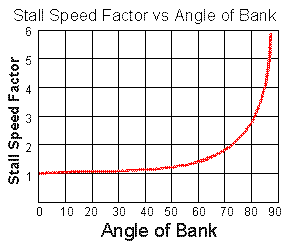
That would be a 2G load factor, but approximately a 41 percent increase in stall speed, would it not? Not realizing the difference might get you a rock sandwich for lunch if you erroneously thought your stall speed was going to be doubled, and flew the turn too fast.crazy_aviator wrote: it can be wise to unload a little in the turn ,,that is instead of holding level in a 60 degree bank, thereby incurring a 2 times incr. in stall speed,,,
Stall Speed Vs. Angle of Bank
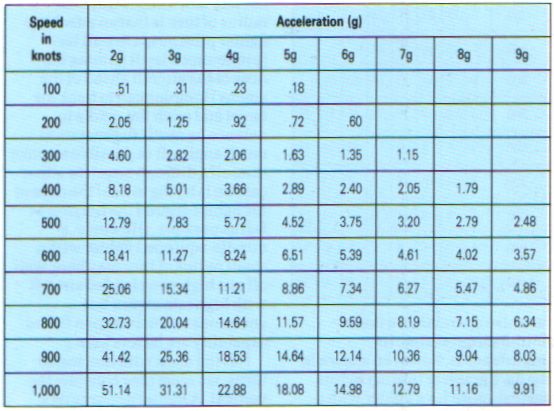
Aircraft turn radius in thousands of feet as a function of speed in knots and load factor in g
-
crazy_aviator
- Rank 8
- Posts: 917
- Joined: Thu May 01, 2008 10:13 am
Re: Mountain Course
Yes, i stand corrected, i meant 2 G load and reducing the load will reduce the stall speed also
-
iflyforpie
- Top Poster
- Posts: 8132
- Joined: Tue Apr 15, 2008 12:25 pm
- Location: Winterfell...
Re: Mountain Course
Stall speed only increases with wing loading. The wing loading only increases in that manner in a level turn.Stall Speed Vs. Angle of Bank
A canyon turn is not level. You are essentially flying a ballistic arc (or close approximation thereof) so you can use most of the lift available to you to turn the aircraft.
It seems that most pilot think that loading will increase to infinity at 90 degrees. I've done 90 degree banked turns and can tell you my plane has not stalled or ripped the wings off.
Stall warning devices and buffeting will still give you ample warning of a stall at increased loadings/airspeeds. This is because they are based on angle of attack, not airspeed.
Geez did I say that....? Or just think it....?
-
Shiny Side Up
- Top Poster
- Posts: 5335
- Joined: Tue Feb 17, 2004 5:02 pm
- Location: Group W bench
Re: Mountain Course
I mentioned it, because I know of a few "Mountain Checks" that have been done this way. Instructor and student plan for a hop of 10,500 or more, do a few steep turns and call it good to go. I happen to know of one person who's now a scorch mark on a peak somewhere with this sort of mountain experience.Someone said that flying over the top, you aren't going to learn anything. Over the top might have you feeling pretty sanguine until you have an engine failure. Where are you going to put it? How long will it take for somebody to rescue you? What about destination undercast? Mountain wave and lee mechanical usually hits the hardest when you are at or above the levels of the peaks as well, and the upper winds are usually stronger the higher you go.
As you said, any moutain training is just like everything else, its a licence to learn.
We can't stop here! This is BAT country!
Re: Mountain Course
Not in a sixty degree bank turn it isn't unless you want to lose height.Michael, please be careful to educate the masses in the proper direction ,,,it is better to keep the ball centred
Draw the vector diagram for yourself...
At forty five degrees of bank there is an equal amount of nose up pitch and yaw into the turn.
The result is a level vector.
At less than forty five degrees there's less pitch and more yaw.
At more than forty five degrees it's more pitch than yaw.
A flat turn is all yaw, a knife edge turn is all pitch, and at angles in between there are different fractions of both.
In knife edge the rudder is the elevator and the ball is displaced hard towards the bottom wing.
At sixty degrees of bank the ball is displaced proportionately in the direction of the lower wing.
Try doing sixty degree bank turns in a light aircraft with the ball in the middle and holding your altitude.
Re: Mountain Course
All you need is a bit of power - the Pitts will do it easilyTry doing sixty degree bank turns in a light aircraft with the ball in the middle and holding your altitude

Re: Mountain Course
It is not certified in the aerobatic category. However, it is utility (at all weights), and that allows it to do turns with an angle of bank up to, but not exceeding 90 degrees. Don't believe me? Check out CAR 523.3 (and yes, it follows the FARs. The below is directly from TC's site)Hedley wrote:P.S. As per the TC civil aircraft registry, I didn't
know the Diamond DA-20 was certified in the
aerobatic category.
523.3 Aeroplane Categories
(a) The normal category is limited to aeroplanes that have a seating configuration, excluding pilot seats, of nine or less, a maximum certificated takeoff weight of 5700 kg (12,566 lbs.) or less, and intended for non-aerobatic operation. Non-aerobatic operation includes:
FAR:
(a) The normal category is limited to airplanes that have a seating configuration, excluding pilot seats of nine or less, a maximum certificated takeoff weight of 12,500 lbs (5670 kg) or less, and intended for non-acrobatic operation. Non- acrobatic operation includes:
(1) Any manoeuvre incident to normal flying;
(2) Stalls (except whip stalls); and
(3) Lazy eights, chandelles, and steep turns, in which the angle of bank is not more than 60°.
(b) The utility category is limited to aeroplanes that have a seating configuration, excluding pilot seats, of nine or less, a maximum certificated takeoff weight of 5700 kg (12,566 lbs.) or less, and intended for limited aerobatic operation. Aeroplanes certificated in the utility category may be used in any of the operations covered under paragraph (a) of this section and in limited aerobatic operations. Limited aerobatic operation includes:
FAR:
(b) The utility category is limited to airplanes that have a seating configuration, excluding pilot seats, of nine or less, a maximum certificated takeoff weight of 12,500 lbs (5670 kg) or less, and intended for limited acrobatic operation. Airplanes certificated in the utility category may be used in any of the operations covered under paragraph (a) of this section and in limited acrobatic operations. Limited acrobatic operation includes:
(1) Spins (if approved for the particular type of aeroplane); and
(2) Lazy eights, chandelles, and steep turns, or similar manoeuvres, in which the angle of bank is more than 60 degrees but not more than 90 degrees.
(c) The aerobatic category is limited to aeroplanes that have a seating configuration, excluding pilot seats, of nine or less, a maximum certificated takeoff weight of 5700 kg (12,566 lbs.) or less, and intended for use without restrictions, other than those shown to be necessary as a result of required flight tests.
FAR:
(c) The acrobatic category is limited to airplanes that have a seating configuration, excluding pilot seats, of nine or less, a maximum certificated takeoff weight of 12,500 lbs (5670 kg) or less, and intended for use without restrictions, other than those shown to be necessary as a result of required flight tests.
(d) The commuter category is limited to propeller-driven, multi-engine aeroplanes that have a seating configuration, excluding pilot seats, of 19 or less, and a maximum certificated takeoff weight of 8618 kg (19,000 lbs.) or less. The commuter category operation is limited to any manoeuvre incident to normal flying, stalls (except whip stalls), and steep turns, in which the angle of bank is not more than 60 degrees.
(e) Except for commuter category, aeroplanes may be type certificated in more than one category if the requirements of each requested category are met.
Gravity lands us, we just make it look good.
Re: Mountain Course
CAR 101.01(1) defines:
http://www.tc.gc.ca/civilaviation/regse ... bpart1.htm
that the definition of "aerobatics" in Canada is very restrictive -
for example, Transport argued (and the Tribunal agreed) that
a maneuvre with even a gentle +2G is "aerobatic" despite the
fact that yes, in the USA, the normal category is defined as +3.8
and the utility category is +4.4. It doesn't matter what a foreign
country says - what matters is what Transport is able to successfully
argue at the Tribunal.
If you think you can do better at the Tribunal, please do go ahead.
The above is pretty clear that if you exceed 60 degrees of bank
in Canada, you are performing aerobatics.
I have had an Enforcement Inspector perform "covert survellance"
on me - secretly coming out to the airport under cover, and videotaping
me, trying to collect evidence that I was exceeding 60 degrees
of bank in the circuit and thus contravening CAR 602.27(d).
http://www.tc.gc.ca/civilaviation/regse ... bpart1.htm
Transport Canada has argued at the Tribunal (which has agreed)"aerobatic manoeuvre" - means a manoeuvre where a change in the attitude of an aircraft results in a bank angle greater than 60 degrees, an abnormal attitude or an abnormal acceleration not incidental to normal flying;
that the definition of "aerobatics" in Canada is very restrictive -
for example, Transport argued (and the Tribunal agreed) that
a maneuvre with even a gentle +2G is "aerobatic" despite the
fact that yes, in the USA, the normal category is defined as +3.8
and the utility category is +4.4. It doesn't matter what a foreign
country says - what matters is what Transport is able to successfully
argue at the Tribunal.
If you think you can do better at the Tribunal, please do go ahead.
The above is pretty clear that if you exceed 60 degrees of bank
in Canada, you are performing aerobatics.
I have had an Enforcement Inspector perform "covert survellance"
on me - secretly coming out to the airport under cover, and videotaping
me, trying to collect evidence that I was exceeding 60 degrees
of bank in the circuit and thus contravening CAR 602.27(d).
-
iflyforpie
- Top Poster
- Posts: 8132
- Joined: Tue Apr 15, 2008 12:25 pm
- Location: Winterfell...
Re: Mountain Course
That is why when we practice them we are not above an assembly of people and recover at least 2000ft AGL. It's the same for all the other 'aerobatic' maneuvers we do, like spins and chandelles.
In case of an emergency, I think it is better to beg forgiveness than ask permission. I'd rather be alive for my Tribunal.
In case of an emergency, I think it is better to beg forgiveness than ask permission. I'd rather be alive for my Tribunal.
I would agree with them in this case. Those are only the limiting load factors for certification and safe operations. You said it yourself that hot-shot performers use less G than the normal category for their maneuvers. I can do an aileron roll and hardly pull any G at all....Transport argued (and the Tribunal agreed) that
a maneuvre with even a gentle +2G is "aerobatic" despite the
fact that yes, in the USA, the normal category is defined as +3.8
and the utility category is +4.4.
Geez did I say that....? Or just think it....?


