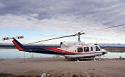
I'm pretty sure you're wrong, but I can understand how those without exposure to the real world of EMS can have their perception skewed by the Hollywood dramatizations. For those of you who have actually done a Medevac run, please respond to this...How many times have you flown to get a patient and your crew was the only medical crew on scene?
A couple of hundred at least. And not all RW.
I will bet that with the exception of SAR that almost no helicopter medevac and absolutely no fixed wing have arrived to pick up a patient who has not already been receiving medical care from a qualified professional.
Nope again. Many FW scene flights where no medical personell on scene. Just lay public / co-workers / bystanders.
These medical professionals are quite capable of determining the severity of the situation and to inform the dispatch centre of the details.
Ummmm... not so much. Great in theory. Ever hear of "scene calls with walls" AKA "Well Lit Scene Calls" or "IFT (interfacility transfer) Recues"?
Ambulance dispatch centres use a tool called the Medical Priority Dispatch System, MPDS, this system is used to improve safety and patient outcomes by evaluating how serious the condition of the patient is over the phone and sending the ambulance using the appropriate emergency response. Many times, an ambulance will drive to the location and to the hospital without lights and sirens, most times they will drive with lights and sirens to the location, then without to the hospital, and finally, lights and sirens to the location, to the hospital, and to the donut shop, but Never Never back to base. As always, if the patient's condition deteriorates, we can turn on our lights and sirens...just like a pilot can append "Medevac" mid flight.
So, if we liken the term "Medevac" to an ambulance using lights and sirens it just makes sense. Using the information provided by the medical staff at the location the dispatch centre or medical flight crew can determine if:
Not gonna happen - no way is a PIC going to let a dispatcher (EMS not a TC or FAA approved aviation dispatcher) determine if he requests any particular flight plan - including the MEDEVC delaration/request
- You do not need to append medevac
You need to append Medevac to get there, but after their evaluation it is not required on the way back
You need to append Medevac both ways
The only reason that people think ambulances use their lights and sirens all the time in real life is because when you see one it grabs your attention....try this, look more closely and you will see many many more ambulances without lights and sirens.
Besides, the vast majority of Medevac calls in my experience are for 2 reasons, The patient is in a remote location that is not accessible by road or going by air is far faster than going by ground when long distances are required, in rare instances the patient might actually be in critical condition and necessitate the "Medevac" call sign rather than just using the air ambulance for convenience.
I'll give you that - and the number of times I have asked the PIC for direct routing/priority handling I can count on my digits per year. But they are already on a "MEDEVAC" designation anyway. All that does is let ATC know that this one is real and priority handling IS required.
There was an incident a few years back where a controller was so flustered by the unusual use of Medevac that a separation loss occurred. So some of the current situation may be from operators and TC more closely following the wording and having MEDEVAC declared more often. The PIC can always inform ATC if no priority handling is required, if you are a controller in Northern Alberta you'd already have that figured out given the 10,000 or so flights a year that use it.
So in essence MEDEVAC alerts ATC that the PIC might need priority handling, and reduces the stress and surprise if during the flight he does so request. As well as for getting clearance through congested airspace on RW flights when the pt condition is unknown or critical. It is always "fun" crossing a major international's airspace on an outbound scene flight with one medcrew on a radio with the LZ commander, another on a different radio with dispatch, and the pilot on a 3rd with ATC. Sorting the relevant traffic in your headset and still retaining situational awareness is a challenge...