Seem that few people know this, but Canadair DESIGNED the Convair 580.
I was told by their Chief Engineer that it is a complete redesign of the Convair 440
but Canada at the time was still a colony and if Convair owned Canadair,
everything Canadair USED was actually Crown property, buildings, machine tools
even Cartierville Airport.
The CROWN resided in England, favored British interests, Napier Eland was British
and was going to be hung on the Canadair, regardless of whoever's opinion.
The Napier Eland's specs where enough to make your head spin, IT WAS BETTER
THAN THE PW 100 who came 40 years later!!!
However, you'll notice than Pratt is testing their engines at length before putting
them on an airplane...Napier did not spend ONE plugged nickel!!! they just shipped
them to Canadair who just delivered them with the airplane, the Canadair 66(following government's orders!).
Of course, it had stellar performances, but hardly ever finished a flight on two engines.
One time, with a load of Airline owners and executives, it had FOUR engines failures,
dragging itself to a runway alternating from one engine to the other.
Naturally, Quebecair and the Air Forces took all their planes back to Cartierville
and sued the crap out of Canadair.
Napier lost their reputation forever and it took Canadair a long time to
drag itself out of that hole.
General Dynamic-Convair took the airframe back home, put the proven
Allison of it, and voilà, the Convair 580, a resounding commercial success.
http://www.rcaf.com/Aircraft/aircraftDe ... olitan-102
Canadair CC-109 Cosmopolitan
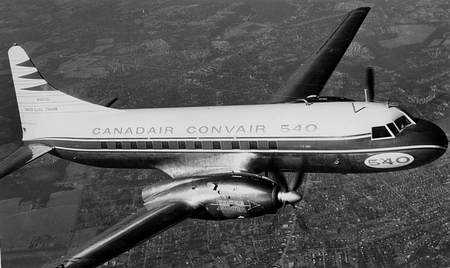
Canadair's parent company in the late 1950's was General Dynamics who also owned Convair Aircraft in the United States. When Convair phased out the Convair CV-440 twin engine transport design, Canadair purchased the production jigs along with some uncompleted airframes. Canadair further refined the original design with 3,500 shp Napier Eland turboprop engines. These new variant was initially known as the Convair 540 since they were initially based on the uncompleted CV-540 airframes. New build aircraft were subsequently given the CL-66 Canadair designation.
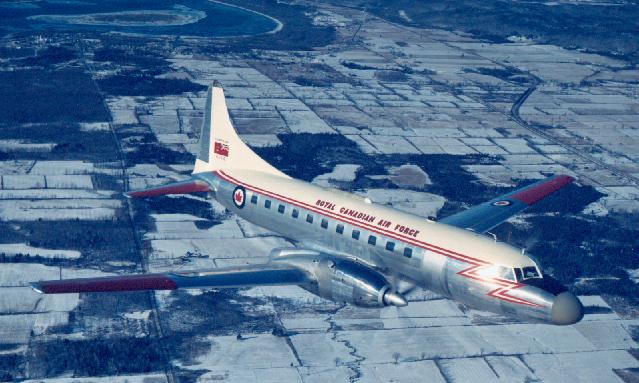
The RCAF became the launch customer for this new version by ordering ten CL-66B variants which incorporated a reinforced floor, wide load doors and the ability for both cargo and passengers. The aircraft were introduced in Air Transport Command and were primarily used for the bulk of the type's career for VIP transport duties. The aircraft were also deployed to Europe for Canadian NATO contingent support as well as to the US in support of Canadian NORAD operations.
In 1966, eight of the RCAF Cosmopolitans were re-engined with Allison T-56 turboprops. After an avionics upgrade to "glass cockpit" status, the aircraft were retired in 1995.
aircraft specifications
CDN Reg: CC-109
US/NATO Reg.:
Manufacturer: Canadair Aircraft Ltd
Crew / Passengers: crew of four with provisions for 40 passengers or up to 14,300 lb (6,486 kg) in cargo
Power Plant(s): two 3,500 eshp Napier Eland 504 turboprop engines / Allison T-56 turboprops
Performance: Max Speed: 340 mph (547 km/h) Cruising Speed: 322 mph ( 518 km/h) Service Ceiling: 26,200 ft (6,220 m) Range: 1,244 mi (1,996 km)
Weights: Empty: 32,333 lb ( 14,666 kg) Gross: 47,000 lb ( 21,319 kg)
Dimensions: Span: 105 ft 4 in ( 32.12 m) Length: 81 ft 6 in ( 24.84 m)
Height: 28 ft 2 in (8.49 m) Wing Area: sq ft ( sq m)
Armament: None