
Shiny: This whole thread has been a very good re-learning experience for myself and hopefully others as well. I instructed for nearly 40 years and did many mountain training courses, some with people who I knew damned well would be a statistic one day and unfortunately it came about even after about 15 hours of dual with a guy who was a typical Type A personnality. Sooner or later we all have to hang up the spurs and quit while we are ahead and probably within the next couple of years I'll sell the "Alley Cat" and have 60 + years of great memories.
This whole thread tells me one thing for certain..back to basics.
Fly safe
Barney
Mountain Flying, and Flight Training
Moderators: lilfssister, North Shore, sky's the limit, sepia, Sulako, Right Seat Captain
-
Old Dog Flying
- Rank (9)

- Posts: 1259
- Joined: Sun Jul 27, 2008 5:18 pm
-
iflyforpie
- Top Poster

- Posts: 8132
- Joined: Tue Apr 15, 2008 12:25 pm
- Location: Winterfell...
Re: Mountain Flying, and Flight Training
Unfortunately, my flying tends to put me in those shorter eastern ranges of the Rockies late in the day. You sure are right about those downdrafts. But since I am flying for the Province of BC I still have one mountain range downwind from me and I use that to stay in (relatively) smooth and performance enhancing air. Even though the wind might be blowing 30 knots tumbling down the valley, the windward side of the mountain still manages to moderate it in time.Shiny Side Up wrote: The other problem is that the air can turn corners considerably sharper than your airplane can. So when the air stops descending, it doesn't mean your airplane does. In this case you'd better be pointing towards terrain that's descending away from you. The worst places for finding some of these types of downdrafts tend to be the last range of rocks eastward - especially later in the day. The air on those slopes cools off rapidly when the suns not on them and flows downhill with the water (this info is also very useful when planning on tenting in these areas too - if you don't want to blow away while you're sleeping). Which brings me to a point that hasn't been mentioned, don't press darkness when you're out in the hills - though I see people do it all the time. For some reason its hard to get through to people that flying is usually best in the morning. Personally if I'm planning on flying in the Rocks, I like to be done before 14:00, especially if you're planning on heading back eastbound.
Absolutely. As Captain Piccard said, where there is mountains, there is shelter and it holds true for the reasons I said above. The highest winds are in the most open areas, the shorter ranges and higher plateaus and valleys of the extreme southeast corner of BC (Cranbrook and south) and western Alberta. There is nothing to stop the wind and just enough mountains to make it interesting.Shiny Side Up wrote:While I only have a small bit of experience out on the coast, respect is rightfully given to the Last ranges (or first depending on your direction of travel). Primarily because its the generator of all the scary weather, in the mountains and eastward onto the flats. A very bad place to be when the wind is out of the west - even when you've though your out of the Rocks. Hence the idea about not flying there in the afternoon. During spring summer and fall the eastern slopes generate CBs on a regular (I would daresay very predictable) basis. Not what you want to encounter on your last leg home, or worst, be forced to divert back into the mountains.People are downright frightened of the Eastern mountains and Coast mountains, but far more seducing are the rolling foothills and the low valleys in the BC interior with high plateaus surrounding.
I was there yesterday; it was actually the smoothest I've ever seen it. Hardly any thermals either.Fly safe and treat any training or experience you have as a license to learn. I was in 30 knot winds flying at 5000ft in the valley to the west yesterday... never seen that before--142 knots ground speed in a 172.
IF you want to find even better groundspeed, I'd reccomend plotting a course out through the crow's nest on a windy day. The tubulence might shake the fillings out of your teeth though.

What I actually meant was I'd never seen that kind of wind at that elevation (5000 ASL, about 1500AGL) in the usually (relatively) placid Columbia valley. I think the winds were actually closer to 40 knots which was funny considering it was only about a 15 knot direct crosswind at the airport 5 miles away. Venturi effect I guess.
And it is not that I don't want this knowledge out there, it is just that in my work environment it just isn't possible to properly teach somebody without lectures and handouts and briefing rooms, all for $200 an hour only when the plane is turned on. For a lot less effort I can get a plane load of self loading cargo, give them a safety briefing, and be off into the wild blue for $300 an hour in our 172. I doubt you will find many pilots who would pay even instructional rates for a 172 for 20 hours to learn to fly in the mountains. Most pilots are too cheap, too proud, or both. Since we aren't an FTU, 20 hours at a time isn't a lot to amortize fixed costs and maybe get a profit in there.
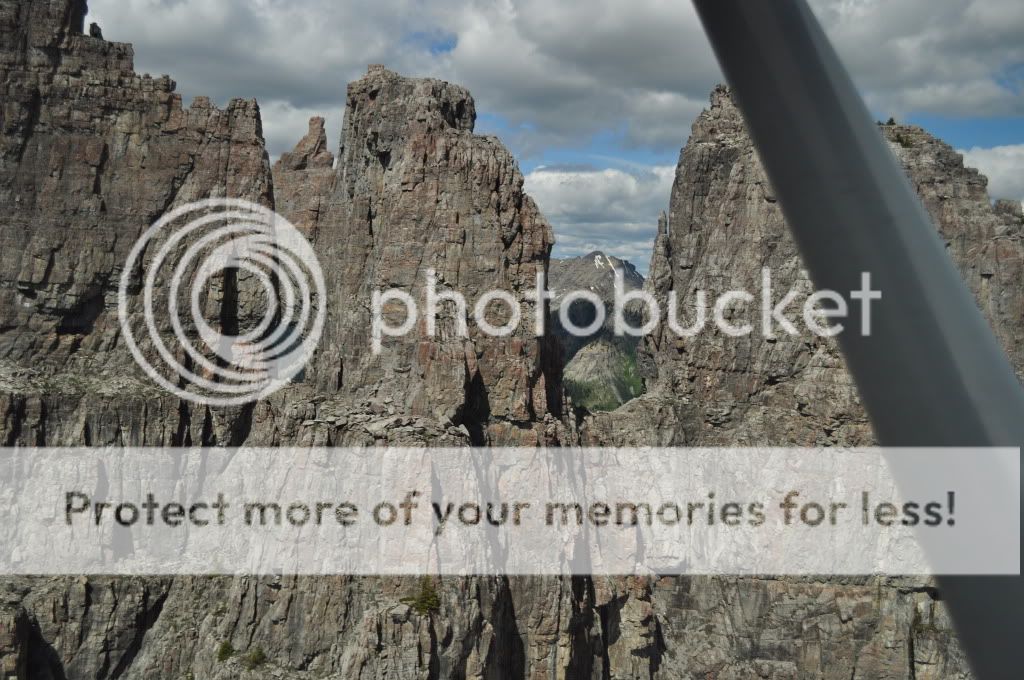
Just remember, when flying in the mountains always make sure you have a hole...

Geez did I say that....? Or just think it....?
-
Shiny Side Up

- Top Poster
- Posts: 5335
- Joined: Tue Feb 17, 2004 5:02 pm
- Location: Group W bench
Re: Mountain Flying, and Flight Training
That hole looks familiar... Its not by chance that little gap between those nobs of rock westward up the glacier (or what's left of it) from Kananaskis lake is it? The other side of the hole going down into the palliser river valley?Just remember, always leave yourself a hole...
We can't stop here! This is BAT country!
-
iflyforpie
- Top Poster
- Posts: 8132
- Joined: Tue Apr 15, 2008 12:25 pm
- Location: Winterfell...
Re: Mountain Flying, and Flight Training
By Summer Lake just off the Bull River, about 20NM NE of Cranbrook. The Mountain is called Empire State Peak.
Usually rougher than hell in there, but yesterday was nice.
Usually rougher than hell in there, but yesterday was nice.
Geez did I say that....? Or just think it....?
-
Shiny Side Up
- Top Poster
- Posts: 5335
- Joined: Tue Feb 17, 2004 5:02 pm
- Location: Group W bench
Re: Mountain Flying, and Flight Training
Well while we're comparing pictures...
Trying to remember where this was exactly at, there's not as much snow like this in the Rocks as when this was taken about six years ago? Maybe more.
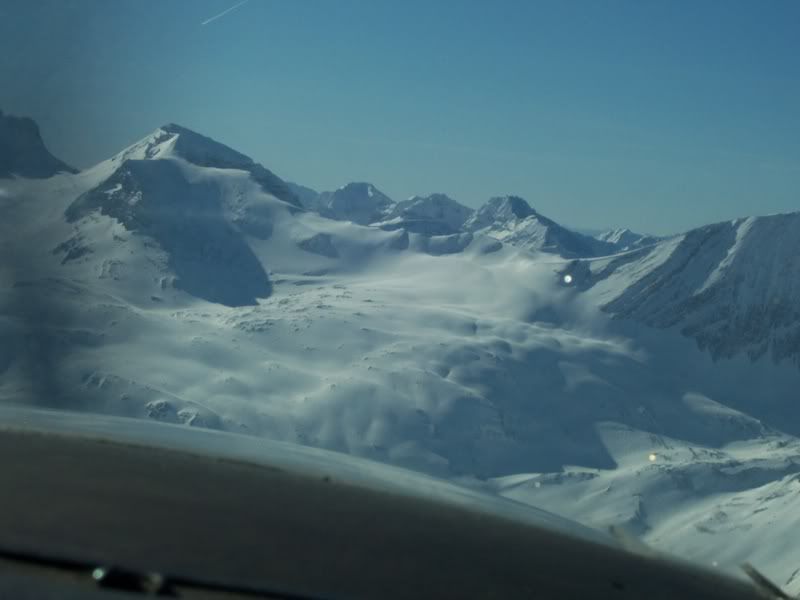
Approaching the saddleback at a bit of an angle. the old Piper's in a climb (or trying to) at this point though it may be tough to tell from the photo, quality is not good, since its scanned from an actual photo. Note the snow blowing over the saddle back, even with the clear blue sky, shortly after this was taken the terrain on the other side started disappearing and it was time to turn around, not a big deal that particular day, we had an easy plan to get away (and of course an alternate route to take in case this one didn't work out)
Something to note here is how your altimeter lies in these places, the venturi effect with the wind blowing through, what seems like a pretty tame gap in the peaks was reading that we should had altitude to spare going through. I think if we would have tried we would have been lucky just to have left some wheel tracks in that snow.
Trying to remember where this was exactly at, there's not as much snow like this in the Rocks as when this was taken about six years ago? Maybe more.
Approaching the saddleback at a bit of an angle. the old Piper's in a climb (or trying to) at this point though it may be tough to tell from the photo, quality is not good, since its scanned from an actual photo. Note the snow blowing over the saddle back, even with the clear blue sky, shortly after this was taken the terrain on the other side started disappearing and it was time to turn around, not a big deal that particular day, we had an easy plan to get away (and of course an alternate route to take in case this one didn't work out)
Something to note here is how your altimeter lies in these places, the venturi effect with the wind blowing through, what seems like a pretty tame gap in the peaks was reading that we should had altitude to spare going through. I think if we would have tried we would have been lucky just to have left some wheel tracks in that snow.
We can't stop here! This is BAT country!
-
iflyforpie
- Top Poster
- Posts: 8132
- Joined: Tue Apr 15, 2008 12:25 pm
- Location: Winterfell...
Re: Mountain Flying, and Flight Training
That's Mount Joffre at the extreme left of the frame, with Mt Cordonnier to the right of it and Warrior Mountain with the exposed strata disappearing off the right side of the frame. It's just above the top end of the Kananaskis heading into the back of the Palliser.
That group of mountains you were thought my original picture was is a few miles to the south in BC at the head of the Elk Valley by the Elk Lakes. I usually use that to gain altitude before doing the equally challenging pass to the south of Mt Joffre to get to the White River.
Again, the tame terrain is sometimes more challenging. When terrain drops off faster than you could ever dive the plane it makes ridge crossings easier all else being equal. I've definitely experienced erroneous altimeter readings in my regular routes, but I use eyesight to cross unfamiliar passes.. usually with lots of room to spare.
That group of mountains you were thought my original picture was is a few miles to the south in BC at the head of the Elk Valley by the Elk Lakes. I usually use that to gain altitude before doing the equally challenging pass to the south of Mt Joffre to get to the White River.
Again, the tame terrain is sometimes more challenging. When terrain drops off faster than you could ever dive the plane it makes ridge crossings easier all else being equal. I've definitely experienced erroneous altimeter readings in my regular routes, but I use eyesight to cross unfamiliar passes.. usually with lots of room to spare.
Geez did I say that....? Or just think it....?
-
Posthumane
- Rank 7

- Posts: 651
- Joined: Sat May 09, 2009 6:16 pm
Re: Mountain Flying, and Flight Training
So with the mountains being an alluring but complex environment, and with the lack of willing and experienced instructors, how can you gauge your level of "readiness" for flying in the rocks? And how do you get there if the instruction that's available isn't doing it?
Obviously there are different levels of knowledge and experience required for carrying out different types of flights, from going over the top with a high performance airplane, to carving through wide valleys, cutting across ridges, to working down low on a regular basis in a variety of challenging scenarios.
The emphasis in this thread seems to be on the following things:
- Understanding your aircraft, it's limitations and capabilities, and listening to what it is telling you
- Mastering the basics of aircraft control
- Thorough knowledge of weather, air currents, the effects of topography, etc. and using that knowledge for strict decision making about whether or not to fly
- Having clearly defined rules and limitations to adhere to while you are gaining experience.
So, what tools can you use to self-assess? I've done a rather brief "mountain checkout" with an experienced instructor, been reading what I can on mountain flying, and have practiced turns and climbs in a variety of configurations in my plane to get more acquainted with it's performance. I THINK I could safely fly along a published VFR route in very good weather, but nothing more than that. However I don't have a good way to know if I'm being over/under confident.
A general rule to the instructors or mentors - at what point do you consider your student ready to be cut loose for "basic" (read: short, simple) mountain flight? At what point are they ready for more challenging scenarios like off strip work?
Obviously there are different levels of knowledge and experience required for carrying out different types of flights, from going over the top with a high performance airplane, to carving through wide valleys, cutting across ridges, to working down low on a regular basis in a variety of challenging scenarios.
The emphasis in this thread seems to be on the following things:
- Understanding your aircraft, it's limitations and capabilities, and listening to what it is telling you
- Mastering the basics of aircraft control
- Thorough knowledge of weather, air currents, the effects of topography, etc. and using that knowledge for strict decision making about whether or not to fly
- Having clearly defined rules and limitations to adhere to while you are gaining experience.
So, what tools can you use to self-assess? I've done a rather brief "mountain checkout" with an experienced instructor, been reading what I can on mountain flying, and have practiced turns and climbs in a variety of configurations in my plane to get more acquainted with it's performance. I THINK I could safely fly along a published VFR route in very good weather, but nothing more than that. However I don't have a good way to know if I'm being over/under confident.
A general rule to the instructors or mentors - at what point do you consider your student ready to be cut loose for "basic" (read: short, simple) mountain flight? At what point are they ready for more challenging scenarios like off strip work?
"People who say it cannot be done should not interrupt those who are doing it." -George Bernard Shaw
-
Shiny Side Up
- Top Poster
- Posts: 5335
- Joined: Tue Feb 17, 2004 5:02 pm
- Location: Group W bench
Re: Mountain Flying, and Flight Training
Ah yes, to the right of the frame, not visible is the gap with some nobby rocks, which is a little bit lower than the saddleback in frame. Just at the far left obscurred by the prop blur is the foot of the glacier, which has almost disappeared last time I was up that way a few months ago. Lots of that snow in the pic used to be there year round, but alas not any longer.iflyforpie wrote:That's Mount Joffre at the extreme left of the frame, with Mt Cordonnier to the right of it and Warrior Mountain with the exposed strata disappearing off the right side of the frame. It's just above the top end of the Kananaskis heading into the back of the Palliser.
Hard to say. In most cases it ain't my business to "cut people loose" they have their own licenses, they have their own planes and are grown up people. I hate to say it but many come only because of their own ignorance because they think there is actually such thing as a "mountain rating", a mixed blessing. I would say that any reasonably cautious pilot who has a good dose of common sense would have nothing to fear about a reasonably planned trip. Everyone, of course, thinks that they are a cautious pilot though.posthumane wrote:A general rule to the instructors or mentors - at what point do you consider your student ready to be cut loose for "basic" (read: short, simple) mountain flight?
We can't stop here! This is BAT country!
-
Big Pistons Forever
- Top Poster
- Posts: 5953
- Joined: Wed Feb 18, 2004 7:17 pm
- Location: West Coast
Re: Mountain Flying, and Flight Training
For new pilots I tell them start with winds aloft not more than 20 knots and No cloud below 2000 feet above the highest enroute elevation and No forecast precip/smoke. Follow the VFR routes and carry at least 1.5 hour fuel reserve. The only way to get good at Mountain flying is to do it .....a lot.Posthumane wrote: So, what tools can you use to self-assess? I've done a rather brief "mountain checkout" with an experienced instructor, been reading what I can on mountain flying, and have practiced turns and climbs in a variety of configurations in my plane to get more acquainted with it's performance. I THINK I could safely fly along a published VFR route in very good weather, but nothing more than that. However I don't have a good way to know if I'm being over/under confident.
A general rule to the instructors or mentors - at what point do you consider your student ready to be cut loose for "basic" (read: short, simple) mountain flight? At what point are they ready for more challenging scenarios like off strip work?
I also am particular about who I teach. The right attitude is more important then hours/ratings or even stick and rudder skills (although there is a minimum competency level obviously). IMO my value is less in the flying we do (which will only be a small sample of what you could experience) and more in the groundschool and PDM discussions.......and I don't teach "canyon" turns because if that is your only way out of the situation you are almost certainly on your way to becoming a statistic.
But I hold a current flight instructor rating so what do I know


Re: Mountain Flying, and Flight Training
And here I was taking your words as gospelBig Pistons Forever wrote:But I hold a current flight instructor rating so what do I know
Actually I couldn't agree more. I'm planning my second major trip into the mountains and I'm doing it like an extension of my previous experience.
Last time I flew through with an experience CFI in the passenger seat, helping with the nav and decision making. It was hot, the plane was near gross and I had a very steep cruise prop; it really underscored how many factors that can complicate flying in terrain.
This time the plan is to fly in company with another pilot and his aircraft. So the basic flying and decision making will be mine but I will have someone I trust and who I know has mountain experience available on the radio. Plus its going to be fun and we've got days to cover 300mi each way, so no weather push at all.
It will be early September so we should avoid too much heat but hopefully without really getting into the fall winds.
This time I've got enough experience flying my plane to really pay attention to my surroundings and get some experience making the right decisions.
-Grant
-
LousyFisherman
- Rank 7
- Posts: 578
- Joined: Sat May 10, 2008 8:32 am
- Location: CFX2
- Contact:
Re: Mountain Flying, and Flight Training
Yes, I was joking, I thought the flippant tags would make it obviousShiny Side Up wrote:I'll assume you're joking here, but you'd be suprised at how many people do actually think the above is true. Newton's laws would disagree with the above idea.LousyFisherman wrote:A 4000 foot/minute downdraft will have a huge cushion of air above the trees so you will never hit the ground

Back to Chucks original question. In a a 4000'/minute downdraft at 1000' I would have 15-20 seconds. I have no illusions about my skill. However, if I am in that situation my PDM was at fault. I have no business flying in weather where those conditions can occur.
I think the real question is what is the correct response in those conditions. I believe it is DO NOT lift the nose, maintain or increase speed and get out sideways. I am uncertain if I could override the natural reaction to lift the nose, which is why I have no business being there.
IFP, my topos are relatively recent and are in feet. They are produced by Energy, Mines and Resources Canada, and are available at MapWorld in Calgary. I will slip in there this week and check and post the info here.
Thanks for the Vy, Vx discussion, I will do some energy management trials at Vx, not in the mountains, as I was not aware that Vx was behind the power curve.
As others have mentioned the big issue is transfer of knowledge for experienced mountain flyers to others like myself. I cannot describe how useful this site has been in setting my personal limits. For example:
IFP and I discussed how close should one fly to cliffs or walls. In my case as close as I am comfortable. The distance at which I am comfortable is far greater than the distance I am safe at.
SSU and I had a long discussion over emergency landing sites. Water, trees, clearcuts or alpine slopes.
Rather than a mountain course, per se, what I need/want is take a number of flights, with a variety of different pilots, in a bunch of different locations who can show me techniques, tips and tricks. For example, landing on steeply sloped (10 degrees) airstrips. Need an airplane for that too, the C150 just ain't going to cut it

Posthumane, set your limits, pick a good day, choose an easy trip and go. Abort whenever you are uncomfortable. I abort about one third of the time, usually where the rivers, Highwood, Bow, or Red Deer, exit the eastern slopes. Either cloud, wind or predicted weather just won't co-operate.
For the following go to 9000 feet and stay there, any wind issues will be obvious at the beginning of the trip.
Easy trip: CYBW, Panther River, Lake Minnewanka, Canmore, CYBW
Harder trip: CYBW, Longview, Highwood Pass, Spray Lakes, Canmore, CYBW
- watch the wind through the pass, Slip over to Mount Assiniboine if you are comfortable
Longer Trip: CYBW, Sundre, Red Deer River, Pipestone Creek, Lake Lousie, Banff, Canmore, CYBW
HTH
LF
Women and planes have alot in common
Both are expensive, loud, and noisy.
However, when handled properly both respond well and provide great pleasure
Both are expensive, loud, and noisy.
However, when handled properly both respond well and provide great pleasure
-
Posthumane
- Rank 7
- Posts: 651
- Joined: Sat May 09, 2009 6:16 pm
Re: Mountain Flying, and Flight Training
Thanks for the route tips LF, I had looked at those trips previously and they look to be quite enjoyable on nice days (and fairly easy navigation, since I've driven and biked in that area a fair bit). If the weather is good, I might end up doing calgary to golden and back this weekend, although I'm undecided about it since I have a specific reason to be there besides just flying for fun and don't want to put myself in a get-there-itis situation.
Regarding the 4000'/min downdraft scenario, I think you have to train yourself to not dip below Vy for anything like that, and if you have terrain ahead an immediate steep turn back to lower terrain is the key. For many people it takes quite a bit of practice to get out of the pullback = climb mentality (probably myself as well).
Regarding the 4000'/min downdraft scenario, I think you have to train yourself to not dip below Vy for anything like that, and if you have terrain ahead an immediate steep turn back to lower terrain is the key. For many people it takes quite a bit of practice to get out of the pullback = climb mentality (probably myself as well).
"People who say it cannot be done should not interrupt those who are doing it." -George Bernard Shaw
-
iflyforpie
- Top Poster
- Posts: 8132
- Joined: Tue Apr 15, 2008 12:25 pm
- Location: Winterfell...
Re: Mountain Flying, and Flight Training
Honestly, I've never seen sustained 4000 FPM downdrafts before, but I have seen them peg a 2000 FPM VSI (they don't peg, they go around, not sure how accurate they are on the other side but at that point I am not trusting it and my eyes are outside). No, you can't be afraid of the ground and even pulling back does not do anything. Even at Vy, a vertical gust has made the stall warning horn go off in my aircraft several times: you don't want to be slower than Vy. The best you can do is try to escape the downdraft by reducing your descent rate as much as you can (with Vy being your minimum sink speed) and flying out of it.
My first trip across the Rocks was with 150TT on June 30, 2003 in good ol' HJC, a Cessna 172 with no GPS and basic VFR instruments. I had no formal mountain training at that point, but I had been to the Coast (300NM to Port Hardy), and through the Eastern BC ranges (except the Rockies) before. None had given me any specific challenges except a trip to Nelson where the weather was a bit low on the way back.
Uppers were 27 knots but it was the severest of severe clears, so I decided to cut the corners off the Southern VFR route. I figured 'turbulence, smurbulence' (I was by myself). I went through Grey Creek pass with a few bumps, landed in Cranbrook and found out fuel was unavailable (they NOTAMed it off later, I did check before I left). I dipped the tanks and figured I had enough to make it to Springbank.
Just going into the Elk Valley was where I got hammered. By Fernie I was genuinely concerned and by Frank Slide I was wondering if I was going to share a similar fate to those still buried under the rubble. Was up at 11,000 feet and having trouble maintaining a 2000 foot block. The turbulence chased me nearly to Lethbridge before I could comfortably turn north and parallel the range.
At this point--my first time ever flying over flatlands--I was lost. My fuel was dwindling, I had no GPS and no recognizable landmarks. Kept going north and figured I would eventually enter Calgary Terminal airspace where I would get yelled at but at least I would know where I was. Picked up the #2 around High River and landed in Springbank for 3.9 total in a 172 with standard tanks.
Looking back on that flight, what got me into trouble was not my flying skills (or lack thereof), it was my decision making. I had not factored in wind as being such a major issue, only being exposed to the relatively benign winds of the Okanagan and flying over other ranges on calm days. I did not think to stop elsewhere for fuel, like Invermere or Sparwood or Pincher Creek or even Lethbridge. I did not think that the winds would have been so powerful outside of the mountains and did not realize that the higher you fly, the more intense the winds are (I was trying to get away from mechanical turbulence, but it was lee wave).
My first trip across the Rocks was with 150TT on June 30, 2003 in good ol' HJC, a Cessna 172 with no GPS and basic VFR instruments. I had no formal mountain training at that point, but I had been to the Coast (300NM to Port Hardy), and through the Eastern BC ranges (except the Rockies) before. None had given me any specific challenges except a trip to Nelson where the weather was a bit low on the way back.
Uppers were 27 knots but it was the severest of severe clears, so I decided to cut the corners off the Southern VFR route. I figured 'turbulence, smurbulence' (I was by myself). I went through Grey Creek pass with a few bumps, landed in Cranbrook and found out fuel was unavailable (they NOTAMed it off later, I did check before I left). I dipped the tanks and figured I had enough to make it to Springbank.
Just going into the Elk Valley was where I got hammered. By Fernie I was genuinely concerned and by Frank Slide I was wondering if I was going to share a similar fate to those still buried under the rubble. Was up at 11,000 feet and having trouble maintaining a 2000 foot block. The turbulence chased me nearly to Lethbridge before I could comfortably turn north and parallel the range.
At this point--my first time ever flying over flatlands--I was lost. My fuel was dwindling, I had no GPS and no recognizable landmarks. Kept going north and figured I would eventually enter Calgary Terminal airspace where I would get yelled at but at least I would know where I was. Picked up the #2 around High River and landed in Springbank for 3.9 total in a 172 with standard tanks.
Looking back on that flight, what got me into trouble was not my flying skills (or lack thereof), it was my decision making. I had not factored in wind as being such a major issue, only being exposed to the relatively benign winds of the Okanagan and flying over other ranges on calm days. I did not think to stop elsewhere for fuel, like Invermere or Sparwood or Pincher Creek or even Lethbridge. I did not think that the winds would have been so powerful outside of the mountains and did not realize that the higher you fly, the more intense the winds are (I was trying to get away from mechanical turbulence, but it was lee wave).
Geez did I say that....? Or just think it....?
-
Posthumane
- Rank 7
- Posts: 651
- Joined: Sat May 09, 2009 6:16 pm
Re: Mountain Flying, and Flight Training
Was that because you were so focused on the turbulence and getting out of it that you didn't think about fuel stops, or didn't consider the possibility of an unplanned stop? Or was it a reluctance to deviate from your planned route? I tend to be somewhat paranoid about fuel and always try to make sure I have plenty of reserve, much more than the half hour prescribed minimum, even though it may reduce my useful load. One of the reasons the southern route through the rockes looks fairly attractive is the availability of all those airports you mentioned in case something happens (weather, mech problems, etc).iflyforpie wrote: I did not think to stop elsewhere for fuel, like Invermere or Sparwood or Pincher Creek or even Lethbridge. I did not think that the winds would have been so powerful outside of the mountains and did not realize that the higher you fly, the more intense the winds are (I was trying to get away from mechanical turbulence, but it was lee wave).
"People who say it cannot be done should not interrupt those who are doing it." -George Bernard Shaw
-
LousyFisherman
- Rank 7
- Posts: 578
- Joined: Sat May 10, 2008 8:32 am
- Location: CFX2
- Contact:
Re: Mountain Flying, and Flight Training
Stopped in at Maptown in Calgary yesterday.
Federal topos are still in feet unless they were created after 2001 (give or take)
Provincial topos, at least for Alberta and BC are more up to date and are in metres.
The up to date information is human impact stuff, roads.etc.
Every federal topo that covers the Coastal - Rocky Mountains as far north as Dawson City, YT is in feet.
Posthumane, I do not consider the Crowsnest Pass an "easy" route. The winds are usually worse, the pass is higher and narrower than the others I have mentioned. Do it for your second trip not your first.
HTH
LF
Federal topos are still in feet unless they were created after 2001 (give or take)
Provincial topos, at least for Alberta and BC are more up to date and are in metres.
The up to date information is human impact stuff, roads.etc.
Every federal topo that covers the Coastal - Rocky Mountains as far north as Dawson City, YT is in feet.
Posthumane, I do not consider the Crowsnest Pass an "easy" route. The winds are usually worse, the pass is higher and narrower than the others I have mentioned. Do it for your second trip not your first.
HTH
LF
Women and planes have alot in common
Both are expensive, loud, and noisy.
However, when handled properly both respond well and provide great pleasure
Both are expensive, loud, and noisy.
However, when handled properly both respond well and provide great pleasure
-
iflyforpie
- Top Poster
- Posts: 8132
- Joined: Tue Apr 15, 2008 12:25 pm
- Location: Winterfell...
Re: Mountain Flying, and Flight Training
At the time our school had a one hour reserve policy, which from my dip in Cranbrook and following my flight planed route I knew I would have, not accounting for tail winds. I did not count on getting lost and my sole focus when in the mountains was escaping that turbulence. After that it was just doggedly continuing on my flight path as I didn't really know where I was and hadn't really 'planned' to go into any other airports (didn't have any diagrams, frequencies, procedures, or even facilities, and wasn't going to try and read the CFS). I knew the plane would go four hours with a half hour reserve, but that was cutting it a bit close.Posthumane wrote:Was that because you were so focused on the turbulence and getting out of it that you didn't think about fuel stops, or didn't consider the possibility of an unplanned stop? Or was it a reluctance to deviate from your planned route? I tend to be somewhat paranoid about fuel and always try to make sure I have plenty of reserve, much more than the half hour prescribed minimum, even though it may reduce my useful load. One of the reasons the southern route through the rockes looks fairly attractive is the availability of all those airports you mentioned in case something happens (weather, mech problems, etc).iflyforpie wrote: I did not think to stop elsewhere for fuel, like Invermere or Sparwood or Pincher Creek or even Lethbridge. I did not think that the winds would have been so powerful outside of the mountains and did not realize that the higher you fly, the more intense the winds are (I was trying to get away from mechanical turbulence, but it was lee wave).
My personal minimums for fuel in the mountains is still one hour, and I tell everybody I can that we have fuel available in Invermere 24/7 on the honour system as I don't want anybody flying around here with low tanks.
The mountains in the southern pass are lower, but as LF said, the pass itself is higher, and the winds horrendous. The best way through is actually following Hwy 93 after Banff to Radium Hot Springs. Not as narrow or stormy as Kicking Horse, but not as windy as the Crow's Nest.
Geez did I say that....? Or just think it....?
-
Shiny Side Up
- Top Poster
- Posts: 5335
- Joined: Tue Feb 17, 2004 5:02 pm
- Location: Group W bench
Re: Mountain Flying, and Flight Training
Went to visit Iflyforpie's place today. It was too beautiful of a day to not take the opportunity. Not many others out doing it, really too bad, you got to take advantage of the good days to go for a $200 cup of coffee. Its very good coffee!
We can't stop here! This is BAT country!
-
Posthumane
- Rank 7
- Posts: 651
- Joined: Sat May 09, 2009 6:16 pm
Re: Mountain Flying, and Flight Training
Damn, wish I could have joined you on that trip, it would have been a treat. The only flying I got to do this weekend was a short buzz over my town in the flat lands. The weather seems less rainy now than it was earlier in the summer (except for all that hail you guys got recently) so I may be able to make the hop out there soon.
"People who say it cannot be done should not interrupt those who are doing it." -George Bernard Shaw
-
iflyforpie
- Top Poster
- Posts: 8132
- Joined: Tue Apr 15, 2008 12:25 pm
- Location: Winterfell...
Re: Mountain Flying, and Flight Training
You missed me. I was taking advantage of a rare Sunday in August off and took the famille four-bying up to Ram Creek hot springs.Shiny Side Up wrote:Went to visit Iflyforpie's place today. It was too beautiful of a day to not take the opportunity. Not many others out doing it, really too bad, you got to take advantage of the good days to go for a $200 cup of coffee. Its very good coffee!
Within spitting distance of the hot springs is a Cessna 310 in Marmalade Basin that tried to outclimb terrain after turning up Marmalade instead of Ram Creek when flying out of Cranbrook. Very fortunate that all walked away from the wreck....

Geez did I say that....? Or just think it....?


Re: Mountain Flying, and Flight Training
I think it will be a long time before I would feel comfortable on a solo mountain flight.
STEP BY STEP:Pilot training and career information - HOW TO BECOME A PILOT.
Re: Mountain Flying, and Flight Training
I don't think you should be so afraid of it. Really, if you pick a day with good weather and light winds, and you don't go too close to the rocks (and stay in wide valleys for your first few flights), there isn't any more danger than any other type of flying.wotai139 wrote:I think it will be a long time before I would feel comfortable on a solo mountain flight.
Re: Mountain Flying, and Flight Training
Just remember, people fly gliders (no engine) around mountains all the time. They do it on ideal days, in ideal conditions. It is some of the most enjoyable flying you can ever do.
-
Posthumane
- Rank 7
- Posts: 651
- Joined: Sat May 09, 2009 6:16 pm
Re: Mountain Flying, and Flight Training
They also do it in strong winds and mountain waves, to take advantage of the lift. Not for the inexperienced or faint of heart, I suppose...buck82 wrote:Just remember, people fly gliders (no engine) around mountains all the time. They do it on ideal days, in ideal conditions. It is some of the most enjoyable flying you can ever do.
"People who say it cannot be done should not interrupt those who are doing it." -George Bernard Shaw

Re: Mountain Flying, and Flight Training
A very interesting thread for a central Canadian pilot like me. Is there a good reference guide for the different cross-country routes from Alberta to the BC coast (and vice-versa)?
-
sheephunter
- Rank 7
- Posts: 673
- Joined: Sat Jun 02, 2007 12:02 am
- Location: Muskoka
Re: Mountain Flying, and Flight Training
My buddies put me in a T-Craft and made me learn how to use the rocks, wind, sun or whatever to get out of holes that the cubs or 185 would just fly out of. They taught me to "fly the plane" and to be in control of it. Where and why to fly valleys, cross ridges, find places to land but a few things they really stressed was knowing exactly where the winds were coming from at all times and what they were doing and knowing exactly where I was and where I was going. Still don't know much about it and have enjoyed reading this thread. Sure is more challenging and more to think about than flying floats here in Ontario where towers tend to be one of my main concerns and are popping up in the middle of no where. I hate them. Surely miss the mountains.

