
Hi guys! This is my first post here. I've been doing a lot of research lately about flight training costs. Most websites provide estimates based on minimum required hours and even when you e-mail them and ask for a realistic budget almost every school will send you a brochure and that's it. So my question is to you guys who have been through all this already. How much did you spend on your training?
I'm planning to do PPL, commercial single and instructor rating (and skip multi and instrument to cut initial costs - I will do them later on). How much do you think I will spend on this, realistically? I see Harv's air offer this package at around $42,000. Sounds like a real deal? Thanks for the help guys!
Actual training cost
Moderators: sky's the limit, sepia, Sulako, Right Seat Captain, lilfssister, North Shore

Re: Actual training cost
I've been inquiring along the same lines and based on what I've currently heard, it's largely a function of your dedication/aptitude and your instructor. Guys I've talked to who've done training on a regular basis - i.e. 3 to 5 times a week consistently over the course of the program - tend to finish around the minimum (this is for the PPL and Rec L). Otherwise, the estimate I've received for a PPL is that, on average, it takes 60 hours or 33% over the minimum.
For myself I've budgeted for 25% over the minimum costs but have been told that this is on the low end.
Others can provide a more realistic estimate given the additional ratings you wish to obtain.
For myself I've budgeted for 25% over the minimum costs but have been told that this is on the low end.
Others can provide a more realistic estimate given the additional ratings you wish to obtain.
-
Colonel Sanders

- Top Poster

- Posts: 7512
- Joined: Sun Jun 14, 2009 5:17 pm
- Location: Over Macho Grande
Re: Actual training cost
It's like asking, "How high is up?"
Data point: Air Cadets train PPL in 6 weeks and 45 hours. They
are young, selected for aptitude and fly frequently in a highly structured
program.
On the other hand, if you are old, have no natural aptitude for
flying and only fly once every couple of months, you're going to
be lucky to do a PPL in 100 hrs.
Data point: Air Cadets train PPL in 6 weeks and 45 hours. They
are young, selected for aptitude and fly frequently in a highly structured
program.
On the other hand, if you are old, have no natural aptitude for
flying and only fly once every couple of months, you're going to
be lucky to do a PPL in 100 hrs.
Re: Actual training cost
Thanks for the info guys! Yeah, I managed to save just enough money to start training full time. 25-30% extra to the advertised cost is pretty much what I planned for. I just hope I manage to do PPL in under 100 hours LOL!
Keep the info coming!
Keep the info coming!

Re: Actual training cost
It all depends, the real killer can be the dual hours. Also rent the cheapest plane you can ie 152 all day every day no matter what.
Granted it was a few years ago 2009, but when I decided to get my licenses I dedicated a year, and did it pretty much full time PPL to CPL MIFR took about a year and less than $40k.
If you are training full time you will be closer to minimums.
One piece of advice I would give you is have a very clear idea of what you need to know and the standards you need to be able to perform to, without relying on your instructor to coach you through it.
If you know the lesson, and what you need to be doing beforehand, you will save yourself hours of time and instruction. Essentially be over prepared.
Granted it was a few years ago 2009, but when I decided to get my licenses I dedicated a year, and did it pretty much full time PPL to CPL MIFR took about a year and less than $40k.
If you are training full time you will be closer to minimums.
One piece of advice I would give you is have a very clear idea of what you need to know and the standards you need to be able to perform to, without relying on your instructor to coach you through it.
If you know the lesson, and what you need to be doing beforehand, you will save yourself hours of time and instruction. Essentially be over prepared.
-
Colonel Sanders
- Top Poster
- Posts: 7512
- Joined: Sun Jun 14, 2009 5:17 pm
- Location: Over Macho Grande
Re: Actual training cost
No such thingEssentially be over prepared

It's very simple: Let's say your instructor tells you next flight
we are going to do steep turns. You then read (gasp) the chapter
in the FTM on steep turns before you show up for the next
lesson.
After the lesson is complete, be sure to get a de-brief! Get
a notebook from walmart and write down in it the important notes
and stuff you learned about doing steep turns that day. Even
if you never look at the book again, the act of writing it down
burns it into the electro-chemical tracks in your brain. Then,
read the chapter in the FTM on steep turns again. It will
make a lot more sense now!
No one ever bothers to do the above. The prefer instead to
be unprepared, forget stuff quickly, and pay thousands of
dollars extra for their flight training.
Most (not all, but most) flying is really not very hard. However
there is quite a lot of it.

Re: Actual training cost
I actually finished my CPL, Multi, IFR well under budget. Have a look at the schools syllabus and see if they will let you tweak it to better suit your needs. For example, I needed much less dual time for Flight test review than the syllabus allowed so I saved much of that time and used it for my Multi and IFR. Also I self taught myself most of my IFR (having free access to a sim certainly helped). With the PPL there really isn't much you can do to save money other than to be prepared for each flight. Remember, every extra minute you spend in that briefing room or airplane is costing you money. Studying before hand is free.
-
Colonel Sanders
- Top Poster
- Posts: 7512
- Joined: Sun Jun 14, 2009 5:17 pm
- Location: Over Macho Grande
Re: Actual training cost
Me too. I taught myself IFR, aerobatics, formation,I self taught myself most of my IFR
formation aerobatics and low-altitude acro/form acro,
and checked myself out on many, many different
types of aircraft.
It's not just a matter of saving money - rarely does
one have the luxury of an available qualified instructor
when it comes to anything advanced.
For example, I had to check myself out on a Beech 18.
Was nervous about it, after all the horrible hangar tales
I had heard about it, but it was a dream to fly. Typical.
Where, for example, could I find an experienced, current
and qualified flight instructor on Beech 18's (on wheels)
in eastern Ontario? Hell, all of Canada?
I couldn't find one, so the throttles went forward and up
went the gear.

-
Shiny Side Up

- Top Poster
- Posts: 5335
- Joined: Tue Feb 17, 2004 5:02 pm
- Location: Group W bench
Re: Actual training cost
I know! People for some reason don't belive in taking notes. Its sooooooooooooooooooooooooooo helpful. It sounds stupid but for some reason soon as I see any of my own hand written notes it instantly springs to mind what was happening when I wrote them down. Since I'm an accursed doodler I tend to remember pictures better so lots of my notes are puctuated by P-40s and Hawker Hurricanes, but they help me remember all that stuff.No one ever bothers to do the above. The prefer instead to
be unprepared, forget stuff quickly, and pay thousands of
dollars extra for their flight training.
I think I broke down and cried with joy the first time I ever had a student take notes. I think I had my class 2 instructor rating before I saw it happen, despite my reccomendations to every previous student, and to date I can count on one hand how many have. Notably each one of these was remarkable in doing very well and completing in minimal time. You'd thin the idea would just sell itself.
Re: Actual training cost
Oh another thing.... Never underestimate the value of chair flying.
Visualize the excersises at home run through the drills over and over again in your head, and surprise, you will get to the plane and know how to do them.
Visualize the excersises at home run through the drills over and over again in your head, and surprise, you will get to the plane and know how to do them.

Re: Actual training cost
I would go splits on a C150 (the cheaper on gas the better) and get a good freelance instructor with a proven track record.
Brief, brief, brief. I used to tell students- we can brief on the ground for $60/hr or we can brief in the air as we're flying around punching holes in the sky at $200/hr. Which one do you want?
You are the customer- get the best instructor you can.
Brief, brief, brief. I used to tell students- we can brief on the ground for $60/hr or we can brief in the air as we're flying around punching holes in the sky at $200/hr. Which one do you want?
You are the customer- get the best instructor you can.

Re: Actual training cost
I'm surprised small in-flight cams with voice recording haven't become more popular for schools to use as training aids

Re: Actual training cost
I actually read my ftgu. Amazing isn,t. It. Then referenced it again and other books like the ipm many many times. Flew IFR in ms flight sim long before the real thing. Asked ( and still do) a ton of questions. Paid for dual I didnt need to to become a better pilot. So here is my advice. Stop the talk about being so cheap and trying to get ratings at the minimum. That is nothing to be proud of. Spend some extra money to get more crosswind, night, IFR, whatever experience, with a good experienced instructor, all with the goal of continually developing into a better pilot. Ratings mean nothing to this. I did my CPL, awhile after my ppl and with some experience, partially at least to train to a higher standard. Most don't have this attitude.
Re: Actual training cost
Edit
Last edited by gaamin on Sun Feb 03, 2013 6:44 pm, edited 1 time in total.
-
Cat Driver

- Top Poster
- Posts: 18921
- Joined: Sun Feb 15, 2004 8:31 pm
Re: Actual training cost
Hey Colonel, I remember when you were asking about what that thing is like tomfly.
I told you it is a pussy cat and just read the POH have a good look at it get in it find all the switches and levers ( which there are a lot of, and just fly the thing.
It is a mans airplame cause your nuts vibrate when those props reach full RPM on take off.
I told you it is a pussy cat and just read the POH have a good look at it get in it find all the switches and levers ( which there are a lot of, and just fly the thing.
It is a mans airplame cause your nuts vibrate when those props reach full RPM on take off.
-
JungianJugular
- Rank 4

- Posts: 237
- Joined: Tue Jul 03, 2012 9:09 am
Re: Actual training cost
Sorry, teacher here who just had to chime in.Colonel Sanders wrote:
After the lesson is complete, be sure to get a de-brief! Get
a notebook from walmart and write down in it the important notes
and stuff you learned about doing steep turns that day. Even
if you never look at the book again, the act of writing it down
burns it into the electro-chemical tracks in your brain. Then,
read the chapter in the FTM on steep turns again. It will
make a lot more sense now!
No one ever bothers to do the above. The prefer instead to
be unprepared, forget stuff quickly, and pay thousands of
dollars extra for their flight training.

The de-brief session in the aviation world is what we call descriptive feedback in education. We are constantly giving it to our students. It's essentially feedback for them to improve. But it can also be "what you have done well on" pointers too.
If you're not told how to improve on your flying technique or having that discussion after a flight, there's a serious problem with the instructor. I hope this is not the case? If so, I'd be looking for a new instructor. Either way, as a student, take initiative and seek feedback. Don't be shy or afraid to ask. Also, there's no such thing as a dumb question ... again, work related example - a question one student is too afraid to ask is typically a question several other students want to ask as well. But what does a government worker know!

Notes - love the idea after a flight, or even a voice recorder. Again, it's part of the descriptive feedback process.
EDIT: Imagine plugging a USB in a newer trainer with a glass cockpit prior to flight. After landing, remove USB and plug it into a computer. Flight data that was recorded is manifested into a visual representation of your entire flight through a computer based program. Am I dreaming??
-
Colonel Sanders
- Top Poster
- Posts: 7512
- Joined: Sun Jun 14, 2009 5:17 pm
- Location: Over Macho Grande
Re: Actual training cost
Nope. Homebuilders are doing it already. I removedImagine plugging a USB in a newer trainer with a glass cockpit prior to flight. After landing, remove USB and plug it into a computer. Flight data that was recorded is manifested into a visual representation of your entire flight through a computer based program. Am I dreaming??
the aerobatic restriction (I think it was an RV-8) doing
the one-off process - basically demonstrate what
maneuvers you want approved - and he popped out
an SD card, put it in his laptop and we could see the
aerobatic sequence I flew.
Sample rate is all the usual parameters every second
or two. The TSB used that data in the fatal crash of
an RV-7A recently, to determine what happened.
-
JungianJugular
- Rank 4
- Posts: 237
- Joined: Tue Jul 03, 2012 9:09 am
Re: Actual training cost
Wow, that's awesome!Colonel Sanders wrote:Nope. Homebuilders are doing it already. I removedImagine plugging a USB in a newer trainer with a glass cockpit prior to flight. After landing, remove USB and plug it into a computer. Flight data that was recorded is manifested into a visual representation of your entire flight through a computer based program. Am I dreaming??
the aerobatic restriction (I think it was an RV-8) doing
the one-off process - basically demonstrate what
maneuvers you want approved - and he popped out
an SD card, put it in his laptop and we could see the
aerobatic sequence I flew.
Sample rate is all the usual parameters every second
or two. The TSB used that data in the fatal crash of
an RV-7A recently, to determine what happened.
-
Colonel Sanders
- Top Poster
- Posts: 7512
- Joined: Sun Jun 14, 2009 5:17 pm
- Location: Over Macho Grande
Re: Actual training cost
I guess. A friend of mine just finished building a homebuilt
supercub, and it has an enormous glass screen in the front
cockpit.
I'm probably a Luddite, but I would prefer just an airspeed,
altimeter, tach, engine oil pressure & temp with a portable
intercom and a handheld VHF comm with an external antenna.
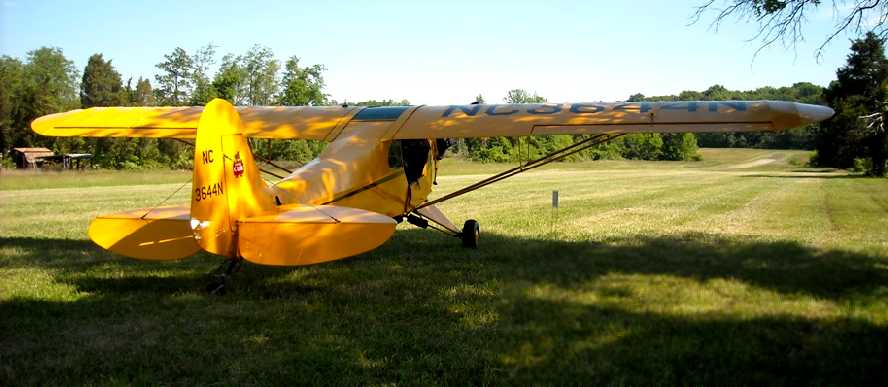
supercub, and it has an enormous glass screen in the front
cockpit.
I'm probably a Luddite, but I would prefer just an airspeed,
altimeter, tach, engine oil pressure & temp with a portable
intercom and a handheld VHF comm with an external antenna.
-
Colonel Sanders
- Top Poster
- Posts: 7512
- Joined: Sun Jun 14, 2009 5:17 pm
- Location: Over Macho Grande
Re: Actual training cost
It worked!I told you it is a pussy cat and just read the POH have a good look at it get in it find all the switches and levers ( which there are a lot of, and just fly the thing.
As usual, all the tall tales about it being a Fire Breathing Dragon (tm)
turned out to be complete nonsense.
It's important to look carefully at the source of the Fire Breathing
Dragon (tm) tales. Often the person would have difficulty landing
a 172 in a 15 knot crosswind, which I might add is stated by the
POH as being within the ability of an "average pilot".
I would love to check myself out in a DC-3 sometime - my father
says it is gentle and docile and slow compared to the Beech 18,
which I might add he flew without the locking tailwheel - but since
the DC-3 needs a type rating, a self-checkout is not likely to
happen - at least not north of the Rio Grande. Other places in the
world, there are no rules, at least none that I can discover.
I want to get DC-3 and C-46 type ratings. Not sure I can do that
in Canada. Probably do them in the USA on my FAA ATP then transfer
the ratings across to my Cdn ATPL.
I think I broke down and cried with joy the first time I ever had a student take notes
-
Colonel Sanders
- Top Poster
- Posts: 7512
- Joined: Sun Jun 14, 2009 5:17 pm
- Location: Over Macho Grande
Re: Actual training cost
Went poking in my father's logbook to look at his
Beech 18 and DC-3 time. Of course, at the insistence
of TC he had to stop logging time years ago, which
makes me kind of sad, but we all know that what TC
wants, TC gets.
Anyways, a few decades ago he made this summary
of types flown, which I thought was cool
Harvard
Maule
C172
C182
Cherokee
Musketeer
Fleet Canuck
Aeronca
Tripacer
Super Cub
Mooney
Misc
T-33 (1500 hrs)
F-86 (800 hrs)
F-104 (700 hrs)
L39
C-45
C-47
Apache
Navajo
North Star
Aztec
Queen Air
Duke
Seneca
Duchess
C310
C421
Aerostar
CF-100
Falcon 10 (aerobatic)
Citation (aerobatic)
It's sad today, that so few people will have a chance to
fly such a diverse selection of aircraft types.
Checking out on different types of aircraft is not something
that is discussed much in aviation circles, which is bizarre,
considering how important it is.
Beech 18 and DC-3 time. Of course, at the insistence
of TC he had to stop logging time years ago, which
makes me kind of sad, but we all know that what TC
wants, TC gets.
Anyways, a few decades ago he made this summary
of types flown, which I thought was cool
Harvard
Maule
C172
C182
Cherokee
Musketeer
Fleet Canuck
Aeronca
Tripacer
Super Cub
Mooney
Misc
T-33 (1500 hrs)
F-86 (800 hrs)
F-104 (700 hrs)
L39
C-45
C-47
Apache
Navajo
North Star
Aztec
Queen Air
Duke
Seneca
Duchess
C310
C421
Aerostar
CF-100
Falcon 10 (aerobatic)
Citation (aerobatic)
It's sad today, that so few people will have a chance to
fly such a diverse selection of aircraft types.
Checking out on different types of aircraft is not something
that is discussed much in aviation circles, which is bizarre,
considering how important it is.
Re: Actual training cost
JungianJugular wrote: EDIT: Imagine plugging a USB in a newer trainer with a glass cockpit prior to flight. After landing, remove USB and plug it into a computer. Flight data that was recorded is manifested into a visual representation of your entire flight through a computer based program. Am I dreaming??
This really shouldnt be too difficult or expensive.
I do not know if there are any aviation specific devices, but I am positive that there are automotive ones that would pretty easily be up to the task.
Just an accelerometer and a program to read the data, an Iphone has all the hardware you need to pull it off.
Re: Actual training cost
Edit
Last edited by gaamin on Sun Feb 03, 2013 6:43 pm, edited 1 time in total.
-
Shiny Side Up
- Top Poster
- Posts: 5335
- Joined: Tue Feb 17, 2004 5:02 pm
- Location: Group W bench
Re: Actual training cost
Its very unfortunate. If there was more interest in it there would be quite a bit more demand for it in this country and a lot more airplanes. Something has changed, and we're a long ways from the golden years of aviation where they used to make cars that emulated airplanes, now we make airplanes that emulate cars.Colonel Sanders wrote:Checking out on different types of aircraft is not something
that is discussed much in aviation circles, which is bizarre,
considering how important it is.
Last month was a good one for me, I got to add two new airplanes that I checked myself out on. Mind you they weren't anything that different or odd, and the one wasn't really new, it was just the taildragger version of a nose dragger I had a reasonable ammount of time in, a RV-7. The other, a Husky, wasn't really that different than a super cub aside from the gadgetry. Either way, something different is always interesting and makes it all worth while.

I also really like Budd's pirep page, but he's way behind putting new ones up.

-
Colonel Sanders
- Top Poster
- Posts: 7512
- Joined: Sun Jun 14, 2009 5:17 pm
- Location: Over Macho Grande
Re: Actual training cost
Budd Davisson, like many other people who have flown many
types, AFAIK don't talk about the actually skill/process/knowledge
that allows them to fly hundreds of different types safely, often
single seat!
And often I find graduates of test pilot schools nearly completely
incomprehensible. Are they actually speaking the Queen's English?!
I tried to put to paper some of my thoughts on this a while ago:
http://www.pittspecials.com/articles/Type.htm
http://www.pittspecials.com/articles/Di ... rcraft.htm
http://www.pittspecials.com/articles/Magnetos.htm
It's a combination of systems knowledge, and stick and
rudder skill. Both are kind of lost, arcane disciplines.
I was talking to a low-time pilot yesterday, and he asked
me if he should fly with somewhat distant instructor "X"
on aircraft "Y". My answer was Hell yes! A low-time pilot
needs to fly with as many different instructors on as many
different aircraft types as he possibly can. Each different
instructor will have something to teach - we all have our
pet peeves, or frankly fetishes - and flying different aircraft
types is simply wonderful for low-time pilots. Different
systems. Different cockpit layouts. Different visuals.
Different stick forces. All of the above force you to fly
differently and break out of the rote-repitition
procedure rut that you might not even know you are
stuck in!
types, AFAIK don't talk about the actually skill/process/knowledge
that allows them to fly hundreds of different types safely, often
single seat!
And often I find graduates of test pilot schools nearly completely
incomprehensible. Are they actually speaking the Queen's English?!
I tried to put to paper some of my thoughts on this a while ago:
http://www.pittspecials.com/articles/Type.htm
http://www.pittspecials.com/articles/Di ... rcraft.htm
http://www.pittspecials.com/articles/Magnetos.htm
It's a combination of systems knowledge, and stick and
rudder skill. Both are kind of lost, arcane disciplines.
I was talking to a low-time pilot yesterday, and he asked
me if he should fly with somewhat distant instructor "X"
on aircraft "Y". My answer was Hell yes! A low-time pilot
needs to fly with as many different instructors on as many
different aircraft types as he possibly can. Each different
instructor will have something to teach - we all have our
pet peeves, or frankly fetishes - and flying different aircraft
types is simply wonderful for low-time pilots. Different
systems. Different cockpit layouts. Different visuals.
Different stick forces. All of the above force you to fly
differently and break out of the rote-repitition
procedure rut that you might not even know you are
stuck in!


