http://www.youtube.com/watch?feature=pl ... O_c#t=162s
If they had just a bit more glass in the panel,
maybe they could have kept it straight.
Groundloop
Moderators: sky's the limit, sepia, Sulako, Right Seat Captain, lilfssister, North Shore
-
Colonel Sanders

- Top Poster

- Posts: 7512
- Joined: Sun Jun 14, 2009 5:17 pm
- Location: Over Macho Grande
-
Masters Off
- Rank 3

- Posts: 178
- Joined: Thu Nov 13, 2008 8:50 pm
- Contact:
Re: Groundloop
It looks like an indecisive, inherently unstable approach all the way through. I cant be sure about turbulance or gusty winds, but the guy just can't keep his airplane in a straight line...
-
Changes in Latitudes
- Rank 10

- Posts: 2396
- Joined: Sat Jan 26, 2008 8:47 am
- Location: The weather is here, I wish you were beautiful.


-
ReserveTank
- Rank 6

- Posts: 493
- Joined: Thu Nov 29, 2012 6:32 am
Re: Groundloop
Left seater appeared tense throughout the whole approach and "landing". Very jerky...
-
Old Dog Flying
- Rank (9)

- Posts: 1259
- Joined: Sun Jul 27, 2008 5:18 pm
-
iflyforpie
- Top Poster
- Posts: 8132
- Joined: Tue Apr 15, 2008 12:25 pm
- Location: Winterfell...
Re: Groundloop
That's just like a Maule on a bumpy day, definitely not looking as stable as your favourite 172 ... although, the IAS fluctuations clearly show the mechanical turbulence is quite strong. Even the stallwarning on final (well below the green) ... maybe too slow early in the flare ?
-
Colonel Sanders
- Top Poster
- Posts: 7512
- Joined: Sun Jun 14, 2009 5:17 pm
- Location: Over Macho Grande
Re: Groundloop
I really don't think the aircraft is much to blame for this.
Note that on final:
1) the stall warning is regularly going off on
final.
2) pilot - with slow airspeed - is sawing back
and forth on the control column (ailerons). He
continues to saw back and forth with the control
column EVEN AFTER TOUCHDOWN, when the
ailerons are going to be producing significant
adverse yaw. That's bad. You don't use the
ailerons for directional control at slow speed
(and after landing!!!) especially in a taildragger.
I don't think this pilot has a clue what the rudder
pedals are for. He drives that taildragger like a
car, sawing back and forth on the control column.
It's a pity no one ever taught him to use the rudder
pedals. I do like the gloves, though. Gotta get me
a pair of those.
Note that on final:
1) the stall warning is regularly going off on
final.
2) pilot - with slow airspeed - is sawing back
and forth on the control column (ailerons). He
continues to saw back and forth with the control
column EVEN AFTER TOUCHDOWN, when the
ailerons are going to be producing significant
adverse yaw. That's bad. You don't use the
ailerons for directional control at slow speed
(and after landing!!!) especially in a taildragger.
I don't think this pilot has a clue what the rudder
pedals are for. He drives that taildragger like a
car, sawing back and forth on the control column.
It's a pity no one ever taught him to use the rudder
pedals. I do like the gloves, though. Gotta get me
a pair of those.
Re: Groundloop
That really begins to show once they got slower in speed, ... gradually throughout this straight-in descent from 1000AGL. Neat article about the adverse yaw (how it "all falls apart at slow speed").Colonel Sanders wrote:I don't think this pilot has a clue what the rudder
pedals are for.
Re: Groundloop
From your nice link CS:
Another thing:
So if someone use his control wheel on the ground like he will do in a car to correct his direction....It will go the other way around and is setting himself up for a nice ground loop.
I think that's what is happening in the video, he probably tried to correct his direction after touch down....Like if he was driving a car.Unfortunately for many students, who have spent decades driving a car, the learning factor of primary has taught them that when they want the nose of a vehicle to go right, they spin the steering wheel to the right.
Another thing:
On the DC-3T, once you set your wheels the ground with this kind of big ailerons and big wing span, any down aileron will start acting like a spoiler. The "measurable adverse yaw!" as it says.on the front side of the power curve, the ailerons behave pretty well. But when the aircraft is slowed down to the bottom and on the back side of the power curve, they can be expected to produce measurable adverse yaw.
So if someone use his control wheel on the ground like he will do in a car to correct his direction....It will go the other way around and is setting himself up for a nice ground loop.
-
Colonel Sanders
- Top Poster
- Posts: 7512
- Joined: Sun Jun 14, 2009 5:17 pm
- Location: Over Macho Grande
Re: Groundloop
I know. From my perspective, learning to deal with
adverse yaw is a fundamental part of ab inition training.
I wonder about this guy flying the Maule. In the USA,
he would be legally required to get a tailwheel endorsement
from a flight instructor, after demonstrating some basic
level of proficiency, which in the video he surely wasn't. I
suppose it was possible he did his tailwheel training
(and got signed off on) something really slow and simple
and easy, like a cub on grass, with no crosswind.
A Maule is not a fire-breathing dragon, especially the
later ones with the huge vertical fin and tiny rudder. A lot
of directional stability there, and pretty easy to take off
and land, especially when the wind is right down the runway.
I wonder if the guy in the video:
1) never received any dual in the Maule, or
2) received dual in the Maule from an incompetent instructor
that didn't understand how to use the rudder, or how to teach
it, or
3) received dual in the Maule from a competent instructor, but
the student was simply incapable of learning, regardless of who
taught him, or how long.
adverse yaw is a fundamental part of ab inition training.
I wonder about this guy flying the Maule. In the USA,
he would be legally required to get a tailwheel endorsement
from a flight instructor, after demonstrating some basic
level of proficiency, which in the video he surely wasn't. I
suppose it was possible he did his tailwheel training
(and got signed off on) something really slow and simple
and easy, like a cub on grass, with no crosswind.
A Maule is not a fire-breathing dragon, especially the
later ones with the huge vertical fin and tiny rudder. A lot
of directional stability there, and pretty easy to take off
and land, especially when the wind is right down the runway.
I wonder if the guy in the video:
1) never received any dual in the Maule, or
2) received dual in the Maule from an incompetent instructor
that didn't understand how to use the rudder, or how to teach
it, or
3) received dual in the Maule from a competent instructor, but
the student was simply incapable of learning, regardless of who
taught him, or how long.
-
Colonel Sanders
- Top Poster
- Posts: 7512
- Joined: Sun Jun 14, 2009 5:17 pm
- Location: Over Macho Grande
Re: Groundloop
depressing video
I double face-palmed when he was still on final. I
probably have a different perspective on these sorts
of events than the "Good Job!" crew, because I feel
really sorry for the airplane.
Before "White Gloves" gave it his special treatment,
it was a pretty nice airplane.
I get unhappy when people roll perfectly functioning
airplanes up into a ball, well, "Just because". Give me
on frikken dual flight with White Gloves ...

I double face-palmed when he was still on final. I
probably have a different perspective on these sorts
of events than the "Good Job!" crew, because I feel
really sorry for the airplane.
Before "White Gloves" gave it his special treatment,
it was a pretty nice airplane.
I get unhappy when people roll perfectly functioning
airplanes up into a ball, well, "Just because". Give me
on frikken dual flight with White Gloves ...
Last edited by Colonel Sanders on Sun Feb 24, 2013 8:30 am, edited 1 time in total.
Re: Groundloop
In another thread, there are some un-nerving videos edited together to remind the taildragger pilot to be to get competent training. I'll have admit that I have never had competent taildragger training myself, just a few pointers from taildragger pilots who all told me I fly fine. With more experience, I hope to share their confidence. In 350 hours, I have never groundlooped, though once thought I might. I took the jumper dumper 185 off the runway exactly where I wanted to, but not under control. When I checked, it had zero tailwheel steering, so once I slowed the roll out, the rudder was in effective. That was luck, and I insisted on tail wheel repairs.
What has probably kept me straight so far has simply been the fear of getting it wrong, and keeping the plane as close as I could on the centerline. With this in mind, I disagree with a statement in the training video that the taildragger pilot needs a wide runway. No, he/she needs a very narrow one, so as to not allow any tolerance of drift/excursion.
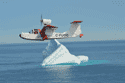
The Teal is a demanding taildragger compared to all but one other I have flown. It allows me 8 feet off each wingtip float to a runway light. I once thought I'd taken one out, but I missed it by that much. Since then, I've kept very precisely to the centerline. I'm happy if my tracks in the grass are all within 2 feet of each other. I seems to require near full application of the rudder during the rollout, but it will do it. Though landings require attention all the way to the stop, that attention is rewarded with straight rollouts.
Pilots of any aircraft who have the luxury of a wide runway suffer a disadvantage. They are not required to keep it straight to stay on the runway, 'cause there is so much runway!
What has probably kept me straight so far has simply been the fear of getting it wrong, and keeping the plane as close as I could on the centerline. With this in mind, I disagree with a statement in the training video that the taildragger pilot needs a wide runway. No, he/she needs a very narrow one, so as to not allow any tolerance of drift/excursion.
The Teal is a demanding taildragger compared to all but one other I have flown. It allows me 8 feet off each wingtip float to a runway light. I once thought I'd taken one out, but I missed it by that much. Since then, I've kept very precisely to the centerline. I'm happy if my tracks in the grass are all within 2 feet of each other. I seems to require near full application of the rudder during the rollout, but it will do it. Though landings require attention all the way to the stop, that attention is rewarded with straight rollouts.
Pilots of any aircraft who have the luxury of a wide runway suffer a disadvantage. They are not required to keep it straight to stay on the runway, 'cause there is so much runway!
-
Colonel Sanders
- Top Poster
- Posts: 7512
- Joined: Sun Jun 14, 2009 5:17 pm
- Location: Over Macho Grande
Re: Groundloop
What do you do, when two facepalms isn't enough?I have never had competent taildragger training
I'm really sorry about that. Obviously you taught yourself
fast enough to avoid an accident, which is not what we should
use as a flight training model in Canada.
Yeah, tailwheels wear out. Springs stretch, the movingit had zero tailwheel steering, so once I slowed the roll out, the rudder was in effective ... I insisted on tail wheel repairs
parts wear and break. A smart operator keeps spare
parts on the shelf for rapid replacement.
But not all operators are smart. They have no spare
parts, and then arguments ensue about how bad the
tailwheel is, before it is no longer serviceable/airworthy.
It's a grey area, and one that the many legal beagles
here will certainly want to quickly wade into.
In the real world - which AvCan certainly is not - what
an experienced taildragger pilot does, when the tailwheel
is sh1t, is to wheel land, and keep the tailwheel up with
forward stick (and maybe even a bit of brake and power)
until you are at taxiing speed. Or stopped. Then, the
tail comes down. You do that until the parts come in.
Free advice on tailwheel repairs ... as the hours go by,
and especially if people forget to grease them, all sorts
of moving parts wear in a tailwheel. It just gets junky
and loose. Jack the tail up, take the weight off the
tailwheel, and wiggle it around.
You can try to adjust it, and get on the treadmill of
ordering parts, and taking it apart, and replacing the
worn parts, and finding more worn parts, and then
ordering them, and taking it apart again, and putting
it together again with the 2nd order of parts, and
it's still loose and junky.
What a waste of time and money. Just order a
new entire tailwheel assembly that bolts onto
the big spring that connects to the aircraft.
PS Slop in the tailwheel doesn't cause a shimmy,
but it will help it once it starts. That's a different
subject.
It's important to realize that homebuilts often haveThe Teal is a demanding taildragger
very challenging handling characteristics which would
not be permitted in a certified aircraft. I have flown
some real doozies. For the youngsters:
http://en.wikipedia.org/wiki/Duesenberg ... gical_note
Re: Groundloop
Yes, I have found that too. The Teal must have been evaluated by a very tailwheel competent FAA test pilot, who approved it for certification, because in today's pilot skill world I would not pass it!homebuilts often have very challenging handling characteristics which would
not be permitted in a certified aircraft.
-
Colonel Sanders
- Top Poster
- Posts: 7512
- Joined: Sun Jun 14, 2009 5:17 pm
- Location: Over Macho Grande
Re: Groundloop
Same thing with the Pitts - another homebuilt that was
eventually certified. Here are some hilarious quotes from
the Pitts S-2B POH:
century. Note "entirely normal" twice in two sentences. The Pitts
is many things, but I assure you "entirely normal" is not one of them!
If I was making the rules, I would require a type rating for the Pitts.
I have flown many aircraft that require a type rating that are a whole
lot more docile.
IIRC the requirements for an individual type rating are:
1) Vso over 80 knots
2) Vne over 250 knots
I would add a third
3) underwear racing stripes. Eg Pitts, MU-2, Cassutt.
PS If you were thinking about legally changing your name
to something, "White Gloves", despite his legendary face-palm,
is actually pretty cool name. Catchy. But then again, so is
"Conquistador". No first or last name. You'd be like Seal
or Cher - just Conquistador.
eventually certified. Here are some hilarious quotes from
the Pitts S-2B POH:
Which has to be one of the Top Ten Understatements of the 20thThe Pitts is a tail wheel type aircraft and is entirely normal
in this respect ... The Pitts ground handling qualities are typical of the
tail wheel type, and entirely normal in this respect. Because of their
popularity in recent years, you may be considerably more familiar
with tricycle gear handling qualities than tail wheel types
century. Note "entirely normal" twice in two sentences. The Pitts
is many things, but I assure you "entirely normal" is not one of them!
If I was making the rules, I would require a type rating for the Pitts.
I have flown many aircraft that require a type rating that are a whole
lot more docile.
IIRC the requirements for an individual type rating are:
1) Vso over 80 knots
2) Vne over 250 knots
I would add a third
3) underwear racing stripes. Eg Pitts, MU-2, Cassutt.
PS If you were thinking about legally changing your name
to something, "White Gloves", despite his legendary face-palm,
is actually pretty cool name. Catchy. But then again, so is
"Conquistador". No first or last name. You'd be like Seal
or Cher - just Conquistador.
Re: Groundloop
Forgive a tricycle gear pilot....what actaully causes the ground loop to develop? Dont these AC have effective rudders and steerable tailwheeels?
-
Colonel Sanders
- Top Poster
- Posts: 7512
- Joined: Sun Jun 14, 2009 5:17 pm
- Location: Over Macho Grande
Re: Groundloop
It's actually very simple: www.pittspecials.com/articles/Tailwheel.htm
A nosewheel aircraft has it's C of G (really C of M)
ahead of the main tires, so if it gets a little sideways
on the runway, the C of M ahead of the main tires
pulls it straight.
However a taildragger has it's C of M behind the
main tires, so if it gets a little sideways on the runway,
the C of M pushes it even more sideways. It's unstable,
and the only thing keeping it from a groundloop is the
pilot's feet. Like balancing a broom on your finger.
Both types of aircraft fly just fine in the air. It's only
when the tires touch the pavement, that it gets dicey.
An airplane is a horrible ground vehicle, and this is true
in spades, the faster it goes. Especially for a taildragger.
A nosewheel aircraft has it's C of G (really C of M)
ahead of the main tires, so if it gets a little sideways
on the runway, the C of M ahead of the main tires
pulls it straight.
However a taildragger has it's C of M behind the
main tires, so if it gets a little sideways on the runway,
the C of M pushes it even more sideways. It's unstable,
and the only thing keeping it from a groundloop is the
pilot's feet. Like balancing a broom on your finger.
Both types of aircraft fly just fine in the air. It's only
when the tires touch the pavement, that it gets dicey.
An airplane is a horrible ground vehicle, and this is true
in spades, the faster it goes. Especially for a taildragger.
Re: Groundloop
Thanks. A little tailwheel time is on my flying list one day. Regretfully? Though I just bought a 182.....so still in the nose wheel camp.
-
Colonel Sanders
- Top Poster
- Posts: 7512
- Joined: Sun Jun 14, 2009 5:17 pm
- Location: Over Macho Grande
Re: Groundloop
Congratulations! There's nothing wrong with a nosewheel:
I've never even seen a tailwheel jet
I've never even seen a tailwheel jet
-
white_knuckle_flyer
- Rank 3
- Posts: 175
- Joined: Wed Jan 16, 2013 8:43 am
Re: Groundloop
Yeah, this pilot definitely appeared to be sawing some wood with that control column. ( Would I do any better ? Probably not. ) I wish the sound was included with the clip....I'd like to hear what was going on...expletives and all.
At first view, I couldn't even tell when the wheel(s) touched down. It wasn't until they were sideways that I figured out I had missed it.
In the world of groundloops, where does this one rate on a scale of 1 to 10 in terms of severity or potential for damage to airplane or persons ?
At first view, I couldn't even tell when the wheel(s) touched down. It wasn't until they were sideways that I figured out I had missed it.
In the world of groundloops, where does this one rate on a scale of 1 to 10 in terms of severity or potential for damage to airplane or persons ?
Re: Groundloop
Looks like fun.
It's actually a 182 RG I bought. I'm in the import process on it. One attribute I have read, I hope to train some dual on, is it can get a touch squirrely in X - winds on the runway, as the tires are small. It's a new type AC for me.
I have a bit of 172 RG time, flown it into some fair X winds without too much difficulty. Just assertive
with rudder when needed. I believe the tires on the 182 RG are the same, its just a lot heavier at gross. Also a heavier nose than I'm used to, so I've heard some with this type AC, close throttle over threshold, then add just a touch in the flare to keep nose up....thoughts on this, fire away!
It's actually a 182 RG I bought. I'm in the import process on it. One attribute I have read, I hope to train some dual on, is it can get a touch squirrely in X - winds on the runway, as the tires are small. It's a new type AC for me.
I have a bit of 172 RG time, flown it into some fair X winds without too much difficulty. Just assertive
with rudder when needed. I believe the tires on the 182 RG are the same, its just a lot heavier at gross. Also a heavier nose than I'm used to, so I've heard some with this type AC, close throttle over threshold, then add just a touch in the flare to keep nose up....thoughts on this, fire away!
-
Colonel Sanders
- Top Poster
- Posts: 7512
- Joined: Sun Jun 14, 2009 5:17 pm
- Location: Over Macho Grande
Re: Groundloop
A groundloop rarely injures any occupants. Heck, I've
seen a cartwheeled Pitts, and the guy was ok. However,
afterwards you may want to kill yourself, and if I am
successful in hunting you down ... (j/k)
A groundloop might not do any damage, if it is done
very slowly. No contact of the prop or wingtip or
aileron. Only damage will be a little rubber scrubbed
off the tires and a skidmark on the pilot's underwear.
A faster groundloop might end up with contact of the
wingtip. Or prop. The gear might sustain damage -
either obvious collapse, or quite common, being bent
which nobody repairs.
Bent landing gear can make a tailwheel aircraft really
unpleasant to handle on the ground, with it's wild toe-in
or toe-out. For some reason, nobody ever bothers
to measure it, after a groundloop.
When you have a prop strike, not only is the prop trash,
but so is the engine. A "sudden strike" requires that the
engine be torn down, which is a major overhaul 99% of
the time. In the old days we would dial the crank and
slap a new prop on, but not any more.
Touching a wingtip can be dicey. The damage might just
be cosmetic, or it could have bent (and cracked) the spar.
A friend of mine - Joe B - is now dead, because he groundlooped
his taildragger, and scraped a wing. He took off again without
doing an inspection, and the now-cracked spar broke, the
wing departed, and he came down like a maple seed. That
was the end of Joe.
seen a cartwheeled Pitts, and the guy was ok. However,
afterwards you may want to kill yourself, and if I am
successful in hunting you down ... (j/k)
A groundloop might not do any damage, if it is done
very slowly. No contact of the prop or wingtip or
aileron. Only damage will be a little rubber scrubbed
off the tires and a skidmark on the pilot's underwear.
A faster groundloop might end up with contact of the
wingtip. Or prop. The gear might sustain damage -
either obvious collapse, or quite common, being bent
which nobody repairs.
Bent landing gear can make a tailwheel aircraft really
unpleasant to handle on the ground, with it's wild toe-in
or toe-out. For some reason, nobody ever bothers
to measure it, after a groundloop.
When you have a prop strike, not only is the prop trash,
but so is the engine. A "sudden strike" requires that the
engine be torn down, which is a major overhaul 99% of
the time. In the old days we would dial the crank and
slap a new prop on, but not any more.
Touching a wingtip can be dicey. The damage might just
be cosmetic, or it could have bent (and cracked) the spar.
A friend of mine - Joe B - is now dead, because he groundlooped
his taildragger, and scraped a wing. He took off again without
doing an inspection, and the now-cracked spar broke, the
wing departed, and he came down like a maple seed. That
was the end of Joe.
-
Colonel Sanders
- Top Poster
- Posts: 7512
- Joined: Sun Jun 14, 2009 5:17 pm
- Location: Over Macho Grande
Re: Groundloop
Ok. On a 150/152, trimming is optional. You cana heavier nose than I'm used to
muscle it around. It's like a kid's toy, and the range
of speeds is pretty small.
Now you move to a 172. A little heavier in the nose.
You can skip trimming, but it's going to get heavy on
the control column in the flare.
Now you move to a 182 or 206. If you do not trim
on final, after you have slowed down, when you slow
down even more in the flare, the pounds of force required
to hold the control column back in the flare can surprise
people, and it is very common for the 182/206 to have
their nosewheels dropped hard onto the runway.
Whenever you buy one of these aircraft, pop the cowls
off and check for any missing rivets from the nosegear
to the firewall. I have even seen wrinkled firewalls from
people dropping the nosewheel on hard!
All you have to do, is trim on final. Some aircraft that I
fly with a "coolie hat" electric trim on the control column,
I will trim in the flare because I am lazy. Some people
don't like that, but it works for me.


