Probably the only plane out there ever to have been converted from a turbine to a piston....!


Wiki:
The Canadair CP-107 Argus (CL-28) was a marine reconnaissance aircraft designed and manufactured by Canadair for the Royal Canadian Air Force (RCAF) and Canadian Forces (CF). In its early years, the Argus was reputedly the finest anti-submarine patrol bomber in the world.[3] The Argus served throughout the Cold War in the RCAF's Maritime Air Command and later the CF's Maritime Air Group and Air Command.
Canadair began work on the CL-28 in April 1954 and at the time it was the largest aircraft built in Canada. The hybrid design was derived from the Bristol Britannia transport, having the same wings, tail surfaces and landing gear except for being "Americanized" - meaning that it used the same general design, but changing the British materials and standard parts for North American ones.
The fuselage was completely redesigned by Canadair, going from the pressure cabin of the Britannia to a non-pressurised one with bomb bays fore and aft of the wings. The powerplant was also changed from the Bristol Proteus turbo-prop engines to Wright R-3350 compound (piston) engines, which had lower fuel consumption necessary for extended missions at low level
Operational history
The Argus replaced the RCAF Lancaster and Neptune aircraft types previously flown in the maritime roles. One of the most effective anti-submarine warfare (ASW) aircraft of its day, the Argus was a mainstay for the RCAF. A large amount of equipment was carried, including: search radar, sonobuoys, electronic counter measures), explosive echo ranging (EER) and magnetic anomaly detector (MAD). Up to 8,000 lb (3,632 kg) of weapons could be carried in the bomb bays, including torpedoes, bombs, mines and depth charges.
A flight crew of fifteen consisting of three pilots, three navigators (Observer Long range), two flight engineers and 6 radio officers (observer rad) until the early sixties when the crew included both commissioned officers (tactical navigator/radio navigator and non commissioned officers (observers), the number of which was dependent on the mission. Four crew bunks and a galley were provided to extend the efficiency of the crew on long patrols (average 18 hrs). The CL-28 had an endurance of approximately 26½ hours with full armament. An Argus flown by 407 Maritime Patrol Squadron held the Canadian military record of slightly over 31 hours for the longest flight by an unrefuelled aircraft.[citation needed] This record stood for almost 20 years until broken by the Rutan Voyager experimental aircraft which circled the globe unrefuelled.
The principal difference between the Mark I and Mark II was primarily in the different navigation, communication and tactical electronic equipment fitted internally. Externally, the Mk II exhibited a redesigned smaller nose radome and additional ECM antenna above the fuselage.[citation needed]
The Argus flew its last service mission on 24 July 1981, and was replaced by the CP-140 Aurora.
The original...Bristol Britannia:

Or the Canadair CL-44(at First):
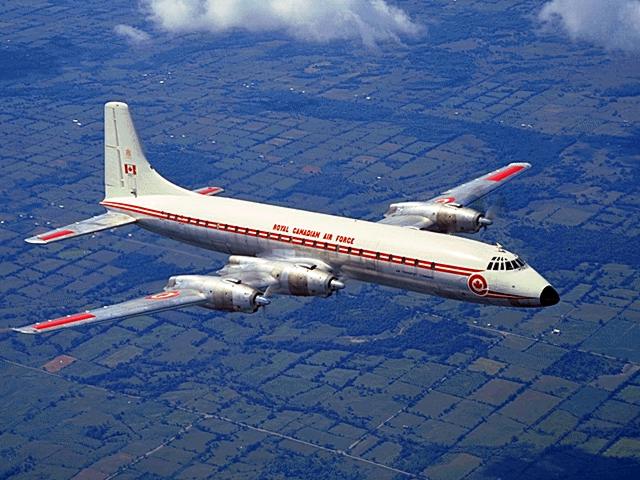
Notice the new cockpit windows...originals rejected to fly in America(too small):

Sabotaged by Diefenbaker, Canadair had to give away all it's CL-44 to George Bachelor(of Arrow Air and Nationair fame)
for the price of beer can aluminium...He sold it to Flying Tiger et al and the CL-44 formed the launching base
of the big Air Cargo business in the United States and then the world...

In the 1950s, Canadair had acquired a licence to build the Bristol Britannia airliner. Their first use of the licence was to build the heavily modified Canadair CL-28 Argus patrol aircraft, that combined the Britannia's wings and tail sections with a new fuselage and engines. The resulting aircraft had lower speed and altitude, but had two bomb bays and greatly extended loiter times.
With an RCAF requirement for a replacement for its C-54GM North Star (an extensive redesign of the Douglas C-54 Skymaster, that among many changes, was powered by Merlin engines) fleets, Canadair began work on a long range transport primarily intended to provide personnel and logistics support for Canadian Forces in Europe. In January 1957 Canadair received a contract for eight aircraft, later increased to 12. The RCAF designation for the new design was the CC-106 Yukon, while the company's civilian variant was known as the CL-44-6. In company parlance the CL-44 was simply "the Forty-Four."
The RCAF had specified the CL-44 to be equipped with Bristol Orion engines. When the British Ministry of Supply canceled the Orion program, the RCAF revised the specifications to substitute the Rolls-Royce Tyne 11. The CL-44 fuselage was lengthened making it 12 ft 4 in (3.75 m) longer than the Britannia 300 with two large cargo doors added on the port side on some aircraft, while the cabin was pressurised to maintain a cabin altitude of 2,400 m at 9,000 m (30,000 ft). The design used modified CL-28 wings and controls. The Yukon could accommodate 134 passengers and a crew of nine. In the casualty evacuation role it could take 80 patients and a crew of 11.
The rollout of the Yukon was a near-disaster when the prototype could not be pushed out of the hangar since the tail was unable to clear the hangar doors. The first flight took place 15 November 1959 at Cartierville Airport. During test flights many problems were encountered from complete electrical failure to engines shaking loose and almost falling off. Rolls-Royce had problems delivering engines resulting in the sarcastically named "Yukon gliders" being parked outside Canadair as late as 1961.
Initially, the CL-44-6 was produced for the RCAF as the CC-106 Yukon. Once initial problems were resolved, in RCAF service the Yukon performed well and in December 1961, a Yukon set a world record for its class when it flew 6,750 mi (10,860 km) from Tokyo to RCAF Station Trenton, Ontario, in 17 hours, three minutes at an average speed of 400 mph (640 km/h). Later, a Yukon set a new record staying airborne for 23 hours and 51 minutes. These records were unbroken until bettered by the Boeing 747SP in 1975. By the time of their retirement, Yukons had flown 65 million miles, 1.5 billion passenger miles and 360 million ton-miles. The CL-44D4 was briefly considered for purchase by the USAF in the 1960s but the project was never culminated due to political backlash in Canada and the US.[1] The USAF purchase of the CL-44 was complicated by two factors. It came in the aftermath of the cancellation of the Avro CF-105 Arrow and involved a "swap deal" wherein 100 F-101 Voodoo fighters were obtained in return for a contract for 232 CL-44-D4 transports for the Military Air Transport Service (MATS). The political controversy that resulted led to problems for both a Quebec-based company receiving a contract so soon after an Ontario-based company had lost a major contract. The USAF also quickly found that buying a foreign aircraft was not easy when American companies wanted the business and relinquished the contract to Canadair, awarding an order to Boeing for the KC-135 Stratotanker.
On the cargo aircraft variant CL-44D4 the entire tail section hinged. It could be opened using hydraulic actuators to load large items quickly. An inflatable seal at the hinge-break enabled cabin pressure to be maintained, and eight hydraulic-operated locks assured structural integrity. The tail could be opened from controls within the tail in 90 seconds. The flight controls at the joint were maintained by a system of push pads.
The CL-44D4 was the first large aircraft to be able to 'swing' its tail, although some small naval aircraft had this feature to ease storage. These, however, required rigging before flight. There were only four original customers who bought and operated the CL-44D4.
Loftleiðir was the only passenger operator of the CL-44J, variant of CL-44D4 stretched on request by Canadair. It was the largest passenger aircraft flying over the Atlantic ocean at that time. Loftleiðir marketed the CL-44J under the name "Rolls-Royce 400 PropJet". This led to the confusion that the CL-44J is sometimes referred to as the Canadair-400. Loftleiðir Icelandic Airlines merged with Flugfelag Islands in 1973 and became today's Icelandair.
In 1981 a Baku, Azerbaijan-based Soviet Union interceptor deliberately rammed an Argentine Canadair CL-44 from Transporte Aéreo Rioplatense, killing the three Argentines and one Briton on board; the aircraft was delivering arms from Israel to Iran.[2]