Out of respect to thread drift, I shall open a somewhat parallel topic to the Vmc discussion. More broadly, WITHIN the limitations and recommended practices for the given aircraft, and the appropriate training curriculum, is it adequate to simply warn the candidate pilot away from certain maneuvers, erring to the side of caution?
A main stream example could certainly be spinning. The student chooses to receive training in a type not spin certified (let's say a C182) does that mean that the student should never be exposed to spins at all? Or, never actual Vmc, because the type advises against approach to those conditions?
The training stream will allow a candidate through with a lesser/lessening experience, and this could be perceived as an element of dumbing down the training. I was trained spins back in the day. Apparently that is not longer done - did planes stop spinning when carelessly flown? Or, was there just a rising sense of a poor risk vs benefit to the training?
I was not trained in the yahoo scheme, I learned at Brampton Flying Club, which is well reputed for good, comprehensive training. We trained the curriculum, a little more here and there, but not much more - but nothing less either. I immediately pursued more training upon PPL. I also started hanging around with other pilots for better or worse. I saw some extreme flying - again, for better or worse - but I learned. I learned some things not to attempt, even though they had just been demonstrated. I learned to do as I was advised - but, also why, based upon vastly more experienced pilots showing me that much more skills development was (and still is) possible.
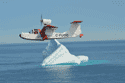
To my amusement, while test flying a BFC 172 not too many years ago, I asked the instructor BFC had sent to "check me out" (for a flight test), what he would like to see me do for a checkout (the flight test was done - the plane fine). To my surprise his reply to my question was: "A roll?". "Nope." I thought he was trying to lure me into irresponsible flying. Then I realized, he just wanted to see a roll. He did not that day. But, I reminded myself, that while a passenger with an aerobatic pilot, in his 185 amphibian, I asked if a plane like that would roll - it does! But would I try? Nope! But, I learned that I always have more to learn, and a skill set to continue to develop.
I think that an important part of what a pilot shall learn is discipline. The fact that a plane perhaps can do something, does not mean it should be attempted. We're going to license or endorse a candidate, when the instructor thinks that the candidate might go "test flying" when sent on their own? We have to have confidence that limitations and procedures are respected - or more training is required!
But, to balance that, if a pilot is to be declared type or class competent, and they have not actually done the curriculum maneuvers, within the limitations of that aircraft, I think that they should at least have received a demonstration during training. If the aircraft type does not permit that demonstration within it's limitations, and that item is a training element, the candidate needs to train in another type for that portion of the training....
These experiences for candidate pilots will assure that they have balanced confidence, and a sense of appropriate respect for aircraft. And, should they become instructors, they build that broader experience on a firm basis, so as to not train diminishing skill sets, with growing inexperience in the training industry.
With all the foregoing, I do respect and defer to instructors, and established curriculum. I am not an instructor.
To warn away, simulate or demonstrate...
Moderators: sky's the limit, sepia, Sulako, Right Seat Captain, lilfssister, North Shore
Re: To warn away, simulate or demonstrate...
Worth mentioning the bit in the Instructor Guide:
Teach your students to have mastery over the aircraft; to fly with verve and spirit to the limit of the aircraft's flight envelope; to know what they can and cannot do; but draw a very definite distinction between intelligent confidence and foolhardiness.
For instance, I think blanket bans on eg using more than 30 degrees of bank in the circuit aren't within the spirit of this guideline. I hate the idea of teaching a student pilot to be a student pilot; student pilots should be taught to be pilots, period.
Does that address the issue?
Teach your students to have mastery over the aircraft; to fly with verve and spirit to the limit of the aircraft's flight envelope; to know what they can and cannot do; but draw a very definite distinction between intelligent confidence and foolhardiness.
For instance, I think blanket bans on eg using more than 30 degrees of bank in the circuit aren't within the spirit of this guideline. I hate the idea of teaching a student pilot to be a student pilot; student pilots should be taught to be pilots, period.
Does that address the issue?
-
Colonel Sanders
- Top Poster

- Posts: 7512
- Joined: Sun Jun 14, 2009 5:17 pm
- Location: Over Macho Grande
Re: To warn away, simulate or demonstrate...
I thought it was no more than 19 degrees of bankusing more than 30 degrees of bank in the circuit
because that's the square root of 360 which is how
many degrees of heading change there is in a circuit?
Q.E.D.

Re: To warn away, simulate or demonstrate...
IMHO - There is no substitute for experiencing the real thing. The real deal burns it and the correct reactions into your memory for a long time. Obviously you cant teach everything in every a/c but a pilot should seek out the proper a/c and instructors so that they don't learn the first time with passengers.
On the vmc issue, i am sure that snap roll type departures in an appropriate a/c would help get a bit of a feel for what yaw does at low airspeed and high aoa without the risk of doing it in a high polar moment of inertia twin.. But how many folks flying twins have ever done a full snap?
On the vmc issue, i am sure that snap roll type departures in an appropriate a/c would help get a bit of a feel for what yaw does at low airspeed and high aoa without the risk of doing it in a high polar moment of inertia twin.. But how many folks flying twins have ever done a full snap?
Re: To warn away, simulate or demonstrate...
19 times 19 is three hundred and sixty one.Colonel Sanders wrote:I thought it was no more than 19 degrees of bankusing more than 30 degrees of bank in the circuit
because that's the square root of 360 which is how
many degrees of heading change there is in a circuit?
Q.E.D.
-
Colonel Sanders
- Top Poster
- Posts: 7512
- Joined: Sun Jun 14, 2009 5:17 pm
- Location: Over Macho Grande
Re: To warn away, simulate or demonstrate...
And that, my friends, illustrates the difference between
an engineer and a mathematician
an engineer and a mathematician
Re: To warn away, simulate or demonstrate...
... Mathematicians are one degree higher. 
-
Big Pistons Forever
- Top Poster
- Posts: 5956
- Joined: Wed Feb 18, 2004 7:17 pm
- Location: West Coast
Re: To warn away, simulate or demonstrate...
Maybe things are different elsewhere but I don't see a lack of "flying to the edge of the envelope" at FTU's, in fact I see the opposite. Bored instructors are doing less than smart things in "hey watch this" moments. Unfortunately they pretty much universally don't have the skills to cash the cheques their egos are writing.
I don't like to see this because this lack of discipline and the exercise of good airmanship sends the worse possible message to students
I don't let my PPL students exceed 30 deg of bank in the circuit because if you stay ahead of the airplane and anticipate the winds and traffic there is never any need to turn harder. If the student misses a turn and you let him/her crank it around you are rewarding their bad judgement.
However in the case of the forced approach I want the student to do what ever it takes to get to the field. If that means a low level steeply banked turn then you do what you have to do. Obviously I am going to debrief how this turn could have been avoided but I want the student to have the attitude that they are not going to give up until the dust cloud has settled.
Ultimately it is not do you let the student bank steeply or not, the important part is teaching the the skills to judge when it is appropriate and when it is not.
Saying I have dumbed down flying training because I don't let the student bank more than 30 degs in the circuit IMO totally misses the point and reflects a pretty profound lack of understand of ab initio flight training.
As for the spin question. I just wish this one would go away. I teach spins all the time as part of my introductory aerobatics course. That is because a spin is an aerobatic manoever and should not IMO be practiced in isolation from aerobatic attitudes and orientations by non aerobatically qualified instructors
As for the argument that PPL's need spin training so they can recover if they get into one ? Well when both TC and the FAA moved the emphasis from spin recovery training to stall/spin avoidance training the GA fatal spin accident rate decreased and the majority of the remaining accidents occurred at such a low altitude that recovery was impossible once the aircraft entered the spin
For your average PPL flying a certified airplane to get to where they need to apply the POH spin recovery technique in order to recover from a spin they would have had to be stupid times 4
1) They let the aircraft get into slow flight and did nothing
2) They let the aircraft stall and then did nothing
3) After the aircraft stalled they let the aircraft yaw and did nothing
4) They allowed to aircraft to continue to roll and yaw for more than a 180 degrees of heading change and did nothing.
It is only until after stupid step No 4 that recovery of the aircraft can't be effected by simply applying forward stick and applying rudder opposite any yaw.
The bottom line from my POV is simple. The best thing you can to make sure a PPL won't kill him self due to a stall/spin accident is to make sure by training and repeated practice that the automatic and instinctive reaction to any impending or occuring departure from controlled flight is stick forward, power as required(usually full), straight with the rudder.
Finally my metric for piloting "goodness" is the level of smoothness I see. Flying smoothly is IMO the hardest skill to master. It is easy to yank and bank but it is hard to manoever so that the start and stop of every manoever is almost imperceptible with each heading and altitude change finishing precisely on speed and altitude with no wobbles or wiggles.
You as an instructor are IMO ultimately doing a student a much bigger favour by being an attitude and airspeed Nazi, insisting on accurate and precise flying, and expecting an anticipation of where the aircraft is going, then by examining every sharp corner of the aircraft manoevering envelope.
I don't like to see this because this lack of discipline and the exercise of good airmanship sends the worse possible message to students
I don't let my PPL students exceed 30 deg of bank in the circuit because if you stay ahead of the airplane and anticipate the winds and traffic there is never any need to turn harder. If the student misses a turn and you let him/her crank it around you are rewarding their bad judgement.
However in the case of the forced approach I want the student to do what ever it takes to get to the field. If that means a low level steeply banked turn then you do what you have to do. Obviously I am going to debrief how this turn could have been avoided but I want the student to have the attitude that they are not going to give up until the dust cloud has settled.
Ultimately it is not do you let the student bank steeply or not, the important part is teaching the the skills to judge when it is appropriate and when it is not.
Saying I have dumbed down flying training because I don't let the student bank more than 30 degs in the circuit IMO totally misses the point and reflects a pretty profound lack of understand of ab initio flight training.
As for the spin question. I just wish this one would go away. I teach spins all the time as part of my introductory aerobatics course. That is because a spin is an aerobatic manoever and should not IMO be practiced in isolation from aerobatic attitudes and orientations by non aerobatically qualified instructors
As for the argument that PPL's need spin training so they can recover if they get into one ? Well when both TC and the FAA moved the emphasis from spin recovery training to stall/spin avoidance training the GA fatal spin accident rate decreased and the majority of the remaining accidents occurred at such a low altitude that recovery was impossible once the aircraft entered the spin
For your average PPL flying a certified airplane to get to where they need to apply the POH spin recovery technique in order to recover from a spin they would have had to be stupid times 4
1) They let the aircraft get into slow flight and did nothing
2) They let the aircraft stall and then did nothing
3) After the aircraft stalled they let the aircraft yaw and did nothing
4) They allowed to aircraft to continue to roll and yaw for more than a 180 degrees of heading change and did nothing.
It is only until after stupid step No 4 that recovery of the aircraft can't be effected by simply applying forward stick and applying rudder opposite any yaw.
The bottom line from my POV is simple. The best thing you can to make sure a PPL won't kill him self due to a stall/spin accident is to make sure by training and repeated practice that the automatic and instinctive reaction to any impending or occuring departure from controlled flight is stick forward, power as required(usually full), straight with the rudder.
Finally my metric for piloting "goodness" is the level of smoothness I see. Flying smoothly is IMO the hardest skill to master. It is easy to yank and bank but it is hard to manoever so that the start and stop of every manoever is almost imperceptible with each heading and altitude change finishing precisely on speed and altitude with no wobbles or wiggles.
You as an instructor are IMO ultimately doing a student a much bigger favour by being an attitude and airspeed Nazi, insisting on accurate and precise flying, and expecting an anticipation of where the aircraft is going, then by examining every sharp corner of the aircraft manoevering envelope.
-
costermonger
- Rank 8

- Posts: 881
- Joined: Fri Apr 15, 2005 7:52 pm
Re: To warn away, simulate or demonstrate...
The spin and Vmc demos make for a good comparison on this subject, because they both exist as optional training elements. If we can ignore restrictions placed on the training because of aircraft limitations for a moment, I'm pro-spin and anti-Vmc. Largely because a) I can't do anything with the aircraft that looks, acts and recovers like a spin without actually spinning (I know that the accident stats support avoidance based training, but I don't view performing spins as contradictory to the avoidance training), while I can use 'magic-instructor-tricks' to make the aircraft behave as though it's reached Vmc without actual exposure to it, and b) they exist in different phases of training with different expectations of the trainee.
An example of what I mean by that, I guess, is that if a PPL student is approaching an intentional stall and they're uncoordinated, I know the wing drop is coming, but I'm not going to say anything. What's about to happen to that student's stall is going to give me a chance to evaluate their recovery - if they do it well, they get a 'nice recovery, but how could you have prevented the wing drop in the first place?' and if they botch it, we're going to work on that and hopefully they'll learn something. They're new, they're not as precise as they will be, and we'll be practicing things that take the aircraft right up to the edge of a spin, and it's important (to me, anyway) that they see what a spin looks like and perform a recovery, even if the main premise of the lesson for a PPL is avoidance.
A multi student, by contrast, has a very different life. They're just not allowed to deviate from their declared speed in any maneuver, really, but it becomes especially rigid when we're simulating anything with a single engine. I'll stop them and correct a speed error immediately. We're not going to be flying those exercises until they student completely understands why this is so important, so I very rarely have to intervene with more than an "airspeed" remark. The need to fly a twin like this is pretty self evident, but it gets stressed to the student that it's the only way to ensure control and extract whatever performance there is to be squeezed out of the aircraft. So unlike spins, none of our training elements to rub right up against the end of the envelope* where a real encounter with Vmc might occur. They still obviously have to know what Vmc is, what factors affect it, etc, but unlike spins (in my experience, at least) it's a ripe area for developmental teaching. If they understand what causes the departure from control, they can almost always reason their way to what the result will look like. They can usually also come up with the correct recovery too. I'm still going to do the demo described in the instructor guide for the ME rating, but there is nothing about that event that surprises the student. I honestly can't work out what training value the 'real thing' offers over this approach.
* - the 'you need to do everything right just to avoid losing altitude at Vyse' portion of the envelope gets well explored, however
Now, all that said, I think I would encourage a student who wants to learn from the beginning in a non-spin-certified aircraft to get some training on spins in a similar type that can perform them. But I don't really see the need to find a twin that allows for a demonstration of the published Vmc, because the student should understand everything that's going to happen at that point anyway.
I have to say that I can't really think of any other training item where I don't favour the real thing if it's legal and safe. In a perfect world, people don't learn how to do short and soft landings and takeoffs on 5000x150 paved runways.
An example of what I mean by that, I guess, is that if a PPL student is approaching an intentional stall and they're uncoordinated, I know the wing drop is coming, but I'm not going to say anything. What's about to happen to that student's stall is going to give me a chance to evaluate their recovery - if they do it well, they get a 'nice recovery, but how could you have prevented the wing drop in the first place?' and if they botch it, we're going to work on that and hopefully they'll learn something. They're new, they're not as precise as they will be, and we'll be practicing things that take the aircraft right up to the edge of a spin, and it's important (to me, anyway) that they see what a spin looks like and perform a recovery, even if the main premise of the lesson for a PPL is avoidance.
A multi student, by contrast, has a very different life. They're just not allowed to deviate from their declared speed in any maneuver, really, but it becomes especially rigid when we're simulating anything with a single engine. I'll stop them and correct a speed error immediately. We're not going to be flying those exercises until they student completely understands why this is so important, so I very rarely have to intervene with more than an "airspeed" remark. The need to fly a twin like this is pretty self evident, but it gets stressed to the student that it's the only way to ensure control and extract whatever performance there is to be squeezed out of the aircraft. So unlike spins, none of our training elements to rub right up against the end of the envelope* where a real encounter with Vmc might occur. They still obviously have to know what Vmc is, what factors affect it, etc, but unlike spins (in my experience, at least) it's a ripe area for developmental teaching. If they understand what causes the departure from control, they can almost always reason their way to what the result will look like. They can usually also come up with the correct recovery too. I'm still going to do the demo described in the instructor guide for the ME rating, but there is nothing about that event that surprises the student. I honestly can't work out what training value the 'real thing' offers over this approach.
* - the 'you need to do everything right just to avoid losing altitude at Vyse' portion of the envelope gets well explored, however
Now, all that said, I think I would encourage a student who wants to learn from the beginning in a non-spin-certified aircraft to get some training on spins in a similar type that can perform them. But I don't really see the need to find a twin that allows for a demonstration of the published Vmc, because the student should understand everything that's going to happen at that point anyway.
I have to say that I can't really think of any other training item where I don't favour the real thing if it's legal and safe. In a perfect world, people don't learn how to do short and soft landings and takeoffs on 5000x150 paved runways.
Re: To warn away, simulate or demonstrate...
i don't think being a Fascist about anything in life is very positive, and I don't agree with the general sentiment that the things you measure on a dial are more important than the things you can't.You as an instructor are IMO ultimately doing a student a much bigger favour by being an attitude and airspeed Nazi, insisting on accurate and precise flying, and expecting an anticipation of where the aircraft is going, then by examining every sharp corner of the aircraft manoevering envelope.
Because you can measure airspeed on a dial but you can't measure, for instance, the way a student gets a feeling for how a stall develops, it's easy to assume the one is more important and more worthy of Fascism than the other.
-
Big Pistons Forever
- Top Poster
- Posts: 5956
- Joined: Wed Feb 18, 2004 7:17 pm
- Location: West Coast
Re: To warn away, simulate or demonstrate...
What you described above is not a spin recovery.costermonger wrote:
An example of what I mean by that, I guess, is that if a PPL student is approaching an intentional stall and they're uncoordinated, I know the wing drop is coming, but I'm not going to say anything. What's about to happen to that student's stall is going to give me a chance to evaluate their recovery - if they do it well, they get a 'nice recovery, but how could you have prevented the wing drop in the first place?' and if they botch it, we're going to work on that and hopefully they'll learn something. They're new, they're not as precise as they will be, and we'll be practicing things that take the aircraft right up to the edge of a spin, and it's important (to me, anyway) that they see what a spin looks like and perform a recovery, even if the main premise of the lesson for a PPL is avoidance.
.
I think we may have a different idea what a "spin" is.
A spin has 3 phases
-The entry
-The incipient phase
-The fully developed phase
Since we are talking about PPL training a good guide is the Cessna Aircraft Company booklet "Spin Characteristics of Cessna Model 150,A150,152,A152,172,R172,and 177 aircraft".
It shows the generally accepted definition of the 3 phases of the spin as follows
-The entry the first approximately 180 degrees of rotation
-The incipient phase 180 to 2 full turns of rotation
-The developed phase more than 2 full turns of rotation
The general rule with Cessna aircraft is
-During the entry phase the aircraft can be recovered with the POH stall recovery technique
-During the incipient phase the aircraft may be recovered with the POH spin recovery technique although simply relaxing the back pressure applied in the entry is sufficent to brake the spin (Note this will likely result in the aircraft entering a spiral dive
-During the developed phase the POH spin recovery method must be used to ensure recovery under all conditions.
So going back to the quoted passage what was described is not a spin recovery,it is a stall recovery with spin avoidance.
This is absolutely a necessary manoever to demonstrate and practice because it shows positive application of the rudder while the AOA is reduced with forward stick, when the aircraft departs controlled flight at the moment of the stall and starts to yaw and roll, will quickly result in a return to controlled flight everytime.
To properly demonstrate a true spin recovery the aircraft must be in a developed spin. To get to this point full into spin rudder and full up elevator has to be applied and held.
I can think of no credible circumstance where a PPL would let the aircraft stall and yaw and then hold full into spin controls for 2 whole turns. This is why I think there is little point in teaching spins to PPL's so that "they will know what to do if they ever get into a spin"
However let me be clear spin avoidance training necessarily involves letting the student experience the departure from controlled flight that is part of the spin entry. In particular The student should see and experience the initial yaw and roll that results from a stall in uncoordinated flight. Furthermore this should be experienced not as some stand alone sterile "OK lets climb up to 4000 feet and do spins" lesson, but rather as a result of a real world scenario like a climbing turn stall that results in trying to get over the trees on a short field takeoff or a skidding base to final turn.
The above represents one opinion. I don't think I have "dumbed down" my PPL training but of course it is ultimately up to the reader to decide. I welcome a dissenting argument to enrichen the debate for all the readers of this thread
-
costermonger
- Rank 8
- Posts: 881
- Joined: Fri Apr 15, 2005 7:52 pm
Re: To warn away, simulate or demonstrate...
I know I wasn't describing a spin; maybe it was poorly worded but the reason I want a student to see and recover from an incipient spin because an uncoordinated stall resulting in a wing drop is likely to occur at some point in their training, and getting that wing moving down means you're one bad reaction away from an incipient spin. PPL training takes you into the area of the envelope where spins can happen, so they're going to show me they know the recovery (and prevention) before they go up and practice slow flight and stalls solo.Big Pistons Forever wrote:What you described above is not a spin recovery.
I think we may have a different idea what a "spin" is.
A spin has 3 phases
-The entry
-The incipient phase
-The fully developed phase
Since we are talking about PPL training a good guide is the Cessna Aircraft Company booklet "Spin Characteristics of Cessna Model 150,A150,152,A152,172,R172,and 177 aircraft".
It shows the generally accepted definition of the 3 phases of the spin as follows
-The entry the first approximately 180 degrees of rotation
-The incipient phase 180 to 2 full turns of rotation
-The developed phase more than 2 full turns of rotation
The general rule with Cessna aircraft is
-During the entry phase the aircraft can be recovered with the POH stall recovery technique
-During the incipient phase the aircraft may be recovered with the POH spin recovery technique although simply relaxing the back pressure applied in the entry is sufficent to brake the spin (Note this will likely result in the aircraft entering a spiral dive
-During the developed phase the POH spin recovery method must be used to ensure recovery under all conditions.
So going back to the quoted passage what was described is not a spin recovery,it is a stall recovery with spin avoidance.
This is absolutely a necessary manoever to demonstrate and practice because it shows positive application of the rudder while the AOA is reduced with forward stick, when the aircraft departs controlled flight at the moment of the stall and starts to yaw and roll, will quickly result in a return to controlled flight everytime.
To properly demonstrate a true spin recovery the aircraft must be in a developed spin. To get to this point full into spin rudder and full up elevator has to be applied and held.
I can think of no credible circumstance where a PPL would let the aircraft stall and yaw and then hold full into spin controls for 2 whole turns. This is why I think there is little point in teaching spins to PPL's so that "they will know what to do if they ever get into a spin"
However let me be clear spin avoidance training necessarily involves letting the student experience the departure from controlled flight that is part of the spin entry. In particular The student should see and experience the initial yaw and roll that results from a stall in uncoordinated flight. Furthermore this should be experienced not as some stand alone sterile "OK lets climb up to 4000 feet and do spins" lesson, but rather as a result of a real world scenario like a climbing turn stall that results in trying to get over the trees on a short field takeoff or a skidding base to final turn.
The above represents one opinion. I don't think I have "dumbed down" my PPL training but of course it is ultimately up to the reader to decide. I welcome a dissenting argument to enrichen the debate for all the readers of this thread
So if you define "spin training" as seeking a fully developed spin then no, I don't do that either. I've never been in a fully developed spin with a PPL student.
Re: To warn away, simulate or demonstrate...
Though I had not intended to reopen the spin training discussion specifically, okay...
In the context of BPF's clarification, I think I agree completely. If "Spin avoidance" training requires a candidate to recover from a deliberately entered incipient spin, that's certainly enough. By a half or at most one turn a round, you'll have the idea. No real world benefit to be gained going around more than that, unless it is full on aerobatic training. If the candidate demonstrates the ability to recognize and recover at the half a turn around point of an incipient spin, I think the objective is entirely met for a demonstration of skill.
In the context of BPF's clarification, I think I agree completely. If "Spin avoidance" training requires a candidate to recover from a deliberately entered incipient spin, that's certainly enough. By a half or at most one turn a round, you'll have the idea. No real world benefit to be gained going around more than that, unless it is full on aerobatic training. If the candidate demonstrates the ability to recognize and recover at the half a turn around point of an incipient spin, I think the objective is entirely met for a demonstration of skill.
-
Colonel Sanders
- Top Poster
- Posts: 7512
- Joined: Sun Jun 14, 2009 5:17 pm
- Location: Over Macho Grande
Re: To warn away, simulate or demonstrate...
Full spin training for someone that isn't doing aerobatics
is silly. I agree with BFR that the objective of spin training
is to deal with a wing drop - 1/4 turn at most, ideally.
1) The student should be aware that a wing drop can occur.
2) The student should be aware of what conditions can
cause a wing drop.
3) The student should apply immediate, correct recovery
inputs when a wing drop does occur to arrest the incipient
spin by 1/4 turn.
If someone has mastered 1 thru 3 above, that's the "spin
training" he needs. Doing 6 turns at 7000 feet really isn't
going to help him much. Although you might find it great
fun from the right seat, he's probably going to be terrified
and will very likely barf. Complete waste of everyone's
time.
I enter and exit spins (generally inverted) below 1000 feet
all the time. The objective is to arrest the yaw as soon as
possible. Keep in mind that this picture was taken from
the ground.
is silly. I agree with BFR that the objective of spin training
is to deal with a wing drop - 1/4 turn at most, ideally.
1) The student should be aware that a wing drop can occur.
2) The student should be aware of what conditions can
cause a wing drop.
3) The student should apply immediate, correct recovery
inputs when a wing drop does occur to arrest the incipient
spin by 1/4 turn.
If someone has mastered 1 thru 3 above, that's the "spin
training" he needs. Doing 6 turns at 7000 feet really isn't
going to help him much. Although you might find it great
fun from the right seat, he's probably going to be terrified
and will very likely barf. Complete waste of everyone's
time.
I enter and exit spins (generally inverted) below 1000 feet
all the time. The objective is to arrest the yaw as soon as
possible. Keep in mind that this picture was taken from
the ground.



