rule during descent, which is actually completely
irrelevant.
Take a look at this crack:

That's from someone shoving the mixture forward
in a descent.
Don't do that. Mixture lean in the descent.

|
Moderators: Sulako, Right Seat Captain, lilfssister, North Shore, sky's the limit, sepia





Precisely. As we can see above, people stubbornlywhy then is nobody concerned with shock heating?

I don't have a very detailed knowledge about this, but the way I interpreted it, was that the maximum heating difference you generate with your full power is less than the maximum cooling difference you can generate with idle power, high airspeed in cold air. Similar to: "you can't accelerate to death in your car, but you can decelarate to death if you hit a tree"photofly wrote:why then is nobody concerned with shock heating? Full power suddenly applied on takeoff!!? How damaging!

But doesn't the propeller itself keep generating quite a big airflow into the engine, since it's mounted right in front of it ? Even when your airspeed is close to zero ?Colonel Sanders wrote:You can easily hurt your engine
with full power. Just raise the nose, cut off the
airflow, and cook it.
Yes I know you can overheat your engine. My question was related to the shock cooling during descends and the reverse, let's call it shock heating at takeoff.Colonel Sanders wrote:You're pulling my leg, right?
EDIT -- no hard feelings, digit, but you scare the crap
out of me.
Is it really typical for a CPL/MIFR/class 3 instructor to
not know that you can cook a piston engine if you climb
too steeply?
 maybe I just can't think.
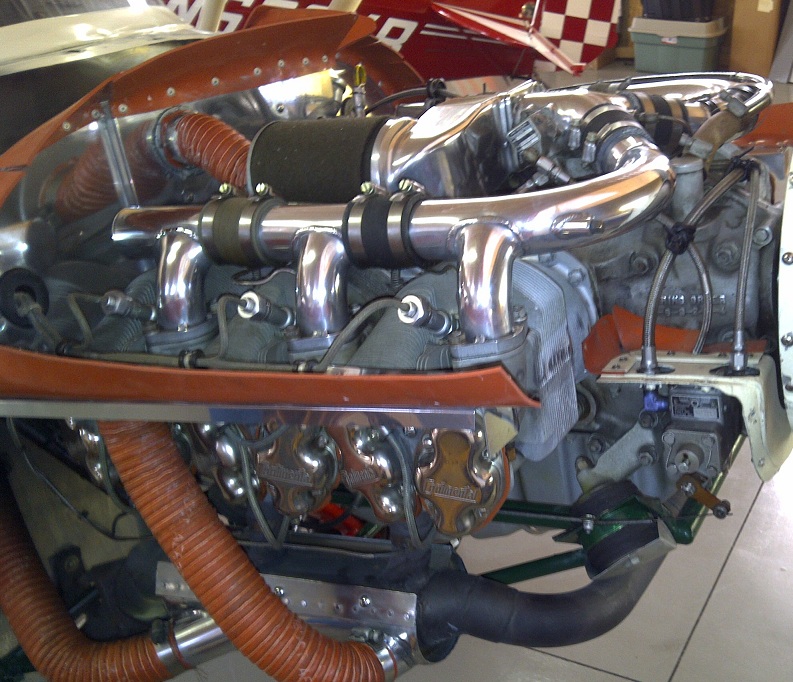
Betcha $25 I could fly it 100 hours and not hurt it.Another airplane, has the fearsome TCM IO-360. Original
cylinders after 45 years. Not a single crack, because I've
flown it for the last 42. You give that engine to one of the
experts here, after one year it would be trash:


"Shock heating" as one might imagine it, doesn't happen. One has to imagine how an engine gains heat, and how it loses heat. Overheating is different than one might imagine a heating "shock". Cylinders separate when overheated since they're made of both steel and aluminum and at the point of redline temperatures both start to lose their strength (Mike Busch suggests that both Continental and Lycoming have optimistic redlines). Metal has a greater ability to absorb heat than it does to lose heat - remember that when it loses heat it shrinks. If everything is expanding in the engine, stuff gets looser (and more malleable) so stuff never breaks when you're heating it (unless you heat it too much to essentially melt it). Cooling and shrinking however are a different matter. As the Colonel's picture shows, your chief danger is cooling the engine at a specific point. Unburnt fuel makes a terrific coolant, escpecially when it is suddenly applied.Yes I know you can overheat your engine. My question was related to the shock cooling during descends and the reverse, let's call it shock heating at takeoff.

I have no idea how to interpret that. Could you elaborate?Shiny Side Up wrote: Metal has a greater ability to absorb heat than it does to lose heat.
Thanks, Beef. I think. Actually, rather unusually, IHedley flys as much as he posts
|
|


Use AvCanada's information at your own risk!
We reserve the right to remove any messages that we deem unacceptable.
When you post a message, your IP is logged and may be provided to concerned parties where unethical or illegal
behavior is apparent.
All rights reserved.

