Forced Approach - Best Glide Speed

This forum has been developed to discuss flight instruction/University and College programs.

Moderators: sky's the limit, sepia, Sulako, Right Seat Captain, lilfssister, North Shore

User avatar
Cat Driver
Top Poster
Top Poster
Posts: 18921
Joined: Sun Feb 15, 2004 8:31 pm

Re: Forced Approach - Best Glide Speed

Post by Cat Driver »

Assuming you have competent instruction, which is the hiccup.

The problem people have C.S. is where do they find competent instruction?

The FTU's do not seem to be teaching the basics of airplane handling skills and for sure T.C. does not require them to teach basics in enough depth that the students can understand angle of attack.....

....so what is the answer?
---------- ADS -----------
 
The hardest thing about flying is knowing when to say no


After over a half a century of flying no one ever died because of my decision not to fly.
Big Pistons Forever
Top Poster
Top Poster
Posts: 5956
Joined: Wed Feb 18, 2004 7:17 pm
Location: West Coast

Re: Forced Approach - Best Glide Speed

Post by Big Pistons Forever »

Cat Driver wrote:
Assuming you have competent instruction, which is the hiccup.

The problem people have C.S. is where do they find competent instruction?

The FTU's do not seem to be teaching the basics of airplane handling skills and for sure T.C. does not require them to teach basics in enough depth that the students can understand angle of attack.....

....so what is the answer?
And so the instructor bashing starts, what a surprise :roll:
---------- ADS -----------
 
User avatar
AirFrame
Rank 10
Rank 10
Posts: 2610
Joined: Sun Oct 11, 2009 10:27 pm
Location: Sidney, BC
Contact:

Re: Forced Approach - Best Glide Speed

Post by AirFrame »

Colonel Sanders wrote:No. I am trying (in vain) to try to teach people, by using extreme examples, that bank angle IS NOT EVIL as you have been taught, and as your instructors have been taught, and as their instructor were taught. Blind adherence to religious dogma.
Got it now, thanks for clarifying. I agree, if I had been taught AOA earlier in my flight training it would have made a lot of sense. Unfortunately, not having an AOA instrument in any airplane i've ever flown might have made it difficult to teach...
---------- ADS -----------
 
User avatar
Shiny Side Up
Top Poster
Top Poster
Posts: 5335
Joined: Tue Feb 17, 2004 5:02 pm
Location: Group W bench

Re: Forced Approach - Best Glide Speed

Post by Shiny Side Up »

Colonel Sanders wrote:
What I find is a great introductory maneuver
is the wingover, which is a required maneuver
on the FAA COMM checkride. At the apogee,
they are at a steep bank angle with very little
airspeed on, ball in the center and a low AOA.
Me too, though most people I've shown it to just about shit their pants. We have to remember that most pilots are going to be queasy about any bank angles over 30 degrees (or pitch angles for that matter) and their main endeavor in flying is to get as quickly as possible straight and level. Everything else is extra in their view of flying. Anything extra is "emergency use only" and they ain't going to ever get into an emergency. Right? Right.

We can blame instructors and schools, sure that's part of the problem, but they're more a symptom I feel of the over all issue that just happens when you have human being involved. We're inherently lazy creatures. Its the exceptional individual that strives above and beyond.

On that note, I did to rental checks which ended up in "you need more work". Both were CPL holders, and though bother hadn't flown in over a year, their skill degradation was horrendous. Neither could satisfactorily land the airplane. 4 tries each before I decided to have enough. Neither could maintain a speed when asked, neither seemed to know what the rudder was for, despite the poor little Cessna's protests. EFATO? frig, neither of them could fly a coordinated turn. The part that gets me I guess, was that neither seemed to be particularly disappointed in their poor performance, I'd be pretty pissed at myself if I'd forgotten how to fly, or embarrassed myself in front of someone else in such fashion. I can accept some of the less than a hundred hours recreational fun flyers forgetting how to do stuff after a year or so of no flying, but 200 hour plus CPL holders? There were so many points of just not giving a damn for that to get through.
---------- ADS -----------
 
We can't stop here! This is BAT country!
User avatar
Colonel Sanders
Top Poster
Top Poster
Posts: 7512
Joined: Sun Jun 14, 2009 5:17 pm
Location: Over Macho Grande

Re: Forced Approach - Best Glide Speed

Post by Colonel Sanders »

not having an AOA instrument in any airplane i've ever flown might have made it difficult to teach
That's certainly a huge problem - we can't look
at a nice (dual-indicating) gauge and see the AOA
for each wing.

As a result, over the decades people have developed
all sorts of approximate rules, to try to keep the AOA
correct. "Hold this airspeed" or "don't exceed this
angle of bank".

The problem is that they are just approximate rules.
They either leave AOA "on the table" that could be
used, or they are horribly incorrect and result in
exceeding the AOA, in the corner cases.

Fundamentally, the wing ONLY cares about AOA.
See the Cl curve. The wing doesn't actually care
about airspeed, or angle of bank, or scary visuals,
or anything else, really.

Experienced, proficient pilots intuitively know the
above, even if they can't explain it very well. They
know when they are working the wing hard, and
when they are not.

My father and I did thousands of inside/outside loops
together - he did an outside loop as lead, and I did an
inside loop on wing, lined wingtip to wingtip. It was
quite a lesson in aerodynamics. First of all, even though
the wings were symmetrical, the aircraft was not. This
resulted in more AOA being required inverted than upright,
to create the same lift. Next, it was quite interesting
for me, because I would have the stall warning indicator
blaring away, under +ve G. I got used to that, but it
got me thinking. Lead had a higher -ve AOA than I did.
He was working the aircraft right to the limit of it's stalling
-ve AOA, without any instrumentation whatsoever - by
"feel" only. He was constantly flying the aircraft to within
a degree or two of it's -ve stalling AOA, as the airspeed,
G and pitch attitude varied wildly during the outside loop.
Humbling, to watch such a virtuoso performance. But
that's the skill you get, from 50+ years in the cockpit,
of not flying straight and level.

I digress with such irrelevant history. The USN understands
the importance of AOA - that's how they fly carrier approaches.
They don't do the silly dance of calculating their weight,
then looking up their Vref based on that, which always
seemed terribly baroque to me.

---------- ADS -----------
 
User avatar
Colonel Sanders
Top Poster
Top Poster
Posts: 7512
Joined: Sun Jun 14, 2009 5:17 pm
Location: Over Macho Grande

Re: Forced Approach - Best Glide Speed

Post by Colonel Sanders »

CPL holders ...
neither could satisfactorily land the airplane.
neither could maintain a speed when asked
neither seemed to know what the rudder was for
neither of them could fly a coordinated turn
I know. Button pushers. That's what everyone
wants to be, these days. Zero interest in learning
what actually makes an aircraft fly, or developing
skill to control it precisely and proficiently.

Why would they bother to learn to fly the aircraft?
They have autopilots for that.
The pilot of an Asiana Airlines jet that crashed in San Francisco this year told investigators after the accident that he had been "very concerned" about landing without help from an airport navigation system that was out of order.

Capt. Lee Kang Kuk, who was highly experienced in a Boeing 747 but was transitioning to flying a 777, told the National Transportation Safety Board that he found it "very stressful, very difficult" to land without the glideslope indicator that helps pilots determine whether the plane is too high or too low during approach.

"Asked whether he was concerned about his ability to perform the visual approach while piloting Asiana Flight 214, he said 'very concerned, yea,'" the safety board revealed at a hearing on Wednesday on its investigation into the July 6 crash that killed three people and injured more than 180 others.

The jet struck a sea wall and broke apart on the runway following a missed approach
Incredibly, Boeing wants more of that.
---------- ADS -----------
 
User avatar
Cat Driver
Top Poster
Top Poster
Posts: 18921
Joined: Sun Feb 15, 2004 8:31 pm

Re: Forced Approach - Best Glide Speed

Post by Cat Driver »

You will be pleased to know that Iflyforpie has taken over my Cub project Colonel...... and it has the Alpha Systems AOA in it.

When it is finished, hopefully this coming winter when his busy flying season is over it will be available for anyone wishing to become proficient in airplane handling skills.

I believe that given some time there will be a need to buy a second Cub to keep up with the demand for advanced airplane handling skills training.

It sure paid off for me when I was working in the flying industry, I hate to just quit without leaving the industry with another avenue for training.

Some here accuse me of being anti instructor.

Nothing could be further from the truth.

I am anti establishment with regard to the quality of flight instruction to be found in a lot of FTU,s

Flight instruction is the highest calling in aviation and flight instructors once experienced and qualified to give advanced flight instruction should be paid at the top of the aviation pay scale.

So.......I am going to make sure Iflyforpie becomes the best paid instructor in Canada.
---------- ADS -----------
 
The hardest thing about flying is knowing when to say no


After over a half a century of flying no one ever died because of my decision not to fly.
User avatar
PilotDAR
Rank 11
Rank 11
Posts: 4113
Joined: Sun Sep 30, 2012 6:46 pm
Location: Near CNJ4 Orillia, Ontario

Re: Forced Approach - Best Glide Speed

Post by PilotDAR »

Okay, so back to the main, and very important theme here:

What are pilots doing to increase their understanding of the ideal speed to glide a particular aircraft, for differing circumstances? Let's say that the Flight Manual, with that nice little chart of altitude vs ground distance, and the fuzzy gliding line says 70 KIAS.

1) You're off shore, hoping to simply get to somewhere dry instead of splashing. Speed?

2) You've foolishly hung the plane on the prop on climbout, you're 300 feet up, indicating 60 KIAS. What speed would you like to see in less than five seconds?

3) You're touring along, and bang, no power. Look, there's a perfect, long sod field right underneath you! Speed?

4) following any of the above, you're 50 feet up, short final to your chosen spot, and you are already aware of a nasty stone fence as your final obstacle before the touchdown zone. Crossing speed for that?
---------- ADS -----------
 
User avatar
Pop n Fresh
Rank (9)
Rank (9)
Posts: 1270
Joined: Mon Jan 06, 2014 3:46 am
Location: Freezer.

Re: Forced Approach - Best Glide Speed

Post by Pop n Fresh »

Cat Driver wrote:... it will be available for anyone wishing to become proficient in airplane handling skills.

I believe that given some time there will be a need to buy a second Cub to keep up with the demand for advanced airplane handling skills training.
Sounds pretty good Cat but there will still be quite a few people that will want the simplest way to build a larger number in a log book to get a job instead of "Advanced airplane handling skills."

Sounds crazy to someone who has flown for a while, but somehow seems smart to some young guys just starting out.
---------- ADS -----------
 
User avatar
Cat Driver
Top Poster
Top Poster
Posts: 18921
Joined: Sun Feb 15, 2004 8:31 pm

Re: Forced Approach - Best Glide Speed

Post by Cat Driver »

Sounds pretty good Cat but there will still be quite a few people that will want the simplest way to build a larger number in a log book to get a job instead of "Advanced airplane handling skills."
True.

But the law of averages dictate he will be successful because there are enough candidates out there to more than keep him very busy.

The pilots who succeed in aviation are those who strive to be the best.

Those who are content with the lowest airplane handling skills levels fly into sea walls.
---------- ADS -----------
 
The hardest thing about flying is knowing when to say no


After over a half a century of flying no one ever died because of my decision not to fly.
Big Pistons Forever
Top Poster
Top Poster
Posts: 5956
Joined: Wed Feb 18, 2004 7:17 pm
Location: West Coast

Re: Forced Approach - Best Glide Speed

Post by Big Pistons Forever »

PilotDAR wrote:Okay, so back to the main, and very important theme here:

What are pilots doing to increase their understanding of the ideal speed to glide a particular aircraft, for differing circumstances? Let's say that the Flight Manual, with that nice little chart of altitude vs ground distance, and the fuzzy gliding line says 70 KIAS.

1) You're off shore, hoping to simply get to somewhere dry instead of splashing. Speed?

2) You've foolishly hung the plane on the prop on climbout, you're 300 feet up, indicating 60 KIAS. What speed would you like to see in less than five seconds?

3) You're touring along, and bang, no power. Look, there's a perfect, long sod field right underneath you! Speed?

4) following any of the above, you're 50 feet up, short final to your chosen spot, and you are already aware of a nasty stone fence as your final obstacle before the touchdown zone. Crossing speed for that?

My 02 cents

For question 1 and 3: An attitude that will hold a steady 70 kts. Your average light aircraft has such crappy glide performance that there will not be a lot of difference in performance until you get a long way from the POH speed.

For question 2: Gliding speed is irrelevant in this scenario, an immediate hard push down is required or the airplane will very quickly stall. Once you have averted the danger of stalling, that close to the ground you will be touching down very quickly so the challenge will be to have enough energy to stop the rate of descent enough in order to not damage the aircraft or yourself. This maneuver has to be done by feel, you will not have time to look inside at your airspeed.

For question 4: I would suggest this is less about speed than about flight path management. If you have the ability to assess that at the present speed you will clear the obstacle than no action required. If you are going to be long than you need to add drag, and if you are short you need to know how short in time to do something about it. If you are 50 feet up and short as you said than it is too late to do much except trade energy (speed) for height and hope there is enough in the energy bank to make it over the stone wall.
---------- ADS -----------
 
CpnCrunch
Rank 11
Rank 11
Posts: 4196
Joined: Mon Feb 08, 2010 9:38 am

Re: Forced Approach - Best Glide Speed

Post by CpnCrunch »

All this talk about EFATO turnbacks, wingovers, etc. is unrealistic for the average PPL. Even the TC forced landing with its 'key points' is overkill IMO. Who in reality is going to remember about those key points when the engine really quits? You're just going to find a nice field and use your flying skills (or lack thereof) to try and land in it.

IMO here is what flight instructors should be doing for their PPLs (but most don't, as far as I can tell):

- regularly cut the power at 500ft AGL and make sure the student immediately pushes the nose down and maintains glide speed, looking for a place to land within 30 degrees of the nose.

- regularly ask the student 'where you would land now if the engine quit', so that it becomes a habit.
---------- ADS -----------
 
User avatar
Colonel Sanders
Top Poster
Top Poster
Posts: 7512
Joined: Sun Jun 14, 2009 5:17 pm
Location: Over Macho Grande

Re: Forced Approach - Best Glide Speed

Post by Colonel Sanders »

unrealistic for the average PPL
You're probably right. It all comes down to
motivation, in my experience. If someone is
happy being borderline incompetent, well,
not much is going to change.

What I like to see is someone really unhappy
when their performance is less than stellar.

If someone is motivated to improve, I can
do something with them. Generally, in not
too many hours, I can having them doing
stuff they wouldn't have believed possible.

But they have to want it. It has to be important
to them. If it's not, well, they're just going
to be hamburger in the cockpit, pushing buttons.

When I was a young pilot, it really pissed me
off that my abilities were so much more limited
than the airframe's. See Bob Hoover. So, I
did something about it.

However, most pilots are happy to just fly
straight and level, and hope nothing bad ever
happens.
---------- ADS -----------
 
CpnCrunch
Rank 11
Rank 11
Posts: 4196
Joined: Mon Feb 08, 2010 9:38 am

Re: Forced Approach - Best Glide Speed

Post by CpnCrunch »

Colonel Sanders wrote: You're probably right. It all comes down to
motivation, in my experience. If someone is
happy being borderline incompetent, well,
not much is going to change.
I think you're being unfair saying someone is 'borderline incompetent' simply because they don't do aerobatics. Would you say someone is borderline incompetent driving a car if they can't do handbrake turns, bootlegger reverses and sliding turns?

I don't do aerobatics, but I'm certainly not 'borderline incompetent'.
---------- ADS -----------
 
User avatar
Colonel Sanders
Top Poster
Top Poster
Posts: 7512
Joined: Sun Jun 14, 2009 5:17 pm
Location: Over Macho Grande

Re: Forced Approach - Best Glide Speed

Post by Colonel Sanders »

Ok. In the 172M POH, Cessna says that
an "average" pilot can land with a 15 knot
direct crosswind.

So, according to Cessna, if you can't land a
172 with 15 knots of direct crosswind, you
are a "below average" pilot.

Somewhere in the "below average" range
is "borderline incompetent".

I just landed, a few minutes ago in the Maule,
doing this:

http://www.youtube.com/watch?v=US9je8STwjo

Does any of the above have to do with aerobatics?
No. But it certainly has to do, with competence.

60% of all general aviation accidents occur during
takeoff and landing, usually under pretty benign
conditions. Is that a display of competence?
---------- ADS -----------
 
Last edited by Colonel Sanders on Sun Aug 03, 2014 1:58 pm, edited 1 time in total.
User avatar
Shiny Side Up
Top Poster
Top Poster
Posts: 5335
Joined: Tue Feb 17, 2004 5:02 pm
Location: Group W bench

Re: Forced Approach - Best Glide Speed

Post by Shiny Side Up »

CpnCrunch wrote:
Colonel Sanders wrote: You're probably right. It all comes down to
motivation, in my experience. If someone is
happy being borderline incompetent, well,
not much is going to change.
I think you're being unfair saying someone is 'borderline incompetent' simply because they don't do aerobatics.
He didn't say that, he only said that people are happy being borderline incompetent, much like the two CPL holders I gave as examples above. When it comes to flying airplanes while what constitutes "amazing" skill has no real top limit, there's definitely a metric for determining who's acceptable and who's incompetent. BPF gave some examples in a previous post, but one can make a short list here.

As a pilot are you able to:

1) Hold a constant speed on a descent?
2) maintain a constant rate of descent?
3) fly straight and level?
4) land on the centerline?
5) to land at a specific point down the length of the runway?
6) glide to a point?
7) make a coordinated medium angle of bank turn?
8) make a coordinated steep angle of bank turn?
If one's answer to any of the above is no, or some times, you are probably borderline incompetent at flying. If you're answer is no to most or all of them, then you're just outright incompetent.

Many people are unfortunately happy being somewhere between borderline incompetent and outright incompetent, which is fine for golf.
---------- ADS -----------
 
We can't stop here! This is BAT country!
User avatar
AirFrame
Rank 10
Rank 10
Posts: 2610
Joined: Sun Oct 11, 2009 10:27 pm
Location: Sidney, BC
Contact:

Re: Forced Approach - Best Glide Speed

Post by AirFrame »

Colonel Sanders wrote:What I like to see is someone really unhappy when their performance is less than stellar.
That was me, today. Flew from Langley to Merritt, about a 100 mile, 40 minute flight. My first "longer" flight this year, to an airport i'd never flown to. Oh, and over mountains, which doesn't bother me but for some reason it scares the willies out of way too many pilots I know. Altitude varied +/- 3-400 feet, and I kept kicking myself every time I checked and realized i'd been drifting off course or altitude and had to bring myself back where I wanted to be. Bounced the landing in Merritt to boot. Not rough, just not stellar. Of course, another plane that flew up with me had the autopilot on the whole way... Commented that it looked like he was following a drunk pilot... Gee thanks. :P

Coming home, I focussed a little more on my flying, got a proper scan going, dialed the trim in a little better, and held my altitude and speed to +/-50' and +/-1 knot the whole way back. And then did a perfect landing back in Langley. What I was thinking taxiing in, is that it didn't take much extra effort to fly a heck of a lot better than I did on the way up. It's easy to get complacent when you always fly to the same nearby places every time you fly... Most of the hamburger runs around here are take-off, climb, short cruise, descend, land... Hardly any time spent at a fixed alitude or speed in cruise means you don't always notice that your precision just isn't there.

Aside: While listening to adjacent airport and practise area frequencies on the way up, I heard ACTPA on every one of them.
---------- ADS -----------
 
User avatar
AirFrame
Rank 10
Rank 10
Posts: 2610
Joined: Sun Oct 11, 2009 10:27 pm
Location: Sidney, BC
Contact:

Re: Forced Approach - Best Glide Speed

Post by AirFrame »

Shiny Side Up wrote:As a pilot are you able to:

1) Hold a constant speed on a descent?
2) maintain a constant rate of descent?
3) fly straight and level?
4) land on the centerline?
5) to land at a specific point down the length of the runway?
6) glide to a point?
7) make a coordinated medium angle of bank turn?
8) make a coordinated steep angle of bank turn?

1. Yes.
2. Yes.
3. Yes.
4. Yes.
5. Yes, but I don't hold any misconception that I'd win any spot landing contests.
6. As in a forced landing? I wouldn't say yes for certain. Like many private pilots, I am remiss in not practising power-off approaches often enough. I am working on drilling into my head the sight picture for a full gliding approach in the RV, which is a lot steeper than in a Cessna. For some reason most RV pilots near me carry power to the fence, which lowers the approach to "cessna-like" glideslope angles... It looks more "normal" as you get one red and one white light on the VASI, but if your engine quits you're going to have a much worse day. I was taught that too, but am trying to break the habit.
7. Yes.
8. Yes.
---------- ADS -----------
 
User avatar
PilotDAR
Rank 11
Rank 11
Posts: 4113
Joined: Sun Sep 30, 2012 6:46 pm
Location: Near CNJ4 Orillia, Ontario

Re: Forced Approach - Best Glide Speed

Post by PilotDAR »

IMO here is what flight instructors should be doing for their PPLs (but most don't, as far as I can tell):

- regularly cut the power at 500ft AGL and make sure the student immediately pushes the nose down and maintains glide speed, looking for a place to land within 30 degrees of the nose.
Herein lies my concern....

"....maintains glide speed....."

Of course, failing to achieve a speed at least that fast and maintaining it is a serious failing, but in my opinion, there could be many circumstances where maintaining a glide at the book "best glide speed" represents a noticeable reduction in safely from what could be achievable. I have seen many pilots and instructors aim for that magic speed without understanding that if they are not trying to reach the far point, they do not need to fly that slowly, and doing so in the final phase of the glide greatly reduces their chances of a more safe controlled landing. Glide it faster!

If you're 10 knots too fast on short final, and you have the touchdown spot made, it's easy to slip off that 10 knots (yes, even in the placarded 172's). This will result in a very much safer landing - you simply have more time to set up the flare. In many aircraft, you can slip with large rudder right onto the ground if you need to. I would much rather do this, and get a controlled landing where I want it - with the slight risk of a low energy overrun, than to muff it and undershoot into the stone fence at the near end. A full power off landing is stressful for those who do not practice regularly, so you need everything you can control going your way. Crossing the fence at the "best glide speed" is cheating yourself out of a real margin of safety!

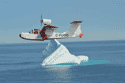
Not long ago, I was practicing and training power off landings from 500 feet in the 182 amphib. Holding a very comfortable 80 knot glide speed with comfortable margins for a flare, the descent angle is about 12 degrees, but every touchdown, both land and water was very gentle and uneventful. In demonstrating that same approach at 70 knots, it was rather stressful to make a non damaging landing, let alone a nice one.

CS aside, who has recently done five power off landings in their aircraft from 500 feet, at varying glide speeds, to understand these effects?
---------- ADS -----------
 
User avatar
Cat Driver
Top Poster
Top Poster
Posts: 18921
Joined: Sun Feb 15, 2004 8:31 pm

Re: Forced Approach - Best Glide Speed

Post by Cat Driver »

CS aside, who has recently done five power off landings in their aircraft from 500 feet, at varying glide speeds, to understand these effects?

When I was doing type ratings on the PBY we did three minute circuits on the water.

Every landing was power off from 200 feet until they were completely competent and comfortable performing the landings.

After they become competent with performing all landings without the crutch of power assist they preferred it.
---------- ADS -----------
 
The hardest thing about flying is knowing when to say no


After over a half a century of flying no one ever died because of my decision not to fly.
User avatar
trampbike
Rank (9)
Rank (9)
Posts: 1013
Joined: Tue Jun 23, 2009 8:11 am

Re: Forced Approach - Best Glide Speed

Post by trampbike »

CpnCrunch wrote:All this talk about EFATO turnbacks, wingovers, etc. is unrealistic
for the average PPL. Even the TC forced landing with its 'key points' is overkill IMO.

Are you aware of what future military pilot are taught in their very first 20h of flying?
Let me know if you want the list of maneuvers they need demonstrate on the first flight test...

I'm not suggesting a PPL holder should be held to the same standards, however EFATOs,
wingovers and "key points" forced landing patterns certainly should not be considered
unrealistic for them!

Cheers
Olivier
---------- ADS -----------
 
Think ahead or fall behind!
User avatar
Colonel Sanders
Top Poster
Top Poster
Posts: 7512
Joined: Sun Jun 14, 2009 5:17 pm
Location: Over Macho Grande

Re: Forced Approach - Best Glide Speed

Post by Colonel Sanders »

You simply cannot compare military and
civilian flight training. Night and day. To
do so, is ludicrous.

Civilian flying is all about egalitarianism -
anyone who walks through the front door
is entitled to a PPL - and feelings, and milking
the student financially senseless through
intentional inefficiency. Any knowledge or
skill that is accrued is done so almost accidentally,
or at least in spite of the training.

There is precious little egalitarianism, no
entitlement and no inefficiency tolerated in
military flight training. And no one could
give a hoot about your precious feelings.
---------- ADS -----------
 
Big Pistons Forever
Top Poster
Top Poster
Posts: 5956
Joined: Wed Feb 18, 2004 7:17 pm
Location: West Coast

Re: Forced Approach - Best Glide Speed

Post by Big Pistons Forever »

trampbike wrote:

Are you aware of what future military pilot are taught in their very first 20h of flying?
Let me know if you want the list of maneuvers they need demonstrate on the first flight test...
Could you please provide more detail about how the EFATO is taught. Specifically what criteria is used for the turnback, as I assume there is a briefed minimum altitude, and what skill level s expected pre first solo and at the end of the Grob phase ?

Thanks

BPF
---------- ADS -----------
 
User avatar
Shiny Side Up
Top Poster
Top Poster
Posts: 5335
Joined: Tue Feb 17, 2004 5:02 pm
Location: Group W bench

Re: Forced Approach - Best Glide Speed

Post by Shiny Side Up »

Colonel Sanders wrote: To
do so, is ludicrous.

Civilian flying is all about egalitarianism -
anyone who walks through the front door
is entitled to a PPL - and feelings, and milking
the student financially senseless through
intentional inefficiency. Any knowledge or
skill that is accrued is done so almost accidentally,
or at least in spite of the training.
While you're right that they're two different things, I wouldn't put it that way. And whether you think military training is "efficient" certainly depends on what your goal is. Certainly from a taxpayer stand point it isn't, but it is when it comes to skill level of the finished product. Civilian flight training is simply way more varied than military training. It could be equal to military training, but so far the market won't stand for that. Just like military training would fold up if you started requiring the candidates to pay for it. I've heard that this actually happens in some countries, and you get predictable results.
---------- ADS -----------
 
We can't stop here! This is BAT country!
User avatar
trampbike
Rank (9)
Rank (9)
Posts: 1013
Joined: Tue Jun 23, 2009 8:11 am

Re: Forced Approach - Best Glide Speed

Post by trampbike »

Big Pistons Forever wrote:
trampbike wrote:

Are you aware of what future military pilot are taught in their very first 20h of flying?
Let me know if you want the list of maneuvers they need demonstrate on the first flight test...
Could you please provide more detail about how the EFATO is taught. Specifically what criteria is used for the turnback, as I assume there is a briefed minimum altitude, and what skill level s expected pre first solo and at the end of the Grob phase ?

Thanks

BPF
Students are not expected to turn back on the Grob phase 1.
On phase 1 they are taught forced landing patterns from or above high key.

EFATO is dead simple on phase 1: get to 90kias (the climb is done at 100kias), drop the
gear, find a nice field somewhere in front of you (that's all there is around Portage anyway!),
maneuver and use the flaps (3 stages flaps, down to 60degrees) as required to make
it there. After field selection, you are somewhat expected to troubleshoot a little bit while
gliding there (at least switch change fuel tanks, turn the boost pump on, shove the mixture rich, etc).

Keep in mind phase 1 is more of a selection phase than a real flying course. However, after about 20h,
a student with no previous flying experience will have soloed on a 260hp CS prop RG aircraft and be tested on:
ground handling, comms, emergencies (red pages commited to memory, yellow pages have to be read
but a solid understanding of the actions to be taken is expected), circuits and closed patterns, PFL, EFATO,
clean stall, turning stall, landing configuration stall, unusual attitude recoveries, slow flight, various descents,
climbs and turns, loops, aileron rolls, spins, crazy good lookouts including some wingovers, and all the
airborne checks are commited to memory.

Once on the Harvard II, the turnback is not taught on phase II, (I don't know about Phase II Grob though...
not having an ejection seat must certainly changes the perspective) mainly because the very dense traffic
would not make it a viable option (certainly less than a ride in the bang seat!) to students with
low S.A of where everyone is. It is however very easy to do, since the Harvard outclimbs its glide gradient
by a huge margin. I've practiced it a lot in the sim from different energy states and positions, and when
the airfield is yours, it's quite easy and safe, even from 10ft of altitude if you have some speed.
Forced landings are mostly taught during the phase 3.

Cheers,
Olivier
---------- ADS -----------
 
Think ahead or fall behind!
Post Reply

Return to “Flight Training”