To offer a comment toward answering the question.... I ease them toward fine when I believe they are no longer governing. If I'm wrong, and get an RPM rise, I'll pause, until power is reduced more. But... that's just me, and my experience.
..
Good to have someone get back to reality, so thanks PilotDar.
You can fly until the second coming or when you go to paradise at 120 years old and using that technique you will never harm an engine nor yourself.
---------- ADS -----------
The most difficult thing about flying is knowing when to say no.
After over a half a century of flying I can not remember even one trip that I refused to do that resulted in someone getting killed because of my decision not to fly.
PilotDAR wrote:To offer a comment toward answering the question.... I ease them toward fine when I believe they are no longer governing. If I'm wrong, and get an RPM rise, I'll pause, until power is reduced more. But... that's just me, and my experience...
This is the best method.
The only disadvantage is that for most airplanes the point at which the props are on the fine pitch stops and therefor there is no rise in RPM when the prop levers are pushed up, generally occurs on short final.
For new pilots first transitioning to higher performance aircraft I have found that this can be an added distraction during a time of higher work load. For that reason I get them to set the props to climb RPM on the prelanding check. All of the common standard non turbocharged Continental and Lycoming engines are approved for full throttle operation with climb RPM set although they will obviously deliver a bit less than full power when in this configuration and thus in the event of a go around they only have to push the throttles up to full forward.
After a few hours the student should start to become comfortable with the aircraft and I will get them to transition to the method Step has outlined
PilotDAR wrote:To offer a comment toward answering the question.... I ease them toward fine when I believe they are no longer governing. If I'm wrong, and get an RPM rise, I'll pause, until power is reduced more. But... that's just me, and my experience...
Two things: First, I run a flight school and that's how we do things. Second, the bolded part is something I find when a student has that brain fart and can't remember which lever to move first, I tell them "just do it slow, if it sounds like the airplane's protesting, you're moving the wrong one." With constant speed propellers, you only have to hit the student a few times before they get the idea.
For new pilots first transitioning to higher performance aircraft I have found that this can be an added distraction during a time of higher work load. For that reason I get them to set the props to climb RPM on the prelanding check. All of the common standard non turbocharged Continental and Lycoming engines are approved for full throttle operation with climb RPM set although they will obviously deliver a bit less than full power when in this configuration and thus in the event of a go around they only have to push the throttles up to full forward.
Then
After a few hours the student should start to become comfortable with the aircraft and I will get them to transition to the method Step has outlined
Why not just teach it right from the get go? Moving levers forward if moving levers forward.. no?
---------- ADS -----------
Rule books are paper - they will not cushion a sudden meeting of stone and metal.
— Ernest K. Gann, 'Fate is the Hunter.
For new pilots first transitioning to higher performance aircraft I have found that this can be an added distraction during a time of higher work load. For that reason I get them to set the props to climb RPM on the prelanding check. All of the common standard non turbocharged Continental and Lycoming engines are approved for full throttle operation with climb RPM set although they will obviously deliver a bit less than full power when in this configuration and thus in the event of a go around they only have to push the throttles up to full forward.
Then
After a few hours the student should start to become comfortable with the aircraft and I will get them to transition to the method Step has outlined
Why not just teach it right from the get go? Moving levers forward if moving levers forward.. no?
What part of
For new pilots first transitioning to higher performance aircraft I have found that this can be an added distraction during a time of higher work load
Did you have difficulty understanding ?
If you had actually done any instructing you might have more credibility......
Strega wrote:
My personal thoughts are a student should not be learning to use a CS prop on a twin..but who am I?
In an Ideal world that would indeed be the case, but I've seen lots of times where that just doesn't happen. Guy with lots of money goes from a 172 to a light twin, or at least I know that you know of a guy who went straight from a Cherokee to a Twin Comanche, so you know there are guys out there doing this stuff. Especially in a lot of flight schools it happens since having more types on the FTUOC is a PITA. Unfortunate, but the reality of the world.
In an Ideal world that would indeed be the case, but I've seen lots of times where that just doesn't happen. Guy with lots of money goes from a 172 to a light twin, or at least I know that you know of a guy who went straight from a Cherokee to a Twin Comanche, so you know there are guys out there doing this stuff. Especially in a lot of flight schools it happens since having more types on the FTUOC is a PITA. Unfortunate, but the reality of the world.
Well in the case of someone moving into a twin as described above I teach them what I consider the best way to handle power and RPM changes only one way.
RPM remains at cruise during the full approach until the last power reduction just prior to landing. Unless a go around is performed at which time climb power is set.
If something as simple to remember and perform as setting climb RPM and power overwhelms them they are nowhere near competent to fly a twin.
And yes I am an instructor.
---------- ADS -----------
The most difficult thing about flying is knowing when to say no.
After over a half a century of flying I can not remember even one trip that I refused to do that resulted in someone getting killed because of my decision not to fly.
In an Ideal world that would indeed be the case, but I've seen lots of times where that just doesn't happen. Guy with lots of money goes from a 172 to a light twin, or at least I know that you know of a guy who went straight from a Cherokee to a Twin Comanche, so you know there are guys out there doing this stuff. Especially in a lot of flight schools it happens since having more types on the FTUOC is a PITA. Unfortunate, but the reality of the world.
Well in the case of someone moving into a twin as described above I teach them what I consider the best way to handle power and RPM changes only one way.
RPM remains at cruise during the full approach until the last power reduction just prior to landing. Unless a go around is performed at which time climb power is set.
If something as simple to remember and perform as setting climb RPM and power overwhelms them they are nowhere near competent to fly a twin.
And yes I am an instructor.
Exactly how I have taught it for years, not sure why everyone thinks adding a blue lever is such a complex endeavour.
Now I am going to stir the pot with this
When flying turbo props that have reverse I advance the props short final or if landing on a long runway after touchdown.
In my piston twin I don't advance the props until clear of the runway.
Now before someone questions the missed approach, if I am going to be close to minimums I will advance the props once stabilized on the approach and the manifold pressure in low enough that they are already full fine.
Otherwise I have never had trouble raising the nose, advancing the mixtures, props and throttles and by that time I am at Vy
---------- ADS -----------
Take my love
Take my land
Take me where I cannot stand
I don't care
I'm still free
You cannot take the sky from me
PilotDAR wrote:To offer a comment toward answering the question.... I ease them toward fine when I believe they are no longer governing. If I'm wrong, and get an RPM rise, I'll pause, until power is reduced more. But... that's just me, and my experience...
Same here. Really done for noise concerns. I suppose one could wait for the flare but I might forget it at that point, so just done at approach power further back when concentration is frequently less. Personal technique.
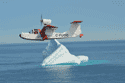
For anybody on the Twin Otter, it was very important to get the props forward.Otherwise there may be no reverse due to a blocking mechanism if the props are not forward of 91%(with 96% being full forward). Offstrip, that could cause serious damage especially on skis. I know of a case where this happened. In fact I had it happened twice to me on long runways where putting the props forward at the last second ended up having the throttles hang up on that interlock-blocking mechanism. No reverse capability was the result. After that I always put them fully forward on short final and physically held them forward even if someone else only wanted them put forward on touchdown. Never had a problem after that.
. . wrote:
If something as simple to remember and perform as setting climb RPM and power overwhelms them they are nowhere near competent to fly a twin.
That would be my opinion too, but it doesn't stop people from trying to make the leap. When they're hell bent to do so, I would personally think the lesser of the two evils would be to give them some tools that re going to keep them out of trouble. One could of course choose just not to instruct them too, but I'm of two minds about that, it just means that they're more likely to find someone who will bash up their tin. There's no win in such scenarios. I ain't the Sky King who dictates who gets to fly.
Well, without quoting quotes of quotes here, I'm going to refine what I posted;
I move engine controls smoothly, and in such a way as to have time to perceive the change (or not) I anticipate, without things going wild. On a CS piston engine, when I move a throttle, I expect to see either an RPM or MP change, depending if the prop is governing or not. The same but in reverse for prop controls. If I am somewhere between downwind, and short final, that movement of throttle and propeller controls will be intended to not result in an RPM increase, unless I have decided to effectively increase the power.
I have expressed previously my aspiration to "configuration assurance" and this is a part of it. Yes, I have landed a Twin Otter with the props not fine, so no reverse - darn! I like to assure that the configuration is always set, or just about so, for any of the next possible things I might like to do with the plane. It's a part of my "being ahead" of the plane. So, on short final, there are two possible "next things" I could want to do with the plane: Remove any remaining power, and land, or apply lots of power, and go around. If the prop(s) is set to anything other than full fine, opening the throttle will create great engine unhappiness. I can't afford greatly unhappy engines, so I don't do that.
The next next thing, for PT6 equipped aircraft (I have not flown other turbines) is that you might like to use reverse, so prop(s) fine for that too. In the Twin Otter, I'll probably be too busy steering to want the distraction of putting props up to get reverse - buy then it's too late. So, I just assure configuration when I have time - final approach is nice for that, or further back, if my senses tell me that final will be busy (landing in a tight lake with boats on the move).
So how do I know when I can move the prop control so as to achieve my desired "no RPM rise"? The same way I can drive a new type of car around a corner, and stay in the lane; I move the control a bit, sense the response, and move more, or pause, as appropriate. Moving engine controls, like flying the plane, can, and should be done by a pilot who either is, or is at least trying to be, in harmony with the plane.
Like so many things in piloting, "rote" is the much less good way to do things.
I am not an instructor (I'm neither proud, now embarrassed about that, I just am who I am), so, I'll leave the techniques of teaching to those qualified to do it. But I hope that instructors are training new pilots to be sensitive to the "feel" of the plane - and engine(s) so they learn how to get it right. Sure, same as bouncing a few times, new pilot can slam in the prop control, with power, on final, and get to the red line RPM - ONCE! Then, lesson learned, right?
PilotDAR wrote:
The next next thing, for PT6 equipped aircraft (I have not flown other turbines) is that you might like to use reverse, so prop(s) fine for that too.
I flew several types with PT-6 engines. Interestingly, only the Twin Otter had this blocking mechanism. Not sure why they were differing designs.