Keystone Navajo Accident in Thompson
Moderators: lilfssister, North Shore, sky's the limit, sepia, Sulako
-
SnotRocket
- Rank 1

- Posts: 48
- Joined: Wed Jan 11, 2012 11:27 am
Re: Keystone Navajo Accident in Thompson
Esso franchises go through regular audits by Esso and other organizations. They are actually quite tedious, lengthy and strict. Someone has to know what they are doing more than just being able to pump fuel into an airplane in order to pass one.
Re: Keystone Navajo down in Thompson.
many operators turn down the "absolute pressure controller" been awhile might not be right term. if i remember correctly it should be around 43" check the manual if less advise MX in writing preferably. also there is an SB prohibiting part throttle takeoffs as there is a two stage metering valve in the carb, you only get the extra fuel when throttle is all the way fwd.....Jack In The Box wrote:I mean that they limit it below max MP.Meatservo wrote:Do you mean "derate" as in drawing a new, lower red line on the gauge, or do you mean they somehow modify them so they can't make it to full MP? If it's the latter, is it done with manufacturer approval or an STC?
As it so happens it seems like the airplane was filled with jet A instead of Avgas. Which makes it fueled and pilot error.
Re: Keystone Navajo Accident in Thompson
Pretty sure in the PA31 it's called the Density controller. Not uncommon to be rigged around the 42" MP mark. I've seen Navajos rigged to 47" on brand new engines. Giddy up! Also, as said previously: Fuel Injected, no carb.
Was in YTH a few weeks ago, called out for AvGas, call it prejudice but after asking for the fill up felt like I should supervise the uplift. Sure enough walking out with the gent he got into the Jet A truck, I just said "wrong truck" and was glad I went out with the guy. Unfortunate this happened, very happy no one perished.
Was in YTH a few weeks ago, called out for AvGas, call it prejudice but after asking for the fill up felt like I should supervise the uplift. Sure enough walking out with the gent he got into the Jet A truck, I just said "wrong truck" and was glad I went out with the guy. Unfortunate this happened, very happy no one perished.
-
Diadem
- Rank 8

- Posts: 911
- Joined: Fri Mar 05, 2010 10:16 pm
- Location: A sigma left of the top of the bell curve
Re: Keystone Navajo Accident in Thompson
Something doesn't add up here. CBC is now reporting that they first reported electrical problems, and that they didn't require assistance; shortly after, they disappeared from radar and lost radio communication, but it isn't specified whether that's because they lost electrical power or because they descended too low. There's also a comment about the wreckage not burning, which makes me wonder about the amount of fuel on board, of any kind. The person who's saying it might have been the wrong fuel type is the company president, and clearly he would stand to gain from putting the blame on the fueller.
http://www.cbc.ca/news/canada/manitoba/ ... -1.3232046
http://www.cbc.ca/news/canada/manitoba/ ... -1.3232046

Re: Keystone Navajo Accident in Thompson
It's surprising they managed to start up, run up, taxi, take off, and fly for 3 minutes before the lines ran out of AvGas considering it is Lighter than JetA. Plus the wing broke off and all lines attached to the engine were severed yet no fire!!! I know JetA isn't as explosive as AvGas but lets hope TC finds fuel in the tanks.
- Attachments
-
- PA31.png (857.04 KiB) Viewed 3835 times

Re: Keystone Navajo down in Thompson.
Anyone who has flown long survey in a Navajo has likely done that. Usually before outright starvation though. When the fuel flow needles start to walk around.Jack In The Box wrote:upintheair_ wrote:One of the practices that I have personally witnessed is running the aux tanks dry and switching to the main tanks. One pilot told me it was a game they played, to see if they could run the engine to starvation and switch the tank to the main just in time to keep it going.
I am not making this up
Good judgment comes from experience. Experience often comes from bad judgment.


Re: Keystone Navajo Accident in Thompson
Running the aux tanks dry to the first sputtering was standard practice when I flew the 310. All aircraft are certified to do it safely.
-
cougarhunter
- Rank 1
- Posts: 22
- Joined: Fri Feb 27, 2004 3:39 pm
Re: Keystone Navajo Accident in Thompson
I haven't posted here in years but I couldn't stay silent on a very salient topic that personally hits close to home. I will not speculate what was the cause or who is to blame but I will say this. Kudos to the crew in bringing the Ho down without fatalities. I know there was a couple of medevacs as a direct result of the crash but all too often when Navajos/Chieftains crash there are on-scene fatalities. The crew dealt with an apparent double engine failure the best they could in low IFR conditions and at low altitude where options for a suitable landing site were limited, considering YTH is situated smack dab in the middle of the second largest boreal forest in the world. Kudos also go out to a couple of Thompson Sheriffs who were driving back to town from the airport and saw one of the pilots and passengers coming out of the bush. The Sheriffs quick response and aid deserves an commendation. I won't go into detail but when the Sheriffs met one of the pilots, the pilot was greatly concerned about the passengers. Last but not least kudos go out to Thompson EMS and RCMP for their rapid response and professionalism at the scene. Those men and women in deal with sh*t that goes on in Thompson on a daily basis without fanfare or accolade.
I don't have a hot clue who the crew was but if I may be so bold to impart a little advice to someone who has been there. Be honest with TSB when they come knocking. Don't defend your employers at Keystone. If their practices are in violation of the CARS and you don't disclose what is going on, it will be found out when the inevitable law suits come out and you are giving day-long depositions to some ambulance chasing lawyer in downtown Winnipeg.
What do I mean about someone who has been there? Well lets just say that many moons ago I crashed a PA31 while operating for a two-bit mom and pop 703 operation. There were no fatalities. I received absolutely no support from my employer after my accident, something I remember to this day. Too many bush operators do not give one flying f*ck about their pilots so don't defend or protect them considering they would not do the same for you.
I'm done. Thanks for listening.
I don't have a hot clue who the crew was but if I may be so bold to impart a little advice to someone who has been there. Be honest with TSB when they come knocking. Don't defend your employers at Keystone. If their practices are in violation of the CARS and you don't disclose what is going on, it will be found out when the inevitable law suits come out and you are giving day-long depositions to some ambulance chasing lawyer in downtown Winnipeg.
What do I mean about someone who has been there? Well lets just say that many moons ago I crashed a PA31 while operating for a two-bit mom and pop 703 operation. There were no fatalities. I received absolutely no support from my employer after my accident, something I remember to this day. Too many bush operators do not give one flying f*ck about their pilots so don't defend or protect them considering they would not do the same for you.
I'm done. Thanks for listening.
Last edited by cougarhunter on Thu Sep 17, 2015 4:44 pm, edited 1 time in total.
-
Jack In The Box
- Rank 4

- Posts: 238
- Joined: Sun Jan 29, 2012 6:51 pm
Re: Keystone Navajo Accident in Thompson
Welp, that makes the 3rd Keystone Navajo I have personally seen balled up into a bunch of wire and shattered metal/glass.Skud Run wrote:It's surprising they managed to start up, run up, taxi, take off, and fly for 3 minutes before the lines ran out of AvGas considering it is Lighter than JetA. Plus the wing broke off and all lines attached to the engine were severed yet no fire!!! I know JetA isn't as explosive as AvGas but lets hope TC finds fuel in the tanks.
Nice job by the crew putting that one down. That's for sure!
Re: Keystone Navajo Accident in Thompson
I'm starting to think Cliff is right. It was misfueled.....with air. That would eventually make the engines run really lean. It wouldn't be the first time they had too much air in the tanks.
Re: Keystone Navajo Accident in Thompson
And thanks for posting.....Thanks for listening
Re: Keystone Navajo Accident in Thompson
if the engines were spluttering etc when the heat is on you might think its electrical ie "mags"
-
Meatservo
- Rank 10

- Posts: 2581
- Joined: Wed Mar 16, 2005 11:07 pm
- Location: Negative sequencial vortex
Re: Keystone Navajo Accident in Thompson
No carb heat on those bad boys- they're fuel-injected.anofly wrote:if the engines were spluttering etc when the heat is on you might think its electrical ie "mags"
If I'd known I was going to live this long, I'd have taken better care of myself
-
human garbage
- Rank 4
- Posts: 212
- Joined: Sun Nov 09, 2008 11:58 am
Re: Keystone Navajo down in Thompson.
Wow that is the most retarded thing I've heard in a while. Thanks for sharing that tidbit. I wouldn't be surprised if that makes the TSB report as contributing to risk.Jack In The Box wrote: ...I mean that they limit it below max MP...
I understand wanting engines to make TBO, but turning down the absolute pressure controller isn't a good way of doing that. As Meatservo pointed out, there is no legal way of doing that given manufacturer instructions. The only exception I know of is when there is an American Aviation intercooler install. The STC provides a new chart for setting max pressure which is slightly lower than stock. Its only an inch and a half IIRC. More than compensated for by denser, cooler charge air in that case...
So these guys take planes capable of maintaining altitude on one engine and make it so it will only take you to the scene of the crash in an effort to save cash. Wonderful priorities there!
"...flying airplanes is really not all that difficult so it attracts some of the most mentally challenged people in society." - . .
"Baby, stick out your can... 'cause I'm the garbageman"
"Baby, stick out your can... 'cause I'm the garbageman"
-
switchflicker
- Rank 5

- Posts: 341
- Joined: Thu Aug 12, 2004 3:25 am
Re: Keystone Navajo Accident in Thompson
If my well used memory is correct, the Turbo-charger needs to go to max open regularly so that the valves don't get gummed up. What makes me think that is that it seems to me when I was flying Turbo-charged (Not Super-charged) the boss said NOT to do partial power take-offs, " 'cause pretty soon the Turbo will not open to the max and you WON'T get full power when you need it the most."
And then there's the notion that the RPM, not the MP is what wears an engine out. Partial MP will make the takeoff run and beginning of the climb longer thus the RPM will be higher for a longer time frame. If your high pressure parts of the engine are so bad that they can't handle a couple or three inches of MP extra, well, need I say any more?
Anybody else remember anything like that?
And then there's the notion that the RPM, not the MP is what wears an engine out. Partial MP will make the takeoff run and beginning of the climb longer thus the RPM will be higher for a longer time frame. If your high pressure parts of the engine are so bad that they can't handle a couple or three inches of MP extra, well, need I say any more?
Anybody else remember anything like that?
"I'd rather have it and not need than to need it and not have it" Capt. Augustus McCrae.
-
upintheair_
- Rank 5
- Posts: 332
- Joined: Thu Jul 16, 2015 4:40 pm
Re: Keystone Navajo Accident in Thompson
Yeah, that's not really how turbos work....
Sure you could maybe gum the wastegate up but I don't think so. I've built a few high HP turbo cars and used to road race. 500whp GTR, RX7, and a 350whp turbo Miata. You think I drove around full throttle all the time? I wanted to... but no.
I always giggle a bit when people talk about aviation engines like they are some magical technology that does not equal cars. It's a low compression flat engine with push rods. It's as simple as it gets. Turbos like full throttle, yes that is true. And a partial power take off will have significantly less power as the impellers won't speed up to produce much extra power at all. But it has nothing to do with gumming up "valves".
Sure you could maybe gum the wastegate up but I don't think so. I've built a few high HP turbo cars and used to road race. 500whp GTR, RX7, and a 350whp turbo Miata. You think I drove around full throttle all the time? I wanted to... but no.
I always giggle a bit when people talk about aviation engines like they are some magical technology that does not equal cars. It's a low compression flat engine with push rods. It's as simple as it gets. Turbos like full throttle, yes that is true. And a partial power take off will have significantly less power as the impellers won't speed up to produce much extra power at all. But it has nothing to do with gumming up "valves".

Re: Keystone Navajo Accident in Thompson
I hope the passengers file a HUGE lawsuit against Cliff and Keystone. The pilot who was trained and signed off by Keystone signed the fuelling receipt. They were supposed to supervise the fuelling of the aircraft. That fuel receipt is the last line of defence in a world where one mistake can cost lives. It has his signature on it. Keystone signed him off. Its their fault if the plane was fuelled with the wrong type of gas.
Absolutely ZERO blame should go to the fueller. Mistakes happen, but there are systems in place to detect these errors and correct them before someone dies.
This company makes me sick to death. Do they still have the up front training bond in effect? Past practice has been to fire a guy if he has a mechanical failure that isn't his fault and just keep the bond. Constant in field maintenance and failures that are never properly rectified. I heard of a guy who had a brake failure in the middle of nowhere. Apparently maintenance took like 2 hours to get the brake lines running again due to how much water was in the lines. How the heck does water get into maintained brake lines? He's lucky he didn't exit the runway and crash into the lake then I would have been reading about him dying working for Keystone.
I've spoken to a friend after their accident in 2012 who told me they trained him to do a sort of VFR/IFR hybrid approach where you OBS the runway and descend to the VFR safe altitude found in the CFS in IMC conditions. He had no doubt the pilot (very little time who the training captains refused to sign off, but Cliff pushed and pushed) who crashed that plane was attempting some version of that when he bit off more than he could chew in ice.
Their fleet of Navajos gets smaller and smaller every few years. How much more life and resources must we as Canadians waste so that Cliff and his gang can live large???
When will Transport finally do something???
Absolutely ZERO blame should go to the fueller. Mistakes happen, but there are systems in place to detect these errors and correct them before someone dies.
This company makes me sick to death. Do they still have the up front training bond in effect? Past practice has been to fire a guy if he has a mechanical failure that isn't his fault and just keep the bond. Constant in field maintenance and failures that are never properly rectified. I heard of a guy who had a brake failure in the middle of nowhere. Apparently maintenance took like 2 hours to get the brake lines running again due to how much water was in the lines. How the heck does water get into maintained brake lines? He's lucky he didn't exit the runway and crash into the lake then I would have been reading about him dying working for Keystone.
I've spoken to a friend after their accident in 2012 who told me they trained him to do a sort of VFR/IFR hybrid approach where you OBS the runway and descend to the VFR safe altitude found in the CFS in IMC conditions. He had no doubt the pilot (very little time who the training captains refused to sign off, but Cliff pushed and pushed) who crashed that plane was attempting some version of that when he bit off more than he could chew in ice.
Their fleet of Navajos gets smaller and smaller every few years. How much more life and resources must we as Canadians waste so that Cliff and his gang can live large???
When will Transport finally do something???
Re: Keystone Navajo Accident in Thompson
Uh, no. Yes, assuming the fuel was the issue the final responsibility lies with the pilot, but that doesn't relieve the fueler of the responsibility to do his job correctly. More than one person fucked up, and more than one person should be held to account. People shouldn't be doing their job at all if their attitude is that someone else with fix their fuckups.Duukar wrote: Absolutely ZERO blame should go to the fueller. Mistakes happen, but there are systems in place to detect these errors and correct them before someone dies.
And just to be clear, I have no love for KEE. I've heard enough horror stories, and saw enough bullshit from the tower in YTH to have any sympathy for Cliff.
no sig because apparently quoting people in context is offensive to them.
Re: Keystone Navajo Accident in Thompson
The reason why one needs to put the throttles full forward in the Navajo is because the FCU meters extra fuel for cylinder cooling and detonation prevention. The way it does that is by opening an extra orifice in the FCU, that is only achieved by having the throttle physically forward. It works in conjunction with the mixture control. I remember seeing a picture somewhere but I cannot find it now.
Re: Keystone Navajo Accident in Thompson
Totally Incorrect.Ki-ll wrote:The reason why one needs to put the throttles full forward in the Navajo is because the FCU meters extra fuel for cylinder cooling and detonation prevention. The way it does that is by opening an extra orifice in the FCU, that is only achieved by having the throttle physically forward. It works in conjunction with the mixture control. I remember seeing a picture somewhere but I cannot find it now.
The piper Navajo has one the most misunderstood fuel / turbo controller systems out there. It is the only engine left that uses it.
Short answer is : It uses a density controller at max power settings. As altitude increases the turbo will increase manifold pressure to maintain rated horsepower of the engine. The density controller compensates for temperature and pressure. The idea is that all performance charts are calculated on rated horsepower 310 325 350 Hp If you don't firewall the throttle the density controller cannot do its job and you have no idea how much power you are developing. Misguided maintenance people have been known to turn these down to save the engine. That idea is not only stupid its criminal. I can post the long winded version of this but don't want top be accused of hi jacking.
People should not have to fear both the government and the criminal. It should be that the criminal fears both the people and the government.
Re: Keystone Navajo Accident in Thompson
I think I would have to modify my original statement, one of the reasons for having the full throttle position on that engine is for extra cooling fuel. The other one would be to allow the density controller to do its job. How that is totally incorrect I do not understand. So the FCU does not meter additional fuel to the engine at full throttle? If that's what you mean then I would have to disagree with you and I think so would the RSA, manufacturer of the FCUs for the TIO-540 engines.hoptwoit wrote:Totally Incorrect.Ki-ll wrote:The reason why one needs to put the throttles full forward in the Navajo is because the FCU meters extra fuel for cylinder cooling and detonation prevention. The way it does that is by opening an extra orifice in the FCU, that is only achieved by having the throttle physically forward. It works in conjunction with the mixture control. I remember seeing a picture somewhere but I cannot find it now.
The piper Navajo has one the most misunderstood fuel / turbo controller systems out there. It is the only engine left that uses it.
Short answer is : It uses a density controller at max power settings. As altitude increases the turbo will increase manifold pressure to maintain rated horsepower of the engine. The density controller compensates for temperature and pressure. The idea is that all performance charts are calculated on rated horsepower 310 325 350 Hp If you don't firewall the throttle the density controller cannot do its job and you have no idea how much power you are developing. Misguided maintenance people have been known to turn these down to save the engine. That idea is not only stupid its criminal. I can post the long winded version of this but don't want top be accused of hi jacking.
http://www.precisionairmotive.com/Publi ... -812_b.pdf
Page 11 and 12 of the document describe exactly what I meant.
This picture will illustrate the enrichment jet channel in the top LH corner.
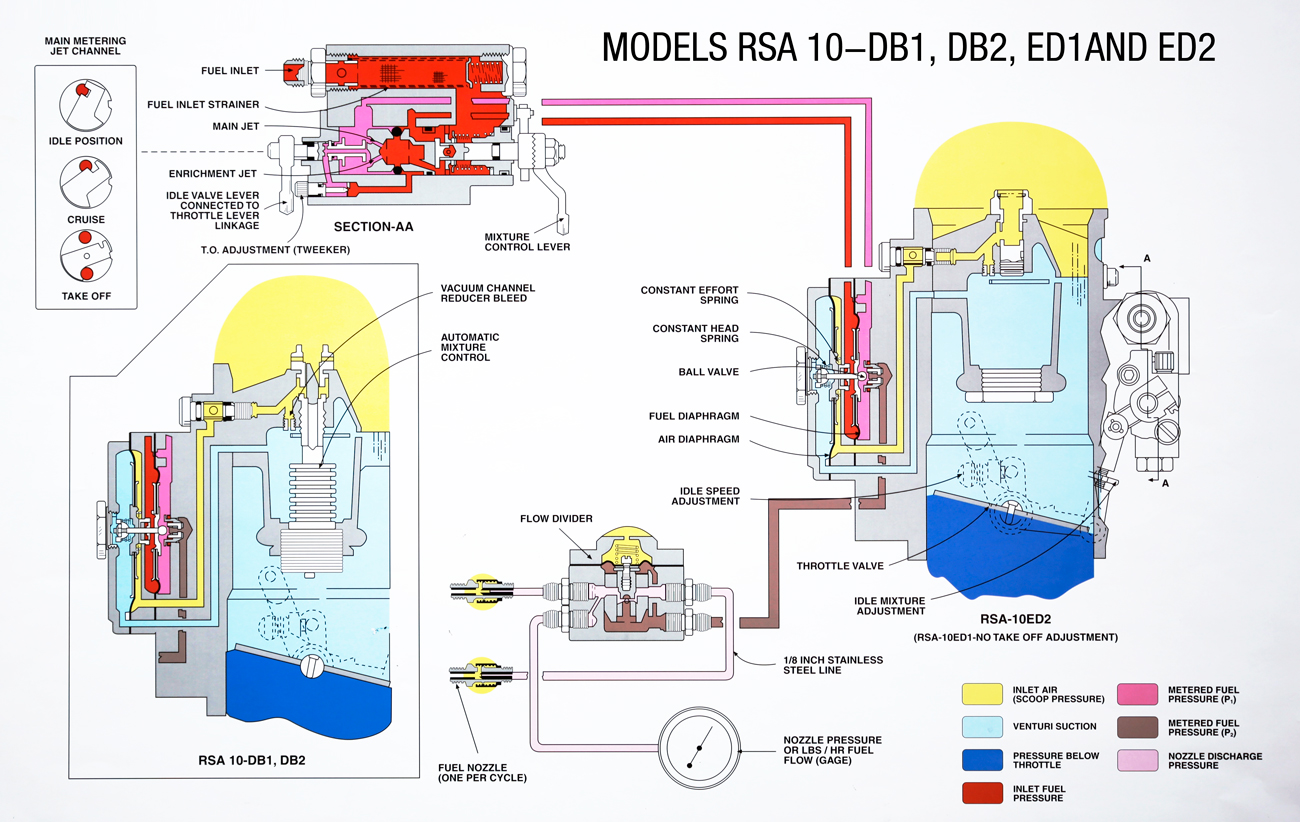
Re: Keystone Navajo Accident in Thompson
All fuel systems, carberated or fuel injected make an allowance to enrich the mixture in the take off or full power position for the purposes of cooling. This is not the reason why part throttle take offs are not recommended for the Navajo.
People should not have to fear both the government and the criminal. It should be that the criminal fears both the people and the government.
Re: Keystone Navajo Accident in Thompson
Isn't that the whole idea of partial power take-offs ? The density controller might not do its job, so you won't have max power, but you are doing a partial power take off so you "don't care" about the exact power.hoptwoit wrote:
Short answer is : It uses a density controller at max power settings. As altitude increases the turbo will increase manifold pressure to maintain rated horsepower of the engine. The density controller compensates for temperature and pressure. The idea is that all performance charts are calculated on rated horsepower 310 325 350 Hp If you don't firewall the throttle the density controller cannot do its job and you have no idea how much power you are developing.
Why would this be bad for the engine ?
As an AvCanada discussion grows longer:
-the probability of 'entitlement' being mentioned, approaches 1
-one will be accused of using bad airmanship
-the probability of 'entitlement' being mentioned, approaches 1
-one will be accused of using bad airmanship
-
crazyaviator
- Rank 7

- Posts: 671
- Joined: Sun Oct 21, 2007 7:52 pm
- Location: Ontario
Re: Keystone Navajo Accident in Thompson
Part power take-offs have been used in the airlines for years now, with sometimes disastrous consequences,, especially when the take-off weight is miscalculated 
Why anyone would do a reduced power take-off in a navajo is beyond me
Why anyone would do a reduced power take-off in a navajo is beyond me
-
upintheair_
- Rank 5
- Posts: 332
- Joined: Thu Jul 16, 2015 4:40 pm
Re: Keystone Navajo Accident in Thompson
I can only see a benefit of doing it if you're empty on a 6000'+ long paved runway. And then it's only to save fuel which benefits the company, not you. So really... just do full power take offs.

