Problem for the Aerodynamics Geeks
Moderators: sky's the limit, sepia, Sulako, lilfssister, North Shore, I WAS Birddog

Problem for the Aerodynamics Geeks
Lets say a plane flies at 120 knots on 120 HP. Theoretically with no extra losses - just increased drag - what speed does it get at 160 HP?

Re: Problem for the Aerodynamics Geeks
both are not linear so you need to know a lot of others parameters as the efficiency of your blade and so on....
You cannot predict it only with these datas i guess
(but I would say around 138^^)
You cannot predict it only with these datas i guess
(but I would say around 138^^)

Re: Problem for the Aerodynamics Geeks
Edit: Wrong math. Speed varies by the cube root of the proportional change in HP (assuming you're making 100% power in cruise), so:
(160/120)^1/3=1.10
1.10*120=132 knots.
http://www.eaa691.net/images/technotes/ ... rmance.pdf
(160/120)^1/3=1.10
1.10*120=132 knots.
http://www.eaa691.net/images/technotes/ ... rmance.pdf

Re: Problem for the Aerodynamics Geeks
Depending on what changes are made to achieve the increase in engine power, probably less than that. Without a new prop the propellor losses are likely to be proportionally higher, so the increase in useful power will be less than the factor of 160/120.
DId you hear the one about the jurisprudence fetishist? He got off on a technicality.
Re: Problem for the Aerodynamics Geeks
It'll depend on the drag polar of the airplane, the type of prop (fixed pitch vs constant speed) and the efficiency factor of the prop.
On a prop airplane, the fuel consumption is proportionnal to the power generated by the engine
On a prop airplane, the fuel consumption is proportionnal to the power generated by the engine
Going for the deck at corner
Re: Problem for the Aerodynamics Geeks
We can make some reasonable guesses though. An aircraft with a 120hp engine is likely to have a fixed pitch prop. And that 120 knots is somewhere round about more than double the best endurance airspeed of any aircraft with 120hp - so that the drag there will be strongly dominated by parasite drag. Although the induced drag will decrease with a rise in airspeed it will be a very minor decrease compared to the increase in parasite drag, which increases as the square of the airspeed. Since power scales as drag x airspeed, the airspeed obeys a one third power law with respect to useful power, as ChrisM points out.
DId you hear the one about the jurisprudence fetishist? He got off on a technicality.

Re: Problem for the Aerodynamics Geeks
about 10 to 12 knots.
The Comanche comes in a 180hp and a 250hp. at 75% power ( approx. 135 hp in the 180, and 187 hp in the 250) there is about 52 hp between them and a 20 mph cruise difference.(close to one third, but not exact)
At lower end power airplanes a rough cut is one third the hp difference.
you can even do this from the power chart of say a bonanza or Comanche with about 250 hp as you can look up the speed for 45 to 75 per cent power and the speed on the chart.
At very close to 75 % funnily enough the last "couple" of miles per hour cost one gallon an hour! they are the most expensive miles per hour... 70% power is a good bargain.... LOL
-
Meatservo
- Rank 10

- Posts: 2581
- Joined: Wed Mar 16, 2005 11:07 pm
- Location: Negative sequencial vortex
Re: Problem for the Aerodynamics Geeks
I offer a "reverse" solution to the problem, if you have actual access to a plane. Consult the power charts to figure out what power settings correspond to, say, 3/4 the horsepower at "normal cruise", then set that power setting and see what happens!
If I'd known I was going to live this long, I'd have taken better care of myself
Re: Problem for the Aerodynamics Geeks
I got 136 knots using the drag equation. Thanks for all the input everyone.
Re: Problem for the Aerodynamics Geeks
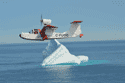
The addition of power does not always result in more speed as hoped. I own a plane which was a one of conversion from 150HP to 180HP. That modification was designed by the original designer of the aircraft. It was a failure. I have extensive experience collecting performance data on my place (back when we were trying to STC the change - and before I had purchased it), and it's un modified sister ship. Their respective performance was pretty well the same.
Though I'm not an expert in drag, I opine that for some not so sleek airframes, drag will begin to rise out of proportion to the change in speed. This, in some cases from flow separation, which begins to have a marked effect as speed increases. I have seen this with some floatplanes - more power does not equate to more speed in the expected proportion, they are just too draggy to begin with.
You can spend a lot of money trying to get a bit more speed by changing the engine, when in some cases, it would have been cheaper to just buy the next faster type of plane.

Re: Problem for the Aerodynamics Geeks
120 kts.
If your prop and RPM are constant, the cruise speed will not change.
If you put a bigger prop on with more power then you'll get that slight increase in cruise speed.
If your prop and RPM are constant, the cruise speed will not change.
If you put a bigger prop on with more power then you'll get that slight increase in cruise speed.
Re: Problem for the Aerodynamics Geeks
You see the diminishing returns rather dramatically with biplanes where its just not worth the power for speed. However power will allow a steeper faster climb of course and for aerobatics the speed is often not as important as climb 
Re: Problem for the Aerodynamics Geeks
There seems to be some confusion about the question. I'm not talking about changing the engine, I'm talking about changing the power setting. Again, disregarding all losses other than increased drag. Thanks all.
Re: Problem for the Aerodynamics Geeks
ahramin, you're not giving enough information to answer the question.
Re: Problem for the Aerodynamics Geeks
If you're supplying a power setting, you have to say where you're measuring it. 160HP shaft horse power? 160HP thrust horsepower? Who determined that a particular power setting is 160HP and how did they measure it?ahramin wrote:There seems to be some confusion about the question. I'm not talking about changing the engine, I'm talking about changing the power setting. Again, disregarding all losses other than increased drag. Thanks all.
Are we to ignore increased propellor drag? That increases too, a lot, with the increased RPM. How about crankshaft drag also?
You think you're specifying the question clearly but just saying "ignore everything but increased drag" isn't unambiguous.
Perhaps you have a magic airplane where you can gain (and measure!) 40HP of thrust power without changing the size of the prop, the blade angle or the rpm, but if that's the kind of airplane you have you should say so.
DId you hear the one about the jurisprudence fetishist? He got off on a technicality.

Re: Problem for the Aerodynamics Geeks
Something I've wondered about - is it possible to convert shaft horsepower delivered to a specific propeller into pounds of thrust?
Re: Problem for the Aerodynamics Geeks
If you have the prop efficiency factor, the SHP and the true velocity, yes.rxl wrote:Something I've wondered about - is it possible to convert shaft horsepower delivered to a specific propeller into pounds of thrust?
Going for the deck at corner
Re: Problem for the Aerodynamics Geeks
ahramin wrote:There seems to be some confusion about the question. I'm not talking about changing the engine, I'm talking about changing the power setting. Again, disregarding all losses other than increased drag. Thanks all.
You can't disregard all other losses, especially if you have a fixed pitch propeller. The efficiency of your prop is proportionnal to your true airspeed divided by the RPM of the prop and it can be significantly less at higher speeds. If you have a constant speed, then it's less of an issue but still not negligeable and it could even help you as the prop efficiency will also be affected by the blade pitch angle (and generally, higher angle means more efficient at its optimal point).
Going for the deck at corner
Re: Problem for the Aerodynamics Geeks
Ok, one more try.
1. Lets say you have a MAGIC airplane that flies at 120 knots on 120 HP.
2. Drag increases by the square of the speed.
3. Increase the thrust by 33 1/3% to 160 HP.
Q: What speed will it do? My guess is about 136 knots.
Assume: Any information missing see note 1 about magic. We're not looking for a correct answer for a specific aircraft. We're looking for a theoretical answer with a magic airplane given the information above. Call it a gross error check.
Re: Problem for the Aerodynamics Geeks
Not sure what you mean by that. I did disregard all other losses, so obviously it's possible.AuxBatOn wrote:You can't disregard all other losses
Actually, I think you may have hit upon something AuxBat. I wonder what my physics prof would have said if I just answered all exam questions with "Not enough information" and "You can't disregard diffraction when calculating free space path loss." Anyone here in University want to give it a try?
Re: Problem for the Aerodynamics Geeks
I guess you can but that would make your model probably useless because of the magnitude of the error from an accurate value it would generate. I tell you that not considering the prop efficiency will render your solution grossly innacurate in some cases.
What you did in University is apply widely accepted models that were useful for the stage of teaching.
What you did in University is apply widely accepted models that were useful for the stage of teaching.
Going for the deck at corner
Re: Problem for the Aerodynamics Geeks
Cube root of 1.33 is 1.10, so you'd expect a 10% increase in speed from 120 to 132 knots. Someone said that earlier.
Is that the answer you want? It's not what I'd expect to see in a real aircraft.
It's not a square root law: drag force goes up as the square of airspeed but work done is velocity times force, so you pick up an extra factor of v hence cube root.
Is that the answer you want? It's not what I'd expect to see in a real aircraft.
It's not a square root law: drag force goes up as the square of airspeed but work done is velocity times force, so you pick up an extra factor of v hence cube root.
DId you hear the one about the jurisprudence fetishist? He got off on a technicality.
Re: Problem for the Aerodynamics Geeks
I would think it's up to me to determine whether or not the error margin is large enough to render my question useless but thanks for the warning. In this case I'm just looking for an upper bound so any propeller efficiency error works in the direction of goodness as far as usefulness goes.
That's pretty much what I was looking for photofly, but could you link to the cube root formula you're using? Like to read a bit more about it.
And since propeller efficiency has come up, I see Sensenich has 3 different props for the C-172. The cruise one has 2" more pitch than the regular one. Does anyone know if a 172 with a cruise prop goes faster at the same percent power or does it just burn less fuel at the same speed? Or both I guess.
Re: Problem for the Aerodynamics Geeks
It's too basic to dignify with a "formula" as such, although there's nothing to stop you inventing one.
Drag force = k v^2, for some k (this is not entirely true for an airplane, but yours is magic, so we'll go with it)
Work done against a force = force x distance moved against that force
Power = rate of work = force x rate of change of position of the point of application of the force (as long as force is constant)
= force x speed against direction of force
= k x v^2 x v
= k v^3
ergo
v = (Power / k) ^ 1/3
Different pitch prop will have a different efficiency curve. A cruise prop is more efficient at turning shaft horse power into thrust horsepower at cruise speeds, so at cruise more of your 120HP does useful work against drag, and less churns up air into turbulence. At the same fuel flow you go faster, or at the same speed you use less fuel, compared to a climb prop.
DId you hear the one about the jurisprudence fetishist? He got off on a technicality.
Re: Problem for the Aerodynamics Geeks
D=Drag
Tr= Thrust required for level flight)
p=density of air
S=Effective Surface Area
Cd=Drag coeffiient
Cdo=Parasite Drag Coefficient
K=Induced Drag Coefficient
Cl=Lift Coefficient
Pr=Power Required For Level Flight
n=Prop Efficiency Factor
N=Prop RPM
D=Prop Diameter
a=0.5*p*S
L=Lift
W=Weight
Assuming a second order drag polar and no lift from thrust, incompressible flow and ignoring Reynolds Number effects,
D=0.5p*v^2*S*Cd
Cd=Cdo+KCl^2
D=a*v^2*Cdo + k*a*v^2*Cl^2
Cl=L/(a*v^2)
L=W (Level flight)
Cl=W/(a*v^2)
D=a*v^2*Cdo + k*a*v^2*W^2/
(a^2*v^4)
D=a*v^2*Cdo + k*W^2/
(a*v^2)
D=Tr (in level flight)
Tr=a*v^2*Cdo + k*W^2/
(a*v^2)
Pr = Tr * V =a*v^3*Cdo + k*W^2/
(a*v)
This is a generalized equation for the power required to maintain level flight.
Pa=power available
Ps=power at the shaft
B= Blade pitch angle
Pa=n*Ps
n=f(V, N, D, B)
Pa = f(V, N, D, B, Ps)
Once you have a model for your propeller, you make Pa=Pr and solve for V. You then have your min and max speeds, limited by power available.
For a constant speed prop, n is fairly constant over a wise range of V and N for a given prop. With a fixed pitch, n varies a lot with V and N changes.
Going for the deck at corner

