A vs. B

This forum has been developed to discuss aviation related topics.

Moderators: sky's the limit, sepia, Sulako, lilfssister, North Shore, I WAS Birddog

TG
Rank 10
Rank 10
Posts: 2105
Joined: Sun Feb 22, 2004 11:32 am
Location: Around

Re: A vs. B

Post by TG »

fixedpitch wrote:
I worry that a "culture" of automation dependence creeps in, and some pilots become very accustomed to watching automation do the job for them, and one day it doesn't. On that day, surprise! Pilot, you gotta fly it right now! (and it's not lined up, on the glidepath).
Interesting point. Is there a "culture of automation" in today's airline cockpits? I know that the Air France incident generated a lot of discussion over this - here's a Vanity Fair article that sums it up. http://www.vanityfair.com/news/business ... -447-crash
It is a lack of understanding of Automation and how it is supposed to behave in abnormal situations that has caused those recent accidents.
Not the lack of flying skill.

let me put it another way.
A thorough knowledge of Automation would have prevented those accidents, no matter the flying skill.


I am very sad to say that but that's what is happening.

---------- ADS -----------
 
Rockie
Top Poster
Top Poster
Posts: 8433
Joined: Sat Oct 08, 2005 7:10 am

Re: A vs. B

Post by Rockie »

Nark wrote:So yes you intervene.

If you're going to harp on me and my use of ECAM vs Status, I'll call you out on your "pushing" ALT. The verb, according to Airbus is Manage.
Perhaps you too should go back to school with me.
No Nark, the verb (action) is push. The mode is "managed descent".

Do us all a favour Nark, run your thrust lever technique on landing by someone in your checking department and report back to us the results.
---------- ADS -----------
 
AuxBatOn
Rank 11
Rank 11
Posts: 3283
Joined: Wed Jan 16, 2008 6:13 pm
Location: North America, sometimes

Re: A vs. B

Post by AuxBatOn »

niss wrote:
I'm curious as to how you're so versed in this? Was it x-training? I thought our Hornets weren't carrier rated.

Cheers!
I am stationned at a Naval Air Station in the US and I work with people that were part of the testing of Magic Carpet so I have an insider's view, although I have never personnally flown the system.
---------- ADS -----------
 
Going for the deck at corner
User avatar
valleyboy
Rank 8
Rank 8
Posts: 797
Joined: Tue May 03, 2016 4:05 am
Contact:

Re: A vs. B

Post by valleyboy »

Remember also that transport category aircraft are "feet on the floor"
can't agree with that statement. It's simpler to teach that than try and teach the finesse required to use rudder to help when hand spanking a heavy jet but using all controls available makes for better control and coordination.

I never had the opportunity to be involved with ACPA but ALPA in several seminars, had industry experts make the statement that deteriorating stick and rudder skills was the next biggest safety issue that the industry has to address. There were some pretty smart guys making these statements. I think maybe it's a good thing for us to listen.
---------- ADS -----------
 
Black air has no lift - extra fuel has no weight
http://www.blackair.ca
fixedpitch
Rank 2
Rank 2
Posts: 56
Joined: Sun Nov 02, 2014 11:52 am

Re: A vs. B

Post by fixedpitch »

It is a lack of understanding of Automation and how it is supposed to behave in abnormal situations that has caused those recent accidents.
Not the lack of flying skill.
In light of this thread I've been re-reading the Air France 447 accident reports and subsequent media coverage. The combined total experience of the three crew members was about 20,000 hours. The more senior copilot (Robert) was trained at France's elite aviation and engineering university, which is not exactly a Mom and Pop flying school. As TG notes the abnormal behavior of automated systems was a major factor (the frozen pitot tube): this induced surprise and panic when the airplane wasn't responding as expected. Ironically the much criticized junior copilot (Bonin) was probably trying to push the nose down continuously to break the stall but the stall warning went off each time he did because the Airbus is apparently designed not to recognize low airspeeds at high AOA (Perhaps Rockie has a perspective on this?).

In short the crew recognized they were in stall but couldn't figure out why and how to correct it. The conflicting inputs between panicked copilots didn't help. They had three minutes and thirty second before impact at 152 knots.

I don't think more Piper Cub time would have changed the outcome.
---------- ADS -----------
 
Last edited by fixedpitch on Wed Aug 10, 2016 5:16 pm, edited 1 time in total.
niss
Top Poster
Top Poster
Posts: 6745
Joined: Sat Jun 25, 2005 8:54 pm
Location: I'm a CPL trapped in a PPL's Body.
Contact:

Re: A vs. B

Post by niss »

AuxBatOn wrote:
niss wrote:
I'm curious as to how you're so versed in this? Was it x-training? I thought our Hornets weren't carrier rated.

Cheers!
I am stationned at a Naval Air Station in the US and I work with people that were part of the testing of Magic Carpet so I have an insider's view, although I have never personnally flown the system.
Neat. Thanks!
---------- ADS -----------
 
She’s built like a Steakhouse, but she handles like a Bistro.

Let's kick the tires, and light the fires.... SHIT! FIRE! EMERGENCY CHECKLIST!
AuxBatOn
Rank 11
Rank 11
Posts: 3283
Joined: Wed Jan 16, 2008 6:13 pm
Location: North America, sometimes

Re: A vs. B

Post by AuxBatOn »

valleyboy wrote:
Remember also that transport category aircraft are "feet on the floor"
can't agree with that statement. It's simpler to teach that than try and teach the finesse required to use rudder to help when hand spanking a heavy jet but using all controls available makes for better control and coordination.

I never had the opportunity to be involved with ACPA but ALPA in several seminars, had industry experts make the statement that deteriorating stick and rudder skills was the next biggest safety issue that the industry has to address. There were some pretty smart guys making these statements. I think maybe it's a good thing for us to listen.
That is a blanket statement. Depending on the control systems (not necessarily fly-by-wire but even hydro-mechanical systems), turn coordination can be provided (rolling surface to rudder interconnect, digital flight control laws, etc). Some airplanes are truly meant to be flown feet on the floor and the aircraft corrects any sideslip for you through a beta feedback (actual vane or more often through INS measurements). In a perfect transport airplane, I'd want the longitudinal controller position to provide a pitch rate, the lateral control position to provide a roll rate (that, without longitudinal inputs keep the velocity vector at the pitch attitude last commanded) and rudder pedals to command sideslip. All this with automatic turn coordination and decoupling between axis. The throttle would command a speed in cruise and an AOA in approach mode.
---------- ADS -----------
 
Going for the deck at corner
User avatar
Jack Klumpus
Rank 5
Rank 5
Posts: 379
Joined: Fri Jan 29, 2010 4:46 pm
Location: In a van down by the river.

Re: A vs. B

Post by Jack Klumpus »

Nark wrote:So yes you intervene.

If you're going to harp on me and my use of ECAM vs Status, I'll call you out on your "pushing" ALT. The verb, according to Airbus is Manage.
Perhaps you too should go back to school with me.
Hopeless.
---------- ADS -----------
 
When I retire, I’ll miss the clowns, not the circus.
CID
Rank 11
Rank 11
Posts: 3544
Joined: Sun Jun 19, 2005 6:43 am
Location: Canada

Re: A vs. B

Post by CID »

I suggest nothing. I urge you, (and everyone else reading) to consider the following and draw your own conclusion;

The crew of Swiss Air 101 followed their checklists to a T. They and their passengers are now dead.
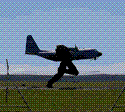
The Herc driver in the article I referenced used his own judgement of the situation and decided to diverge from the book. He and his crew are all alive. Had he continued that take off, odds are the fire would have either burned through the control cables or cooked of the giant fuel tank in the cargo area.

Procedures are a tool to be used when appropriate. They are not a replacement for judgement or airmanship.
What a bizarre notion. It's obvious to me B208 that you're not aware of the cause(s) and issues regarding this accident. First of all, I assume you meant Swissair 111, not 101. The crew did exactly what they were supposed to do and if there is no foreseeable alternative they could have reasonably executed since they had no idea that certain unessential cabin loads were on not being shed. The deficiency lies in the poor design of the cabin systems and the lack of documentation. The published procedures for smoke and fire were inadequate. There was no way for the crew to have known exactly how to remove power from the faulty system.

The published airworthiness limitations, procedures and performance information and the standard operating procedures are not "a tool to be used when appropriate". Pilots with that mentality are dangerous and should never be allowed near any aircraft with advanced automation. Published procedures and SOPs are living documents that are (should be) continuously improved as deficiencies are identified and vetted. They are the default and not the exception.

The cemeteries of the world contain far more fatalities that were the result of a pilot NOT following the published procedures than there are resulting from pilots who did. That is a simple easily verifiable fact. Statistics show that 70% of "pilot error" accidents are caused by pilots failing to follow the published procedures or exceeded an airworthiness limitation.
---------- ADS -----------
 
trey kule
Rank 11
Rank 11
Posts: 4766
Joined: Fri Aug 19, 2005 7:09 pm

Re: A vs. B

Post by trey kule »

The published airworthiness limitations, procedures and performance information and the standard operating procedures are not "a tool to be used when appropriate". Pilots with that mentality are dangerous and should never be allowed near any aircraft with advanced automation. Published procedures and SOPs are living documents that are (should be) continuously improved as deficiencies are identified and vetted. They are the default and not the exception.

The cemeteries of the world contain far more fatalities that were the result of a pilot NOT following the published procedures than there are resulting from pilots who did. That is a simple easily verifiable fact. Statistics show that 70% of "pilot error" accidents are caused by pilots failing to follow the published procedures or exceeded an airworthiness limitation.
I hope you do not mind me reprinting this and putting it up in a classroom...I will properly attribute it to "CID"
---------- ADS -----------
 
Accident speculation:
Those that post don’t know. Those that know don’t post
atphat
Rank 6
Rank 6
Posts: 462
Joined: Wed Feb 11, 2009 8:01 pm

Re: A vs. B

Post by atphat »

+1. Huge. Don't add your own flavour. It tastes really bad.
---------- ADS -----------
 
pelmet
Top Poster
Top Poster
Posts: 7979
Joined: Tue Jun 14, 2005 2:48 pm

Re: A vs. B

Post by pelmet »

CID wrote:
I suggest nothing. I urge you, (and everyone else reading) to consider the following and draw your own conclusion;

The crew of Swiss Air 101 followed their checklists to a T. They and their passengers are now dead.
The Herc driver in the article I referenced used his own judgement of the situation and decided to diverge from the book. He and his crew are all alive. Had he continued that take off, odds are the fire would have either burned through the control cables or cooked of the giant fuel tank in the cargo area.

Procedures are a tool to be used when appropriate. They are not a replacement for judgement or airmanship.
What a bizarre notion. It's obvious to me B208 that you're not aware of the cause(s) and issues regarding this accident. First of all, I assume you meant Swissair 111, not 101. The crew did exactly what they were supposed to do and if there is no foreseeable alternative they could have reasonably executed since they had no idea that certain unessential cabin loads were on not being shed. The deficiency lies in the poor design of the cabin systems and the lack of documentation. The published procedures for smoke and fire were inadequate. There was no way for the crew to have known exactly how to remove power from the faulty system.

The published airworthiness limitations, procedures and performance information and the standard operating procedures are not "a tool to be used when appropriate". Pilots with that mentality are dangerous and should never be allowed near any aircraft with advanced automation. Published procedures and SOPs are living documents that are (should be) continuously improved as deficiencies are identified and vetted. They are the default and not the exception.

The cemeteries of the world contain far more fatalities that were the result of a pilot NOT following the published procedures than there are resulting from pilots who did. That is a simple easily verifiable fact. Statistics show that 70% of "pilot error" accidents are caused by pilots failing to follow the published procedures or exceeded an airworthiness limitation.
There comes a time when the playbook should be closed and more important things done like landing. You are in a big jet near Halifax and there is a significant amount of smoke due to a fire. You are overweight for landing. Who cares. Start dumping fuel after you have directed yourself toward Halifax. You may overrun the runway. A final decision can be made at 5 miles final. Smoke is decreasing significantly, OK, maybe we can go around and continue dumping. Smoke and fire are getting worse. Screw the performance numbers and checklist completion. Continue and land.

As it says partway through the checklist in my aircraft type...."Do not delay landing in an attempt to complete the following steps".

Following all the published procedures is very nice sometimes. There was a FedEx DC-10 on fire about 15 years ago. It made it into Newburgh and burnt out on the ground. The F/O was flying and following the CID/Trey Kule/alphat line of thinking while the captain was following a different line of thinking. Here is what the captain said to the F/O part way through the descent...

"keep the speed up man, don't slow to two fifty .. we're in an emergency situation here."
http://www.tailstrike.com/050996.htm
---------- ADS -----------
 
GRK2
Rank 4
Rank 4
Posts: 263
Joined: Sun Aug 02, 2015 5:04 am

Re: A vs. B

Post by GRK2 »

Absolutely! When the options are dwindling and you need to get it on the ground, yes, by all means! Put it in the water or a field if you can't get to an airport! My checklists say the same thing. But to make sh*t up like B208 advocates because (I think he said something like "well no sh*t, I'm landing") is reckless and irresponsible and does enormous disservice to those who actually know their machines, take pride in operating safely with knowledge and class and hold the profession in high regard.

The statement by CID says it all.
---------- ADS -----------
 
User avatar
PilotDAR
Rank 11
Rank 11
Posts: 4113
Joined: Sun Sep 30, 2012 6:46 pm
Location: Near CNJ4 Orillia, Ontario

Re: A vs. B

Post by PilotDAR »

Happily, in my opinion, CID (Trey Kule) and Pelmet are all right! If human decision making were not still at the top of the food chain, automation would have the final say as to how planes are flown. Generally, pilots don't want to be, and know better than to be test pilots. So stay within the limitations and procedures - that's why they are written.

But, those of us who test fly and write those procedures can't imagine everything that could happen - we try, and there is lots of guidance material, but our imaginations are not limitless (happily, reading here helps me to expand my imagination of what I should allow for in procedures). So, if your sense of saving your own pilot butt in an emergency tells you that you're in a situation where the manual writers have not thought you could be, and you'd rather be walking away from a broken plane as a test pilot, than being carried out of a total crash, be a test pilot then - but not all the time, okay? Just know that choosing to exceed a limitation/prohibition takes you into unknown territory, and there are likely other unexpected outcomes.

I do write "prohibited" in Flight Manual Supplements I prepare, for things I have done in a plane during testing - they did not kill me. If I determine that for normal operations there is simply no need to do those things/do it that way, and there is a noticeable risk with no reward, I might prohibit it. I have never had a situation where I proposed to prohibit something, and a Transport Canada review reached a different conclusion. If a pilot wants to know why something is prohibited, or "not approved", ask, there's probably a well thought out or test result answer. It might help you to appreciate the effort that goes into certification, and preparation of procedures.....
---------- ADS -----------
 
Rockie
Top Poster
Top Poster
Posts: 8433
Joined: Sat Oct 08, 2005 7:10 am

Re: A vs. B

Post by Rockie »

valleyboy wrote:
Remember also that transport category aircraft are "feet on the floor"
can't agree with that statement. It's simpler to teach that than try and teach the finesse required to use rudder to help when hand spanking a heavy jet but using all controls available makes for better control and coordination.
As AuxBatOn says in an earlier post turn coordination and yaw damping are taken care of automatically. Cue the hounds baying about how if you don't coordinate your own turns you don't know how to fly.......
---------- ADS -----------
 
Rockie
Top Poster
Top Poster
Posts: 8433
Joined: Sat Oct 08, 2005 7:10 am

Re: A vs. B

Post by Rockie »

GRK2 wrote:Absolutely! When the options are dwindling and you need to get it on the ground, yes, by all means! Put it in the water or a field if you can't get to an airport! My checklists say the same thing. But to make sh*t up like B208 advocates because (I think he said something like "well no sh*t, I'm landing") is reckless and irresponsible and does enormous disservice to those who actually know their machines, take pride in operating safely with knowledge and class and hold the profession in high regard.

The statement by CID says it all.
As a direct result of Swissair "Smoke" checklists are:

a) printed in large bold print, and;
b) contain the words "If at any time the situation becomes unmanageable consider an immediate landing". That means on whatever surface happens to be underneath you at the time.
---------- ADS -----------
 
User avatar
complexintentions
Rank 10
Rank 10
Posts: 2186
Joined: Thu Aug 19, 2004 3:49 pm
Location: of my pants is unknown.

Re: A vs. B

Post by complexintentions »

At any rate comparing a dire emergency like an uncontrolled fire, to breaking SOP's on a routine approach is rhetorical jack-assery.

(Lookin' at you, B208).
---------- ADS -----------
 
I’m still waiting for my white male privilege membership card. Must have gotten lost in the mail.
CID
Rank 11
Rank 11
Posts: 3544
Joined: Sun Jun 19, 2005 6:43 am
Location: Canada

Re: A vs. B

Post by CID »

I have an interesting story about "common sense". Years ago I found a Flight Safety checklist in a Chieftain. It belonged to one of the pilots who informed me that it's the one he uses because the company one was garbage. I pointed out that the front cover said "TRAINING CHECKLIST - FOR TRAINING PURPOSES ONLY".

He told me that didn't matter because the chief pilot didn't have a clue. He did say that he modified one area. I don't remember the exact wording but the procedure for an engine failure during a takeoff has the pilot establish some airspeed then secure the failed engine then put the gear up. He said that was the wrong order so he used a red permanent marker to change the procedure so that the gear goes up first to "clean up" the airplane. That's just common sense right?

It was very fortunate that we were in the hangar and a Chieftain was up on jacks. I showed him what happens when you select gear up. Two massive holes open up on the belly and the airplane becomes "dirtier" for a time, not "cleaner" until the gear is sucked up and the doors close again.

The changed his mind on the altered procedure but not on the use of the Flight Safety checklist. So that was the end of our friendly relationship since I ratted him out to the Chief pilot and he got spanked hard. I have no regrets and hopefully he's a better pilot today.
---------- ADS -----------
 
crazyaviator
Rank 7
Rank 7
Posts: 671
Joined: Sun Oct 21, 2007 7:52 pm
Location: Ontario

Re: A vs. B

Post by crazyaviator »

The Swissair disaster heralded in a sea-state change in behaviour towards smoke or fire in an airliner. How many lives did it finally take to not only change SOP s but rather EMPHASIZE in the procedures and more importantly, in the minds of pilots that you really really need to get this beast on the ground PRONTO!! Now pilots can see the light and they will willingly break rules and SOP s and fear of the inevitable meeting in the chief pilot's office and do the right thing, Point that puppy dog in the right direction and get down and safe ASAP. :D
---------- ADS -----------
 
the goal is soul
Rank 1
Rank 1
Posts: 42
Joined: Wed Apr 02, 2008 7:41 pm

Re: A vs. B

Post by the goal is soul »

The thread drift towards the procedural compliance vs. deviation reminded me of an excellent article, so I dug it up and posted it below. It's a shame though that most won't find it buried here on page 4, but still worth posting.
"The goal of all cognitive training in aviation should be mental flexibility—the creation of an adaptive intellect. We want to develop a mind so nimble that it can, at one moment, lock itself securely inside a box of procedures during routine operations but, in the next, abandon this mindset to solve a neverbefore-encountered emergency for which there are no procedures."
The A vs B discussion is interesting, but it doesn't give me much to work with as a 3000 hour guy navigating his way through this career and trying to do it well. If it's that black and white, then I'm either better than everyone, or I definitely suck. I didn't get to grow up on DC3s in the bush and almost everything I've flown has been heavily automated. I'm a product of my environment, but I don't feel doomed to be handicapped my whole career because of it.

I'm responsible for developing my skills and knowledge, not the company, the 'bush school of hard knocks', or anyone else. There's a lot of solid guidance and training out there, and beyond that, some great and humble mentors. I'll take input from anyone I can get it, but I'll resist the urge to accept any single perspective as the "only way".

I'm a slightly biased follower of Kern's work - it has aligned the way I look at the profession, the work and my accountability to being really good at what I'm trusted to be really good at.
---------- ADS -----------
 
Eric Janson
Rank (9)
Rank (9)
Posts: 1437
Joined: Thu Feb 08, 2007 10:44 am

Re: A vs. B

Post by Eric Janson »

TG wrote:
fixedpitch wrote:
I worry that a "culture" of automation dependence creeps in, and some pilots become very accustomed to watching automation do the job for them, and one day it doesn't. On that day, surprise! Pilot, you gotta fly it right now! (and it's not lined up, on the glidepath).
Interesting point. Is there a "culture of automation" in today's airline cockpits? I know that the Air France incident generated a lot of discussion over this - here's a Vanity Fair article that sums it up. http://www.vanityfair.com/news/business ... -447-crash
It is a lack of understanding of Automation and how it is supposed to behave in abnormal situations that has caused those recent accidents.
Not the lack of flying skill.

let me put it another way.
A thorough knowledge of Automation would have prevented those accidents, no matter the flying skill.


I am very sad to say that but that's what is happening.
I disagree - AF 447 was caused by the (incorrect) actions of the crew. The report is very clear about that.

There is an Unreliable Airspeed procedure (changed since this accident) that was not followed. In fact there was no ECAM handling or even a clear division of tasks. Most of the inputs on the side stick were "up" inputs.

I've seen a report by a Northwest crew who had the same thing happen flying across the Pacific at night. They disconnected the automatics and flew Pitch and Power. When the airspeed came back they were within 5 knots of target speed.

Air Asia 8501 is another example where the crew stalled and crashed a perfectly flyable aircraft.

Most of the recent accidents feature a clear inability by the crew to fly the aircraft.

FCTM for both Boeing and airbus clearly state the if the automatics are not giving the desired result they must be turned off.
---------- ADS -----------
 
Always fly a stable approach - it's the only stability you'll find in this business
pelmet
Top Poster
Top Poster
Posts: 7979
Joined: Tue Jun 14, 2005 2:48 pm

Re: A vs. B

Post by pelmet »

Correct. Understanding your automation has nothing to do with holding nose up input near continuously while in a stall. I believe that Air France A330 was put in the stall because the pilot flying pitched up to more than 10 degrees at cruise altitude. Who does that in an airliner. Of course, it could be an instinctive reaction to erroneous airspeeds and likely was but you need to be aware of your typical pitch and power setting in cruise and be aware that pitching up significantly is really, really bad.
---------- ADS -----------
 
TG
Rank 10
Rank 10
Posts: 2105
Joined: Sun Feb 22, 2004 11:32 am
Location: Around

Re: A vs. B

Post by TG »

Let me try to reformulate myself.

If they had a thorough understanding of their automation systems they would not have to rely on "master hand flying skill" to save the day.
In those accidents they got caught, confused and really, really confused....


We are in a transition period.
Eventually all this automation will become more and more reliable and way simpler to operate.
Leaving hand flying totally to the ditch (talking about airliners, years down the road)


Hand flying will be like knowing how to start a fire in a wood without any help.
Less and less people know how to do that as technology takes over.
---------- ADS -----------
 
pelmet
Top Poster
Top Poster
Posts: 7979
Joined: Tue Jun 14, 2005 2:48 pm

Re: A vs. B

Post by pelmet »

TG wrote:Let me try to reformulate myself.

If they had a thorough understanding of their automation systems they would not have to rely on "master hand flying skill" to save the day.
In those accidents they got caught, confused and really, really confused....
Much of the automation was not working on the Air France flight. Manual flying skills were required in that situation along with coping with erronous indications.
---------- ADS -----------
 
User avatar
KAG
Rank 11
Rank 11
Posts: 3619
Joined: Wed Feb 18, 2004 11:24 pm

Re: A vs. B

Post by KAG »

Anything you can do, I can better, I can do anything better then you....no you can't...yes I can....Sorry this thread reminds me of that diddy.

Personally, Im using skills I acquired from my PPL days flying the 737. Also following SOP's and AC limitation are paramount to the safe and efficient operation of my machine. I also know when a situation arises that requires some thinking outside the box and/or hand flying, its not a big deal as I hand fly regularly. Not every situation can be written into the SOP's, sometimes you actually need to think for yourself.
That said I hate flying with people that think they know better, make incorrect calls or just whine about how stupid this or that SOP is. Im efficient (lazy) its just easier to fly by the book.

Automation complacency is real and it kills, so does not following SOP's, as does sub par flying skills. It's all tools in your tool box. Personally I like having a big toolbox.
---------- ADS -----------
 
The feet you step on today might be attached to the ass you're kissing tomorrow.
Chase lifestyle not metal.
Post Reply

Return to “General Comments”