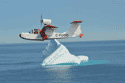
Heck, much bigger airplanes than a 172 can do better than that.A light C-172 can be landed in about 150 feet or the width of 08R at YVR.
http://m.youtube.com/watch?v=JwMlgc1saHs
Moderators: sky's the limit, sepia, Sulako, Right Seat Captain, lilfssister, North Shore

Heck, much bigger airplanes than a 172 can do better than that.A light C-172 can be landed in about 150 feet or the width of 08R at YVR.
Same, though I might add a factor if it were gusty.What approach speed would you recommend in a fifty knot wind ?
The speed I thought most appropriate to approach on a different runway!What approach speed would you recommend in a fifty knot cross wind
Since when does wind direction factor into approach speed? I've never understood the false sense of security some get by carrying extra speed in a crosswind. It just leads to that nasty floating tendency talked about earlier and makes for some spectacular displays of wrestling while the wind has all that extra time to push things off centreline and cant longitudinal axes away from straight.What approach speed would you recommend in a fifty knot cross wind
Couldn't agree more. Learning to understand, however, takes time and is becoming something of a lost art as the early drive for airline prep seems to focus on reliance on numbers, checklists and SOPs, in my opinion.Like many planes, a single Cessna will "talk to you"


Agreed, but not everyone is going to be an airlineLearning to understand, however, takes time and is becoming something of a lost art as the early drive for airline prep seems to focus on reliance on numbers, checklists and SOPs, in my opinion.




Our work here is done, Tonto.I fly nice tight circuits now

Wow, now that's a full stop.shimmydampner wrote:Heck, much bigger airplanes than a 172 can do better than that.A light C-172 can be landed in about 150 feet or the width of 08R at YVR.
There's a good (aerodynamic) reason why you might want extra airspeed in a strong crosswind. Start by asking yourself what is the aerodynamic difference between a forward slip to lose altitude and the sideslip you might use to land in a strong crosswind, particularly a crosswind strong enough to require full rudder input to keep the nose aligned with the runway.shimmydampner wrote:Since when does wind direction factor into approach speed? I've never understood the false sense of security some get by carrying extra speed in a crosswind.What approach speed would you recommend in a fifty knot cross wind
I fully agree.I don't care what the ASl says. And I don't use less flap due to a crosswind.
From my recollection of doing this many times, I don't care about a possible effect upon my rate of descent at that point, 'cause I just entered ground effect, and touched down the upwind main wheel, before I drifted across the runway. Without the excess speed to dissipate, I could get that wheel on, and the other shorty thereafter, and then just steer.Whether you use flap or not - what happens to your rate of descent when you enter a full-rudder sideslip? And what do you do about it?
So no increase in airspeed is helpful if you plan to kick out the crab only once you're in ground effect. I'd tend to agree.PilotDAR wrote:From my recollection of doing this many times, I don't care about a possible effect upon my rate of descent at that point, 'cause I just entered ground effect
Plus cheezeburger!spaner wrote: Just my opinion, it's nice to read others' without the bashing.
IMHO people place 'WAY too much importancebecause the sock is changing
I'm working on it.Colonel Sanders wrote: I would do something about it.

I would actually say airspeed and vertical speed—not height. Descending at a high rate will require a decent pull on the elevator and will increase drag quite a bit. Sometimes descending steeply (just over 3 degrees) and on speed will produce very nice conditions for landing. The flair will bleed most of the speed and you'll only require a slight decrease of power and you'll plop right down where you wanted.It seems that folks do not consider that the energy they are carrying on approach is a combination of both height and speed that must be dissipated
No. Not sure of your physics background, but for simplicityI would actually say airspeed and vertical speed—not height
My read of mgh would be mass * gravity * height, or potential energy. Maybe the comment about rate of descent was considering vertical inertia? Just guessing...Beefitarian wrote:Sorry I'm a giant ignoramus but what's mgh, mean glider height?
You did not need to take physics or much math to get a diploma back when I was trying to get out of high school in Alberta.
I like a nice steep approach too because I can bring the engine to idle and don't have to care about it failing, provided I set up a good gliding approach. The biggest problem for me is not staying current enough by flying everyday so I am not skilled enough to land on the numbers every time.

|


Use AvCanada's information at your own risk!
We reserve the right to remove any messages that we deem unacceptable.
When you post a message, your IP is logged and may be provided to concerned parties where unethical or illegal
behavior is apparent.
All rights reserved.