http://www.youtube.com/watch?v=PwsCOam4r4Q&NR
Citation doing a barrel roll. Kinda nifty...
must be fun??!
Moderators: sky's the limit, sepia, Sulako, lilfssister, North Shore, I WAS Birddog
-
Highflyinpilot
- Rank 8

- Posts: 865
- Joined: Wed Apr 21, 2004 10:30 am
- Location: Holy Hell, is that what you look like in the morning


-
sky's the limit
- Rank Moderator

- Posts: 4614
- Joined: Sat Jan 22, 2005 11:38 am
- Location: Now where's the starter button on this thing???
SKYTRAILS wrote:Kind of nifty????
Kind of stupid me-thinks.
CAR 602.01 No person shall operate an aircraft in such a reckless or negligent manner as to endanger or be likely to endanger the life or property of any person.
Also, do you think their C of A, and insurance was valid?
WHO CARES.....
How many times have these types of videos been posted, and we get all the armchair lawyers worrying about the C of A.... Good grief - it's called FUN. I know that may be a foreign concept for many of you Wanker Bar/Tie wearing types, but I say again, who cares???? Yes, yes, I know, YOU care because you may fly that airplane strraight and level at some point bla bla bla... Whatever. Not all fun is within the CARS... there's plenty to be had outside of them, and yes, every once in a while I turn left on a Red light.
I really wish some of you folks could dispense with the giant Vlasic up your arse once in a while.
STL
Skytrails.. settle down! Wasn't me doing it.. nor would I.. Just thought it entertaining that someone would post that ON a public forum such as youtube.
How can we even tell if the machine was canadian or not? Might not even fall under than massive blanket ruling TC has that you mentioned..
Hell.. you could fly straight and level and they could throw that reg at you!
Cat.. whats your opinion on this?
How can we even tell if the machine was canadian or not? Might not even fall under than massive blanket ruling TC has that you mentioned..
Hell.. you could fly straight and level and they could throw that reg at you!
Cat.. whats your opinion on this?
-
electraguy
- Rank 4

- Posts: 225
- Joined: Tue Jan 09, 2007 10:33 pm
LAME
Skytrails
I believe if you look in the dictionary there is a word called F U N Now sometimes aviation folk have been known to have some now and then. I hardly see the endagerment to anyone but themselves and hey, i rememebr an old quote that goes like this. " If you wanna make yourself into a greasy spot on some patch of desert, I don;t give a S%^t and neither does anyone else, regardless of what they say to your face. So, put away the POH, the CAR's and whatever other regulation manual you may have strapped to your nose and try it sometime! Or better yet, stop being a killjoy and let the rest of us have some fun right Rowdy?
I believe if you look in the dictionary there is a word called F U N Now sometimes aviation folk have been known to have some now and then. I hardly see the endagerment to anyone but themselves and hey, i rememebr an old quote that goes like this. " If you wanna make yourself into a greasy spot on some patch of desert, I don;t give a S%^t and neither does anyone else, regardless of what they say to your face. So, put away the POH, the CAR's and whatever other regulation manual you may have strapped to your nose and try it sometime! Or better yet, stop being a killjoy and let the rest of us have some fun right Rowdy?
Son, Your gonna have to make your mind up about growing up and becoming a pilot.. You can't do both!!
There are lots of fun things you can do in a plane but I think flying it beyond its certified envelope is irresponsible.
Go rent a aerobat if you want to barrel roll... or get your fun doing other things - fly low, big turns, run canyons, whatever... But hey that's just me...
Go rent a aerobat if you want to barrel roll... or get your fun doing other things - fly low, big turns, run canyons, whatever... But hey that's just me...
There are limits imposed on certain machines to cover liabilities. You could JUST as easily overstress an airframe from a hard landing or some moderate-severe turbulence as you could in a roll.
I'm certain the crew operating that machine knew what they were doing.. and if something had gone wrong (from the looks of it.. they had the height to recover) they were capable of handling the situation.
It would take a pretty good F90&)(* up during a gentle roll like that to cause any kind of damage.
Remember gentleman.. it's all about being smooooooth
edited to add...
Altiplano.. too true! If you wanna play.. go rent a machine to play.. or buy one.. or have fun low level
I'm certain the crew operating that machine knew what they were doing.. and if something had gone wrong (from the looks of it.. they had the height to recover) they were capable of handling the situation.
It would take a pretty good F90&)(* up during a gentle roll like that to cause any kind of damage.
Remember gentleman.. it's all about being smooooooth
edited to add...
Altiplano.. too true! If you wanna play.. go rent a machine to play.. or buy one.. or have fun low level

The plane is not certified for loops & rolls because the manufacturer cannot justify spending the extra money to certify those manuevers when they will never be used in normal operation. These planes have far higher stress limits than what they are exposed to during a perfect 1g barrel roll. If they couldn't handle a 1g barrel roll, I wouldn't want to step foot in one.
There are videos of test pilots barrel rolling 707s and other large a/c, but you wouldn't call them irresponsible criminals - but some guy you don't even know, you're happy to start jumping to conclusions!!!

There are videos of test pilots barrel rolling 707s and other large a/c, but you wouldn't call them irresponsible criminals - but some guy you don't even know, you're happy to start jumping to conclusions!!!
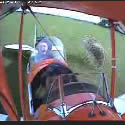

I don't think that was even a barrel roll. It was an aileron roll! During an aileron roll, the airplane rotates 360 degrees around its longitudinal axis while the nose remains pointed at a specific reference straight ahead. In other words, the airplane "twirls" around a line drawn from the tip of the nose to the tail, as if you held your outstretched arm straight and rotated your wrist and elbow. A barrel roll is a combination of a loop and a roll (often confused with the aileron roll, the barrel roll is a different animal).
http://www.stevesairshow.com/langley02/ ... unkin.html
It's kinda sad, the level of ignorance displayed by
99% of most pilots about aerobatics.
Here's a clue, in case you don't have one: a wing
has no eyeballs. It cannot tell which way is up or
down, it can only sense the relative airflow over it.
It reacts the same way EVERY TIME to the same
AOA and velocity and air density by generating lift
and drag in accordance with the formulae which I
suspect none of you are aware of.
I know you straight-and-level pilots dearly love
your man-made regulations, but for a change,
why not try learning about the laws of physics,
instead? It might come in handy sometime.
Sheesh. When I was a kid, over a 1/3 of a century
ago, my father (a just-retired F-104 test pilot) got a
job with a mining company as an engineer, and
when they were buying corporate jets, they'd
make him go fly them, and he did aerobatics in
every one of them.
He used to check pilots out on the F-104, and they
were terrified of it - all the doom-and-gloom they'd
heard about it - "you can't slow an F-104 down"!
So, the first thing he did was a stall turn (aka
hammerhead) from 10,000 feet. Pull vertical,
throttle to idle, and watch the airspeed wind down
to zero. Then kick the rudder, leave the throttle
idle, and it would go supersonic in the vertical
downline with no thrust.
At no time did the AOA exceed the stalling angle,
which is what the WING gave a shit about.
It's kinda sad, the level of ignorance displayed by
99% of most pilots about aerobatics.
Here's a clue, in case you don't have one: a wing
has no eyeballs. It cannot tell which way is up or
down, it can only sense the relative airflow over it.
It reacts the same way EVERY TIME to the same
AOA and velocity and air density by generating lift
and drag in accordance with the formulae which I
suspect none of you are aware of.
I know you straight-and-level pilots dearly love
your man-made regulations, but for a change,
why not try learning about the laws of physics,
instead? It might come in handy sometime.
Sheesh. When I was a kid, over a 1/3 of a century
ago, my father (a just-retired F-104 test pilot) got a
job with a mining company as an engineer, and
when they were buying corporate jets, they'd
make him go fly them, and he did aerobatics in
every one of them.
He used to check pilots out on the F-104, and they
were terrified of it - all the doom-and-gloom they'd
heard about it - "you can't slow an F-104 down"!
So, the first thing he did was a stall turn (aka
hammerhead) from 10,000 feet. Pull vertical,
throttle to idle, and watch the airspeed wind down
to zero. Then kick the rudder, leave the throttle
idle, and it would go supersonic in the vertical
downline with no thrust.
At no time did the AOA exceed the stalling angle,
which is what the WING gave a shit about.

Wasn't there a Lear on the american airshow circuit a while back? Not sure if he's still flying.
Oh and there are Mustangs with Lear wings on them, they do just fine at Reno...
Just to show you that in the right hands with someone who understands what they are doing it's possible and safe.
Reread what Hedley said.
Oh and there are Mustangs with Lear wings on them, they do just fine at Reno...
Just to show you that in the right hands with someone who understands what they are doing it's possible and safe.
Reread what Hedley said.
-
frontside_air
- Rank 2

- Posts: 88
- Joined: Wed Mar 08, 2006 9:34 am
- Location: on someone else's vacation
-
YYC the place to be
- Rank 3

- Posts: 172
- Joined: Wed Apr 06, 2005 8:43 am
- Location: Calgary Alberta Canada
-
No Conflict
- Rank 7

- Posts: 610
- Joined: Fri Sep 10, 2004 6:48 am
- Location: All over the friggin' place....
I do agree that the wing only senses the airflow over it, but (and I might be wrong here) aren't A/C certified for "abnormal" shit strengthened at key points?
If the load factor increases in a turn, doesn't it increase more in a barrel roll? Even if just for a small amount of time? Also forces acting on the tail and fuselage?
I'm all about having fun, but in the right places and times...
my 2cents
NC
If the load factor increases in a turn, doesn't it increase more in a barrel roll? Even if just for a small amount of time? Also forces acting on the tail and fuselage?
I'm all about having fun, but in the right places and times...
my 2cents
NC
-
Cat Driver

- Top Poster

- Posts: 18921
- Joined: Sun Feb 15, 2004 8:31 pm
Some simple rules to stay out of trouble.
(1) Fly your airplane within its certified envelope. ( normal, utility, aerobatic for simplicity. )
( 2) When performing any unusual attitude manouver know what you are doing.
(3) Get proper training in any new realm of flight or new type of flying device.
(4 ) And most important know your own limits and stay away from the outer limits of your limits.
(1) Fly your airplane within its certified envelope. ( normal, utility, aerobatic for simplicity. )
( 2) When performing any unusual attitude manouver know what you are doing.
(3) Get proper training in any new realm of flight or new type of flying device.
(4 ) And most important know your own limits and stay away from the outer limits of your limits.
The hardest thing about flying is knowing when to say no
After over a half a century of flying no one ever died because of my decision not to fly.
After over a half a century of flying no one ever died because of my decision not to fly.
The load factor only increases in a turn/bank if you try to hold altitude and airspeed at a bank angle. If I roll to 60deg bank in ANY plane,as long as I do not pull back to hold altitude, I will stay close to 1g.If the load factor increases in a turn, doesn't it increase more in a barrel roll? Even if just for a small amount of time? Also forces acting on the tail and fuselage?
Think of it this way: It's not the roll or bank that changes your direction of flight! It's the pulling back on the yoke/stick to stay at your altitude, while banked, that changes your direction. (and with that change in direction, your G loading)
This is why you can roll an airplane at 1g while your f/o pours himself a cup of coffee.
http://youtube.com/watch?v=Xp2Uc9XvmjY
-
sky's the limit
- Rank Moderator
- Posts: 4614
- Joined: Sat Jan 22, 2005 11:38 am
- Location: Now where's the starter button on this thing???
Aileron roll is correct... a barrel roll is an aileron roll with G applied to cause a corkscrew flightpath with the pitch going from level to nose high to nose low and back to level.
Learjet 35s are used by several airforces and are pushed to the edge of the envelope. The wing, with 8 spars, is 9G capable from what I was told by a US pilot who flew such missions on contract to the USAF.
Learjet 35s are used by several airforces and are pushed to the edge of the envelope. The wing, with 8 spars, is 9G capable from what I was told by a US pilot who flew such missions on contract to the USAF.
-
Dust Devil

- Rank 11
- Posts: 4027
- Joined: Fri Jun 24, 2005 10:55 am
- Location: Riderville
An aileron (aka ballistic) roll is completely different from a barrel roll, which is totally different than a slow roll, which has nothing to do with a snap roll, which is entirely different than a torque roll, which has nothing to do with a point (aka hesitation) roll.
If the above is not blindingly obvious to you, please do not attempt to perform any of the above, esp in an aircraft which is NOT certified in the aerobatic category, and thus demands that the maneuver be flown perfectly (ie with minimum G).
Would you teach yourself brain surgery? How about instrument flying? Would you recommend that a guy with no hood time head off into the nearest cloud and try to teach himself IFR flying?
FWIW ... an aileron (ballistic) roll is the most gentlest of aerobatic maneuvers. Curiously, it is orphaned by both the airshow crowd (not brutal enough) and by the contest crowd (lacks racial purity or something).
Ever seen the guy with a bucket full of water with a string tied to it, swing it over his head? The water doesn't come out when it's upside down, because of centrifugal force overcoming the 1G of gravity.
A well-flown aileron roll is similar ... when the aircraft is inverted at the apogee, it should be experiencing about a half a +ve G (give or take).
For a poorly-flown aileron roll, you need look no further than the opening scene of the movie "Battle of Britain" - a Spitfire, which has no inverted systems, chokes and pukes while inverted during badly flown aileron roll - he went negative.
With a bit of practice, you can fly an aileron roll with only +0.5G/+2.0G on the accelerometer telltale needles ... +2G in the pitch up, and down to +0.5G while inverted. You could probably get it down to +1.5G if you wanted (shrug).
btw, the guy in the original vid knew what he was doing - note the lack of nose down pitch attitude at the end of the maneuver, which is typical of novice attempts. He nicely pitched up the entry.
Obviously the slower the roll rate, the more pitched up the entry must be, to give time for the roll to complete. And, the more pitched up the entry must be, the higher the entry speed must be, because airspeed is converted to altitude during the pitch up, and you don't want to run out of airspeed at the top. This really isn't rocket science (it's actually high school level physics) but amazing few people seem to be able to comprehend it, nonetheless. I heard that most Canadians aren't able to help their children with their homework, either. Same/same I suppose.
Anyways, if you are interested in aerobatics, strap on a chute and get some dual from an experienced aerobatic instructor. If you've never been upside down before, you will learn an awful lot in one lesson.
If the above is not blindingly obvious to you, please do not attempt to perform any of the above, esp in an aircraft which is NOT certified in the aerobatic category, and thus demands that the maneuver be flown perfectly (ie with minimum G).
Would you teach yourself brain surgery? How about instrument flying? Would you recommend that a guy with no hood time head off into the nearest cloud and try to teach himself IFR flying?
FWIW ... an aileron (ballistic) roll is the most gentlest of aerobatic maneuvers. Curiously, it is orphaned by both the airshow crowd (not brutal enough) and by the contest crowd (lacks racial purity or something).
Ever seen the guy with a bucket full of water with a string tied to it, swing it over his head? The water doesn't come out when it's upside down, because of centrifugal force overcoming the 1G of gravity.
A well-flown aileron roll is similar ... when the aircraft is inverted at the apogee, it should be experiencing about a half a +ve G (give or take).
For a poorly-flown aileron roll, you need look no further than the opening scene of the movie "Battle of Britain" - a Spitfire, which has no inverted systems, chokes and pukes while inverted during badly flown aileron roll - he went negative.
With a bit of practice, you can fly an aileron roll with only +0.5G/+2.0G on the accelerometer telltale needles ... +2G in the pitch up, and down to +0.5G while inverted. You could probably get it down to +1.5G if you wanted (shrug).
btw, the guy in the original vid knew what he was doing - note the lack of nose down pitch attitude at the end of the maneuver, which is typical of novice attempts. He nicely pitched up the entry.
Obviously the slower the roll rate, the more pitched up the entry must be, to give time for the roll to complete. And, the more pitched up the entry must be, the higher the entry speed must be, because airspeed is converted to altitude during the pitch up, and you don't want to run out of airspeed at the top. This really isn't rocket science (it's actually high school level physics) but amazing few people seem to be able to comprehend it, nonetheless. I heard that most Canadians aren't able to help their children with their homework, either. Same/same I suppose.
Anyways, if you are interested in aerobatics, strap on a chute and get some dual from an experienced aerobatic instructor. If you've never been upside down before, you will learn an awful lot in one lesson.
Ah, the irony ... this critique coming from the flight instructor that authoritatively stated on this very website that gravity is a result of the earth's spinning
Better get back to work on your master's thesis!
If anyone actually cares:
A = V squared / R (1)
F = MA (2)
Substituting (1) into (2) gives:
F = M x V squared / R
So, you can quite precisely calculate the force that the idiot flight instructor says doesn't exist if you know the mass of the bucket and water, the speed it's rotating, and the length of the string.
To the idiot flight instructor: have you considered contacting your university and asking them for your tuition back? Under the circumstances, I am sure that they would seriously consider a refund
Better get back to work on your master's thesis!
If anyone actually cares:
A = V squared / R (1)
F = MA (2)
Substituting (1) into (2) gives:
F = M x V squared / R
So, you can quite precisely calculate the force that the idiot flight instructor says doesn't exist if you know the mass of the bucket and water, the speed it's rotating, and the length of the string.
To the idiot flight instructor: have you considered contacting your university and asking them for your tuition back? Under the circumstances, I am sure that they would seriously consider a refund


