Training PPL in Homebuilt

This forum has been developed to discuss flight instruction/University and College programs.

Moderators: Sulako, Right Seat Captain, lilfssister, North Shore, sky's the limit, sepia

cranne
Rank 0
Rank 0
Posts: 1
Joined: Tue Mar 18, 2008 8:35 am

Training PPL in Homebuilt

Post by cranne »

Does anyone know if its possible to do most of the PPL solo time in a homebuilt and who can sign off for the solo (commercial, CFI I-II, god....)? What do you do if it is a single seat... I have the possibility to use a smith mini or maranda...I guess the maranda is the best choice (almost a glider feeling)

I appreciate the help... :D
---------- ADS -----------
 
Hedley
Top Poster
Top Poster
Posts: 10430
Joined: Thu May 27, 2004 6:40 am
Location: CYSH
Contact:

Re: Training PPL in Homebuilt

Post by Hedley »

I have instructed (and had flight students do
flight tests) in 2-seat homebuilts. Transport
doesn't care re: homebuilt vs certified.

Single-seat makes things a LOT more difficult,
because you can't receive dual instruction in
it. You're going to need a two-seat aircraft to
receive dual flight instruction in.

You're asking if your flight instructor will send
you solo in a single-seat aircraft, after he has
checked you out in a two-seat aircraft?! Not
many flight instructors are going to be eager
to do that, but if you look hard enough, you
might find one. Transport may or may not
give him static about it. 99.999% of instructors
will tell you go fly the single-seater after you
get your licence, when it won't be their
problem any more.

Problem is that a two-seat variant is often
a very different animal than the single-seat
variant of even the same type. For example,
a Pitts S-2C is a long, heavy truck compared
to a short, light Pitts S-1C.
---------- ADS -----------
 
MichaelP
Rank (9)
Rank (9)
Posts: 1815
Joined: Mon Jun 25, 2007 3:15 pm
Location: Out

Re: Training PPL in Homebuilt

Post by MichaelP »

Solo 'training' in a single seat homebuilt is not unknown providing you are flying something similar.
If you are training in a J3 Cub then I wouldn't see any problem with the Maranda, but I can't think of too many aeroplanes similar to the Smith Miniplane.
In England you could learn on a Rollason Condor and fly a Turbulent solo, they were similar.

Insurance might be a problem...

You would have to ask Transport Canada about the ownership issue. You have to either be named on the C of R or be a close family member of someone to whom the aeroplane is personally registered.

I trained a pilot in a Kitfox II for his PPL and he owned 50% of the aircraft.
I've trained many people in homebuilt aircraft.

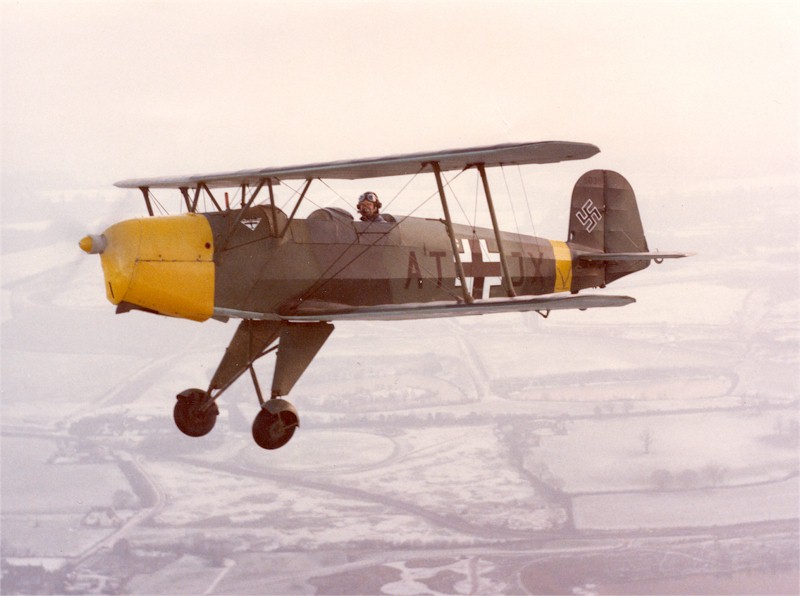
As for the Pitts S2.... Yes it's a bit of a truck, but far more aerobatic than a Cessna 172 8) and having flown one I prefer the Stampe and even better, best of all, the Jungmann :lol:

This is me over the eastern front.... (Just north of Redhill):

Image
---------- ADS -----------
 
Hedley
Top Poster
Top Poster
Posts: 10430
Joined: Thu May 27, 2004 6:40 am
Location: CYSH
Contact:

Re: Training PPL in Homebuilt

Post by Hedley »

more aerobatic than a Cessna 172
Not sure why you have a burr up your tailpipe about
this subject ... FWIW a skilled aerobatic pilot could
easily fly a sportsman category sequence - say
something like this:

http://members.iac.org/knowns/knowns200 ... n_2008.pdf

Without exceeding +4/-1, which is well within
the certification limits of the Utility category.

I can only presume that you never saw Bob
Hoover fly the Aero Commander. Pity.

Like motorcycle riding, it's all about the
operator skill.

Given your anti-metal penchant, I can only
dream about what hostility you must have towards
the RV series of aircraft performing aerobatics -
they have a penchant for ripping their wings off.

As a graduate engineer, I see little difference between
the RV series aircraft and the Cessna trainers wrt
load factor.
---------- ADS -----------
 
MichaelP
Rank (9)
Rank (9)
Posts: 1815
Joined: Mon Jun 25, 2007 3:15 pm
Location: Out

Re: Training PPL in Homebuilt

Post by MichaelP »

:lol: :lol: :lol: :lol: :lol:
The word is malicious, just plain malicious!
:twisted:
---------- ADS -----------
 
Louis
Rank 8
Rank 8
Posts: 997
Joined: Sun Feb 15, 2004 7:28 pm
Location: CYUL

Re: Training PPL in Homebuilt

Post by Louis »

Hedley wrote:the RV series of aircraft performing aerobatics -
they have a penchant for ripping their wings off.

As a graduate engineer, I see little difference between
the RV series aircraft and the Cessna trainers wrt
load factor.
Out of curiosity, would you care to elaborate on that?

Goodbye,

Louis
---------- ADS -----------
 
User avatar
Strega
Rank (9)
Rank (9)
Posts: 1767
Joined: Sun Oct 02, 2005 8:44 am
Location: NWO

Re: Training PPL in Homebuilt

Post by Strega »

Louis wrote:
Hedley wrote:the RV series of aircraft performing aerobatics -
they have a penchant for ripping their wings off.

As a graduate engineer, I see little difference between
the RV series aircraft and the Cessna trainers wrt
load factor.
Out of curiosity, would you care to elaborate on that?

Goodbye,

Louis
Ever tried to break an A150?


Ditto
---------- ADS -----------
 
MichaelP
Rank (9)
Rank (9)
Posts: 1815
Joined: Mon Jun 25, 2007 3:15 pm
Location: Out

Re: Training PPL in Homebuilt

Post by MichaelP »

FYI I have done aerobatics in both the RV4 and the RV6 aircraft.
There are certain manoeuvres to be avoided such as flick rolls, and even spinning, and so I would not consider these aircraft to be "Fully Aerobatic".

I have flown in airshows, and in movies & television, I have done aerobatics in a wide variety of aircraft, and the idea of doing aerobatics of any kind in a Cessna 172 scares me!
The Cessna 172 is a bus, it doesn't do anything very well and it is very safe, it's not meant to be sporty or fun, it's just an aerial sedan in which to go places slowly.
---------- ADS -----------
 
Hedley
Top Poster
Top Poster
Posts: 10430
Joined: Thu May 27, 2004 6:40 am
Location: CYSH
Contact:

Re: Training PPL in Homebuilt

Post by Hedley »

I have done aerobatics in both the RV4 and the RV6 aircraft
You are a braver man than I. I have dark suspicions that
6G's is closer to the ultimate (ie breaking) limit load factor
than it is to the design limit load factor. Thusly, I personally
would not pull more than +4G's in an RV, and I would be
very, very careful to keep the speed down.

Note the high Vne in an RV, and it's very low Va. If that
little gem of engineering data doesn't make you nervous,
well, perhaps the history of RV's shedding wings might. An
inexperienced pilot in an RV can easily let the speed build
quite high, and then put some G on to try to recover from
the dive, and there go the wings. Again.

The way you feel about aerobatics in a 172 is how I
feel about aerobatics in an RV :wink:

I think both of them are poor choices for aerobatics,
as is the wood-wing Citabria.

Remember, just because something is legal does
not make it safe. And vice versa.
---------- ADS -----------
 
MichaelP
Rank (9)
Rank (9)
Posts: 1815
Joined: Mon Jun 25, 2007 3:15 pm
Location: Out

Re: Training PPL in Homebuilt

Post by MichaelP »

If a pilot came back with more than +4, -1.5 g in one of my aeroplanes I'd ask what he or she had been doing.
For all standard level or sportsman level aerobatics exceeding the above gs meant that you were doing something wrong.
Aerobatics need not be stressful, and the +6, -3 tolerance is for screw-ups and not for normal use.

The oft quoted Bob Hoover never did high stress manoeuvres in the Aero Commander, he used efficient low g precise handling to achieve the best performance.

In my reckoning, a pilot trained in a Pitts S2 series aeroplane, or the Extra, for aerobatics is not as good an aerobatic pilot as one who trained on something low performance where energy management is very important.
---------- ADS -----------
 
User avatar
Strega
Rank (9)
Rank (9)
Posts: 1767
Joined: Sun Oct 02, 2005 8:44 am
Location: NWO

Re: Training PPL in Homebuilt

Post by Strega »

from the Vans website

The RV-3B, RV-4, RV-6/6A, RV-7/7A, and RV-8/8A have been designed for the operational stress limits of the aerobatic category (+6.0/-3.0 G) at and below their aerobatic gross weights. The operational stress limits for these aircraft between their aerobatic gross weights and their maximum design gross weights are utility category (+4.4/-1.75 G).

The RV-9/9A and RV-10 are not designed for aerobatic flight.

The design operational stress limit for the RV-9/9A is utility category (+4.4/-1.75 G) at less than 1600 pound gross weight and is standard category (+3.8/-1.5 G) between 1600 pounds and the aircraft’s design gross weight.

The design operational stress limit for the RV-10 is standard category (+3.8/-1.5 G).

No RV should ever be operated above its design gross weight limit.

We recommend that RV pilots limit themselves to what we like to call "sport" aerobatics; aerobatic maneuvers done solely for the enjoyment to the pilot rather than of spectators or judges. These maneuvers can be tailored to be gentle to both the airplane and the pilot. RVs can perform all the usual aerobatic maneuvers (loops, rolls, Immelman turns, horizontal 8s, etc.) very easily and gracefully at low G loads. They rarely need to dive to attain entry speeds. We have found, for instance, that in the RV-4, loops can be entered from level flight and successfully completed on 40% power. We could go on and on with such examples, but this should give you some idea of the effortless agility that awaits you in an RV.
---------- ADS -----------
 
Hedley
Top Poster
Top Poster
Posts: 10430
Joined: Thu May 27, 2004 6:40 am
Location: CYSH
Contact:

Re: Training PPL in Homebuilt

Post by Hedley »

From the NTSB database:


http://www.ntsb.gov/ntsb/brief.asp?ev_i ... 5334&key=1
AS THE AIRPLANE NEARED THE TOP OF THE LOOP MANEUVER THE WINGS FOLDED OVER THE CANOPY OF THE AIRPLANE.

The National Transportation Safety Board determines the probable cause(s) of this accident as follows:

AN OVERLOAD AND TOTAL FAILURE OF THE REAR WING ATTACH FITTING.

http://www.ntsb.gov/ntsb/brief.asp?ev_i ... 4790&key=1
The pilot exceeded the design stress limit of the aircraft, followed by the failure of the right wing main spar.

http://www.ntsb.gov/ntsb/brief.asp?ev_i ... 9658&key=1
The National Transportation Safety Board determines the probable cause(s) of this accident as follows:

in-flight failure of the right wing spar (for an undetermined reason) as the pilot was performing aerobatic flight

http://www.ntsb.gov/ntsb/brief.asp?ev_i ... 0121&key=1
The National Transportation Safety Board determines the probable cause(s) of this accident as follows:

the intentional or unintentional sudden application of aft elevator control by an undetermined aircraft occupant that exceeded the design stress limits of the aircraft.

http://www.ntsb.gov/ntsb/brief.asp?ev_i ... 1259&key=1
The National Transportation Safety Board determines the probable cause(s) of this accident as follows:

The in-flight failure of the right wing spar during aerobatic flight.
Summary: if you are not already a skilled aerobatic pilot,
if you attempt aerobatics in an RV, and you make a mistake,
you may very well shed a wing and die. Not friendly.

On a related note, the list of fatal stall/spin accidents is also
incredibly long. So much for friendly handling characteristics.
---------- ADS -----------
 
MichaelP
Rank (9)
Rank (9)
Posts: 1815
Joined: Mon Jun 25, 2007 3:15 pm
Location: Out

Re: Training PPL in Homebuilt

Post by MichaelP »

The Slingsby T67A had friendly handling characteristics as does the RV series. They're easy to fly.
But all these aeroplanes bite if aerobatics are flown by people without aerobatic training.

If they were made of wood like the Condor, Jodel and CAP 10, then they'd be a lot stronger.

The RV underlines my suspicion of metal aeroplanes for aerobatics.

Wood as used in the Pitts spars is the best material for an aerobatic aeroplane.

---------- ADS -----------
 
BoostedNihilist

Re: Training PPL in Homebuilt

Post by BoostedNihilist »

.
---------- ADS -----------
 
Last edited by BoostedNihilist on Sat Jan 02, 2010 6:46 pm, edited 1 time in total.
User avatar
Strega
Rank (9)
Rank (9)
Posts: 1767
Joined: Sun Oct 02, 2005 8:44 am
Location: NWO

Re: Training PPL in Homebuilt

Post by Strega »

MichaelP wrote:The Slingsby T67A had friendly handling characteristics as does the RV series. They're easy to fly.
But all these aeroplanes bite if aerobatics are flown by people without aerobatic training.

If they were made of wood like the Condor, Jodel and CAP 10, then they'd be a lot stronger.

The RV underlines my suspicion of metal aeroplanes for aerobatics.

Wood as used in the Pitts spars is the best material for an aerobatic aeroplane.

Can you provide me some further info on this?

Wood is a good material, but there are many others that are better ie glass
---------- ADS -----------
 
200hr Wonder
Rank 10
Rank 10
Posts: 2212
Joined: Tue Apr 26, 2005 1:52 pm
Location: CYVR
Contact:

Re: Training PPL in Homebuilt

Post by 200hr Wonder »

OK I need to jump in with a few questions.

Just some back ground, I am instructor, fly the bus of a 172 and one day plan on building a home built. I was seriously considering an RV of one designation or another. However this thread has slowed me down some.

What plane would you recommend in a home built that would be good to learn aerobatics on. 2 seater minimum cause I would be doing it with an instructor.
---------- ADS -----------
 
Cheers,

200hr Wonder
Hedley
Top Poster
Top Poster
Posts: 10430
Joined: Thu May 27, 2004 6:40 am
Location: CYSH
Contact:

Re: Training PPL in Homebuilt

Post by Hedley »

Best cheap 2-seat aerobatic trainer that I know of
is the Decathlon, either the super-D or the older
150hp that has had the metal wing retrofit.

I know, it's not a homebuilt, but buying a homebuilt
is enough of a challenge without it being an
aerobatic homebuilt trainer as well (inverted fuel
and oil systems debugged, etc).

Most efficient with your bucks is to take a basic acro
course on a super-D, say 5 or 10 hours. Then fly a
single-seat homebuilt like a Pitts S-1C or Yak 55M.
---------- ADS -----------
 
200hr Wonder
Rank 10
Rank 10
Posts: 2212
Joined: Tue Apr 26, 2005 1:52 pm
Location: CYVR
Contact:

Re: Training PPL in Homebuilt

Post by 200hr Wonder »

Well part of the exercise is to build the plane. I am 6'4" so most any aerobatic plane will need a few special mods I think.
---------- ADS -----------
 
Cheers,

200hr Wonder
Hedley
Top Poster
Top Poster
Posts: 10430
Joined: Thu May 27, 2004 6:40 am
Location: CYSH
Contact:

Re: Training PPL in Homebuilt

Post by Hedley »

Well part of the exercise is to build the plane
Ok, as long as you are up front that you are going to
spend TEN years building it, at which time you will have
forgotten much about flying, and will have to basically
start all over again, to learn to be a pilot.
I am 6'4" so most any aerobatic plane will need a few special mods I think.
I'm over 6'1" and fit fine in a Pitts. Rob Holland is much
taller than I am and fits fine into a Decathlon, Pitts S-2C,
Ultimate 10-300 and MX-2.

If you get a single seat Pitts and fly it without the canopy -
just a windscreen - all you have to worry about is legroom.
Curtis Pitts was a big guy - taller than me. Most pilots are
midgets, but not all are.

Again, you have to decide if you're going to be a
builder, or a pilot. You don't have time for both
unless you're Kermit Weeks.
---------- ADS -----------
 
200hr Wonder
Rank 10
Rank 10
Posts: 2212
Joined: Tue Apr 26, 2005 1:52 pm
Location: CYVR
Contact:

Re: Training PPL in Homebuilt

Post by 200hr Wonder »

It is all a moot point, I have no $$$ at this time, but my retirement is coming in like 30 years.
---------- ADS -----------
 
Cheers,

200hr Wonder
MichaelP
Rank (9)
Rank (9)
Posts: 1815
Joined: Mon Jun 25, 2007 3:15 pm
Location: Out

Re: Training PPL in Homebuilt

Post by MichaelP »

Can you provide me some further info on this?
Wood is a good material, but there are many others that are better ie glass
Glass is good, I did outside loops in the glass T67M with the flexibility of the wing showing!

If the glass is not properly cured then there can be disaster, the Sukhoi 31 got off to a bad start when one wing failed under load in the USA. There was big trouble over that one!

Wood is reliable, even when it fails.

In spite of what has been said here about the Citabria, although the wing spars were found to have splits and cracks they had not actually failed in flight.
One set of wings did fold in a Citabria, inverted, when the metal struts gave in!
Wood cracks, warns, cracks some more, warns some more... Wood is extremely forgiving.

Metal cracks and lets go immediately, you're dead!

Homebuilt designs

There are a lot of homebuilts that can satisfy the requirement from the two seat EAA Acro II, the Pitts S2E, the Starduster II to many French designs like the very pleasant Piel Super Emeraude, aerobatic and efficient.
There's a Jurca Scirocco for sale locally here, it's a tandem two seat wooden aerobatic aircraft.

This one has a different engine to the normal one, and many have retractable undercarriage though fixed gear is normal:
Image
---------- ADS -----------
 
Hedley
Top Poster
Top Poster
Posts: 10430
Joined: Thu May 27, 2004 6:40 am
Location: CYSH
Contact:

Re: Training PPL in Homebuilt

Post by Hedley »

http://www.tc.gc.ca/aviation/applicatio ... 5-02R1.htm
2000-25-02 R1 AMERICAN CHAMPION AIRCRAFT COMPANY (ACAC): Amendment 39-12255; Docket No. 98-CE-121-AD; Revises AD 2000-25-02, Amendment 39-12036; which superseded AD 98-05-04, Amendment 39-10365 (63 FR 10297, March 3, 1998).

(a) What airplanes are affected by this AD? This AD applies to the following airplane models, all serial numbers, certificated in any category, that are equipped with wood wing spars:

(1) Group 1 airplanes: ACAC Models 7AC, 7ACA, S7AC, 7BCM (L-16A), 7CCM (L-16B), S7CCM, 7DC, S7DC, 7EC, S7EC, 7FC, 7JC, 11AC, S11AC, 11BC, S11BC, 11CC, and S11CC airplanes that have not been modified to incorporate an engine with greater than 90 horsepower.

(2) Group 2 airplanes: ACAC Models 7ECA, 7GC, 7GCA, 7GCAA, 7GCB, 7GCBA, 7GCBC, 7HC, 7KC, 7KCAB, 8GCBC, and 8KCAB airplanes; and any of the airplane models referenced in paragraph (a)(1) of this AD that have been modified to incorporate an engine with greater than 90 horsepower.

(b) Who must comply with this AD? Anyone who wishes to operate any of the above airplanes must comply with this AD.

(c) What problem does this AD address? The actions specified by this AD are intended to detect and repair or replace damaged wood wing spars. Continued operation with such cracks and damage could progress to an in-flight structural failure of the wing with consequent loss of control of the airplane.
---------- ADS -----------
 
MichaelP
Rank (9)
Rank (9)
Posts: 1815
Joined: Mon Jun 25, 2007 3:15 pm
Location: Out

Re: Training PPL in Homebuilt

Post by MichaelP »

Continued operation with such cracks and damage could progress to an in-flight structural failure of the wing
The word is "could", the fact is that wood warns and forgives, metal doesn't.

A properly built and even a badly built wooden aeroplane is stronger and more resilient than the equivalent metal one.

I agree that left to the elements a metal aeroplane will often fare better, whereas a wooden aeroplane should be hangared, and a drafty hangar is best of all...
But I've seen horribly weathered aeroplanes of both kinds and rotten metal aircraft that should be and have been scrapped for it.

I inspected a wooden Moth-alike, that had weathered by the sea side, for a potential buyer. The fuselage was all unglued with damp rot throughout... I condemned it.
A couple of weeks later I was stunned to see it being used for joy rides... It's pilot threatened to hit me when I told him of its condition... I was trying to preserve lives.
Later he became a TC inspector and I would not do a flight test with him!
We've had discussions since then... he said he never exceeded 60 knots, and was very gentle with it.

But the thing is, even in the horrible condition this aeroplane was in, it carried on and everyone survived.
Wood rot is one thing, metal corrosion is another, and so is fatigue that is a part of every metal spar.

Yes I have done aerobatics in the RV and carefully too.
I have done not so careful aerobatics in CAP 10s, Stampes, Tigers, Jungmanns, Pitts, Eagle, and Fournier RF4D to name a few. All of these are wood.
The Stampe lost some of my confidence when the steel tie-rods gave way on one and the wings folded.
These days I am careful in the Chipmunk, while being very very naughty in the wood sparred Decathlon.
---------- ADS -----------
 
trey kule
Rank 11
Rank 11
Posts: 4766
Joined: Fri Aug 19, 2005 7:09 pm

Re: Training PPL in Homebuilt

Post by trey kule »

The oft quoted Bob Hoover never did high stress manoeuvres in the Aero Commander, he used efficient low g precise handling to achieve the best performance.
It is also a little known fact, but Bob's Aero Commander was not stock. It had been structually reinforced for his routine. While he never did high stress manouveres, the smart old fox did not take any chances....something that we could all learn from when considering aerobatic aircraft

---------- ADS -----------
 
Accident speculation:
Those that post don’t know. Those that know don’t post
MichaelP
Rank (9)
Rank (9)
Posts: 1815
Joined: Mon Jun 25, 2007 3:15 pm
Location: Out

Re: Training PPL in Homebuilt

Post by MichaelP »

The Aero Commander had a lot of Boston in it, or Havoc if you like, and it's nearest forebear was the Invader.
The aeroplane had high aspect ratio wings that were very efficient.

The Pitts wings are the Pitts! They are not efficient but they are very strong, wood braced with metal 'wires'.
Power off aerobatics in the Pitts is like a descent in an elevator when the cables snap.
The Aero Commander could use it's efficient wings to do power off aerobatics using gentle hands to milk the best performance out of her.

There are two kinds of aerobatics.

Brain capiliary busting unlimited and high G stuff, and graceful airshow style aerobatics.
I prefer the second.

To me, seeing the two RF4s doing formation aerobatics behind the 39 hp 1200cc Limbach (VW) engines was more enjoyable than an angry Pitts doing it's imitation of a bee.
I did some aerobatics in the Decathlon yesterday... +3.7g, -1.5g... I should have used nearer +4 for the roll off the top, it was a bit slow and wobbly at the top.
The stall turn went well, rolls were spot on, half reverse Cuban very good, quarter upward Cloverleaf's were good too...
the Decathlon has a very inefficient wing but it works alright.
---------- ADS -----------
 
Post Reply

Return to “Flight Training”