Page 1 of 2
VSI reversal error
Posted: Sat Apr 24, 2010 12:11 am
by minicraft
Hi,
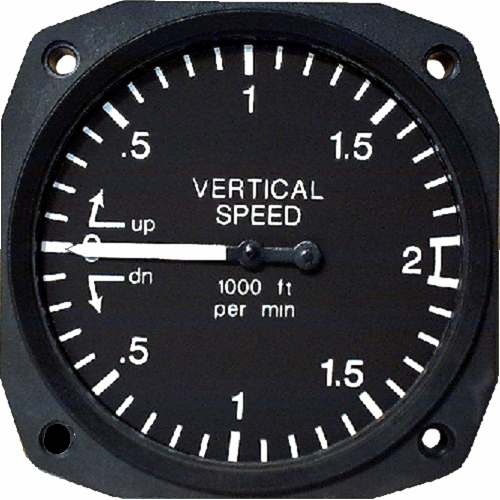
A book says "The VSI is subject to Reversal Error where abrupt changes in attitude may cause the VSI to momentarily show a change in the wrong direction."
It's hard to understand why since i'm a "Sim pilot", never experience this.
Can someone explain why does it happen ?
Thank you.
Re: VSI reversal error
Posted: Sat Apr 24, 2010 7:37 am
by BTD
The aircraft I fly has this tendency on rotation during take-off as I'm sure many other do.
The static ports for a lot of aircraft are on the tail. During rotation (or any pitch change) the tail moves the opposite direction of the way you would like the aircraft to go. On rotation when you pitch the nose up, the aircraft pivots about its main wheels and the tail actually goes down before the aircraft lifts off. As the tail goes down, the VSI indicates a descent (because the tail is going down). Once you lift off it will begin to show a climb.
It is much more noticeable during slow flight regimes where it takes longer for the aircraft to change its direction of flight. However, it also could happen at higher speed if you pitched aggressively enough.
BTD
Re: VSI reversal error
Posted: Sat Apr 24, 2010 7:58 am
by iflyforpie
Most aircraft static ports are in front of the CG and main wheels, so I wouldn't think this would be an issue with most planes. I fly one plane with the static ports on the tail, but I've never noticed anything...
I have had a VSI read a climb because an aggressive descent pushed the needle past the lowest reading (no peg) a few times...
Re: VSI reversal error
Posted: Sat Apr 24, 2010 1:00 pm
by Shiny Side Up
Probably talking out of my butt as usual, but I always was told that an abrupt pitch up puts a g-load on the VSI needle pulling it down, thus indicating a descent. An abrupt pitch down puts a negative load on the needle making it indicate a climb. An IVSI has a small set of couterweights inside which counteracts this effect.
Re: VSI reversal error
Posted: Sat Apr 24, 2010 1:10 pm
by iflyforpie
Most VSI needles (and most instrument needles period) are counterbalanced to reduce G effects...
Re: VSI reversal error
Posted: Sat Apr 24, 2010 1:15 pm
by Shiny Side Up
Which is sufficient to counteract most normal attitude changes, but not enough to counteract more abrupt ones.
edit: I should also say before some chime in that the counterweight isn't the only means they use to go about reducing g-loading effects, If I can find a good diagram liek the one I got in this old FAA "how to instruct using the Cessna book" I'll post it.
Re: VSI reversal error
Posted: Sat Apr 24, 2010 1:22 pm
by ETOPS
I've noticed this when I was flying a PA23 (Aztec).
The static ports were on both sides of the tail. It was a bit annoying. I had to wait about 2-3 sec after getting airborne (while I was clearly climbing) for the VSI to read positive in order to initiate gear up. But I would far from call by rotations abrupt...
Could it have something to do with coming out of ground effect?
Re: VSI reversal error
Posted: Sat Apr 24, 2010 1:55 pm
by 300_hour_wonder
I think it has to do with the inherent errors in a VSI. It has been awhile since i taught this stuff but I belive as VSI has a deley of 6 - 9 secs so bascially its always telling you information that is out of date. IE so if you were climbing and started decending it will show a climb while you are obviously decending. The same theory woudl apply for yoru take off senario. I would also guess that during the takeoff roll the airflow past the static port will cause changes in the air pressure in the system untill it has all stabilzed out.
Re: VSI reversal error
Posted: Sat Apr 24, 2010 2:51 pm
by BTD
300_hour_wonder wrote:The same theory woudl apply for yoru take off senario. I would also guess that during the takeoff roll the airflow past the static port will cause changes in the air pressure in the system untill it has all stabilzed out.
As I already explained the reason for the take-off scenerio is....
BTD wrote:The static ports for a lot of aircraft are on the tail. During rotation (or any pitch change) the tail moves the opposite direction of the way you would like the aircraft to go. On rotation when you pitch the nose up, the aircraft pivots about its main wheels and the tail actually goes down before the aircraft lifts off. As the tail goes down, the VSI indicates a descent (because the tail is going down). Once you lift off it will begin to show a climb.
We see as much as 300 ft per min down during rotation. When you get a long aircraft it becomes more noticeable, if the ports are on the tail.
As far as the G scenerio, I'm not sure.
Re: VSI reversal error
Posted: Sat Apr 24, 2010 2:59 pm
by 300_hour_wonder
Im sorry BTD but I have to disagreee with you on that one the plane I fly has static port forward of the main gear, Air Data Comupter, and an IVSI and it still has this same error during the take off roll and rotation (showing a decent for the first second or two of climb).
I also dont' think VSI's are accurate enough to decect a <10 foot change (In my case and even on the extreme example of a wide body it would be at most 30 ft in a few secs).
I will qualify all this with it just being my opinion if I am wrong I will happily eat my words
Re: VSI reversal error
Posted: Sat Apr 24, 2010 3:01 pm
by Lurch
ETOPS wrote: I had to wait about 2-3 sec after getting airborne (while I was clearly climbing) for the VSI to read positive in order to initiate gear up.
Whoa Whoa, wait a second, side track.

Why the heck would you have to wait for an instrument to tell you you're climbing????

What crack pot instructor did you have????

So if I understand this correctly, if the VSI was U/S you'd have to fly around with the gear down because the VSI didn't work.

Lurch
Re: VSI reversal error
Posted: Sat Apr 24, 2010 3:08 pm
by 300_hour_wonder
Lurch
I think its a "SOP" that devoloped in the FTU world that you required a positive rate on two intrsuments before bringing the gear up (i know this was the rule where I trained as well as different school where my friends trained). I suspect it has somthing to do with the fear that a student is going to try to pull a gear up without actaully being fully off the ground and wind up in a settling situation where you bang up props underbellies etc
ETOPS am I right in my guess?
Re: VSI reversal error
Posted: Sat Apr 24, 2010 3:44 pm
by ETOPS
Lurch wrote:What crack pot instructor did you have????
Come on now, there's no need for that.
300_hour_wonder wrote:I suspect it has somthing to do with the fear that a student is going to try to pull a gear up without actaully being fully off the ground and wind up in a settling situation where you bang up props underbellies etc
Its not just students that can fall pray to this:
Re: VSI reversal error
Posted: Sat Apr 24, 2010 4:17 pm
by lionheart27
With regards to this issue in basic instruments in the six pack and concerning in particular the VSI.
It should have been explained in Ground School about Pitot-Static Instruments and their function.
With regards to the VSI it relies on the Static ports,two of them, located on either side of the A/C to allow for erroneous readings such as steep bank and sideslip, etc.
Static ports are vented to allow incoming air and related pressure to the instrument in question.
The VSI has an aneroid barometer or capsule that will expand or contract accordingly to the needle in the gauge of the VSI.
Factors affecting readings:
Lag error: Due to abrupt change in altitude. Usually as mentioned 6-9 sec avg but can be more or less depending on how abrupt or smooth the transition of change is. ie yank the yoke more lag.
As mentioned counterweights are meant to eliminate some lag.
Instrument Error: Due to malfunction of gauge (rare), static blockage or leaking or breaking of VSI glass. The VSI will usually freeze in a blockage.
Maybe your AME can perform a Static check to see if there are any abnormalities.
An Instantaneous VSI can be put in at an increasing cost to eliminate lag and be more accurate.
Re: VSI reversal error
Posted: Sat Apr 24, 2010 4:33 pm
by AEROBAT
VSI's have such a huge amount of lag they are almost useless for VFR flying. The altimeter however has very little lag. Some aircraft you are starting to level off by the time the VSI catches up!
Re: VSI reversal error
Posted: Sat Apr 24, 2010 4:51 pm
by AuxBatOn
AEROBAT wrote:VSI's have such a huge amount of lag they are almost useless for VFR flying. The altimeter however has very little lag. Some aircraft you are starting to level off by the time the VSI catches up!
When I flew the Harvard II, before I became a total HUD cripple, I always used the VSI to set a rate of descent on an ILS or a PAR, in order to get a perfect 3 degree glide path. Worked like a charm.
Now, I just put the velocity vector 3 degrees below the horizon line or 2 degrees above the -5 degrees line.
Re: VSI reversal error
Posted: Sat Apr 24, 2010 4:59 pm
by AEROBAT
AuxBatOn wrote:AEROBAT wrote:VSI's have such a huge amount of lag they are almost useless for VFR flying. The altimeter however has very little lag. Some aircraft you are starting to level off by the time the VSI catches up!
When I flew the Harvard II, before I became a total HUD cripple, I always used the VSI to set a rate of descent on an ILS or a PAR, in order to get a perfect 3 degree glide path. Worked like a charm.
Now, I just put the velocity vector 3 degrees below the horizon line or 2 degrees above the -5 degrees line.
Note that I said the VSI is pretty much useless VFR. Yes....doing an ILS approach or precision app. radar they are handy. As far as I know you can't get a PAR approach civvy anymore. The only time I ever did one was at Namao.
Re: VSI reversal error
Posted: Sat Apr 24, 2010 5:06 pm
by Dust Devil
300_hour_wonder wrote:Lurch
I think its a "SOP" that devoloped in the FTU world that you required a positive rate on two intrsuments before bringing the gear up (i know this was the rule where I trained as well as different school where my friends trained). I suspect it has somthing to do with the fear that a student is going to try to pull a gear up without actaully being fully off the ground and wind up in a settling situation where you bang up props underbellies etc
ETOPS am I right in my guess?
Very well could be a SOP at some FTUs but it's a stupid SOP. Especially in VFR your eyes shouldn't be spending that much time in the cockpit. And you should be able to tell with your eyes that you have established a positive rate of climb.
Re: VSI reversal error
Posted: Sat Apr 24, 2010 5:12 pm
by 300_hour_wonder
I'm not disagreeing with you Dust Devil just saying what I have seen.
I actaully got given crap by a capt when I first started on a turboprop cause I was waiting for the IVSI to show positive in VMC conditions.
Re: VSI reversal error
Posted: Sat Apr 24, 2010 5:16 pm
by AuxBatOn
Dust Devil,
I think that confirming with 2 sources that you have a positive rate of climb is not a bad habbit. VMC I use my peripherals (ie: I see that I am climbing) and the velocity vector above the horizon bar. If the weather is crappy I will use the altimeter and the velocity vector above the horizon bar.
Re: VSI reversal error
Posted: Sat Apr 24, 2010 6:16 pm
by ETOPS
Dust Devil wrote:Especially in VFR your eyes shouldn't be spending that much time in the cockpit.
...yeah it takes about 0.5s (generous estimate) to look at the VSI and confirm a positive rate.
Re: VSI reversal error
Posted: Sat Apr 24, 2010 6:49 pm
by Dust Devil
ETOPS wrote:Dust Devil wrote:Especially in VFR your eyes shouldn't be spending that much time in the cockpit.
...yeah it takes about 0.5s (generous estimate) to look at the VSI and confirm a positive rate.
I agree glancing at it is fine but you shouldn't need it to confirm a positive rate of climb. If your ASI is looking good and the ground is moving away that should be a pretty good indicator too. My objection is the idea that you need the VSI in VFR to confirm the ground is moving away as part of some sort of SOP.
Re: VSI reversal error
Posted: Sat Apr 24, 2010 7:15 pm
by iflyforpie
For retracting gear, I was always taught to look for a visual positive rate. Even an IFR departure involves a visual takeoff. You then look at the instruments to confirm they are functioning correctly in relation to what you are seeing.
This is the final part of the instrument checks we started on the ground. We have checked during taxi all the flight instruments that we can (rolling instrument check), and during the takeoff roll we check airspeed (airspeed alive, cross-check if there are two ASIs), then we check the altimeters and VSIs to confirm they are working properly during the climb.
Re: VSI reversal error
Posted: Sat Apr 24, 2010 7:21 pm
by Dust Devil
iflyforpie wrote:For retracting gear, I was always taught to look for a visual positive rate. Even an IFR departure involves a visual takeoff. You then look at the instruments to confirm they are functioning correctly in relation to what you are seeing.
This is the final part of the instrument checks we started on the ground. We have checked during taxi all the flight instruments that we can (rolling instrument check), and during the takeoff roll we check airspeed (airspeed alive, cross-check if there are two ASIs), then we check the altimeters and VSIs to confirm they are working properly during the climb.
Perfectly reasonable.
Re: VSI reversal error
Posted: Sat Apr 24, 2010 7:24 pm
by AuxBatOn
iflyforpie wrote:For retracting gear, I was always taught to look for a visual positive rate. Even an IFR departure involves a visual takeoff. You then look at the instruments to confirm they are functioning correctly in relation to what you are seeing.
Have you ever done a low vis take off (as in 1/2 SM or less)? When the horizon is not visible and the vis is not great, it may not be readily visually apparent that you are climbing away or it is possible to confuse the rotation of the aircraft with you going up. On an IFR take off, get into the habbit of check 2 different instruments to confirm you are climbing, preferably 2 instruments that don't use the same system.