Hey everyone,
Just looking to start into a night rating. Wanted a heads up on some stuff I should start reviewing and looking into before I start ground briefings and flying. I am unfamiliar with the course breakdown.... how do I go about building the hours I need? Will all my dual be done first and then take on the solo hours or will it be back and forth? Just looking for a heads up so i can prepare at best.
Thanks again and cheers
Night Rating
Moderators: sky's the limit, sepia, Sulako, Right Seat Captain, lilfssister, North Shore
-
lissie2000
- Rank 0

- Posts: 2
- Joined: Mon Jun 28, 2010 4:37 pm
-
Shiny Side Up

- Top Poster

- Posts: 5335
- Joined: Tue Feb 17, 2004 5:02 pm
- Location: Group W bench
Re: Night Rating
Usually I'll take care of the instrument time first. A good refresher of all the topics covered in the PPL and add in the Partial Panel and make sure they're aware of the unusual attitude recoveries and especially the bear-trap places where flying at night they lurk.421.42 Requirements
(1) Private Pilot Licence - Aeroplane
(a) Experience
An applicant for a night rating shall have acquired in aeroplanes a minimum of 20 hours of pilot flight time which shall include a minimum of:
(i) 10 hours of night flight time including a minimum of:
(A) 5 hours dual flight time, including 2 hours of cross-country flight time,
(B) 5 hours solo flight time, including 10 takeoffs, circuits and landings, and
(ii) 10 hours dual instrument time.
(iii) Credit for a maximum of five hours of the 10 hours of dual instrument time may be given for instrument ground time, provided that the total instrument time shall be in addition to the 10 hours night flight time in subparagraph (a)(i) above.
The night flying usually goes with dual into to the circuit, followed by the problems at night one may encounter - landing light failure, panel light problems, etc. -as well as a good review of the usual problems, electrical problems and what not with the added challenge of the dark cockpit. Essentially you should be able to do these things blindfolded. The take off deserves special mention here and is probably the most dangerous part that people least expect about night flying. After I'm satisfied they can handle themselves near the comfortable lights of the airport, I'll let them do some solo practice. Next is the dual cross country, what to look for at night, weather minimums, judging distances. While there's no solo cross country requirement, I make them do one anyways.
Looking for stuff to read up on? Review how the instruments work, human factors on illusions and meteorolgy. Find out what the "black hole effect" is and why it kills pilots. Learn a bit about astronomy, if you somehow don't know how to find Polaris in the night sky living in this country, now's a good time to learn.
We can't stop here! This is BAT country!

Re: Night Rating
A good book to read : Sunset to Sunrise.
Read about :
Human factors (night vision, illusions, instrument-related illusions too, acuteness of senses, ...)
Aerodrome lighting
Electrical systems of your aircraft, how to cope without this or that
Weather and night flying
Navigating at night, what to look for and what not
Read about :
Human factors (night vision, illusions, instrument-related illusions too, acuteness of senses, ...)
Aerodrome lighting
Electrical systems of your aircraft, how to cope without this or that
Weather and night flying
Navigating at night, what to look for and what not
JBL
-
PanEuropean
- Rank 5

- Posts: 390
- Joined: Fri Jun 05, 2009 3:03 pm
- Location: Toronto, Canada
Re: Night Rating
Hi Lissie:
I suggest you not rush into doing the night rating too quickly after you get your PPL - gain some hours during the day to become fully comfortable with your aircraft both in the circuit and on cross-country flight.
If you rush into the night rating the moment you have the minimum experience requirements met, you will still be gaining proficiency (at a very rapid rate) at tasks that are also carried out during the day, and as a result, you will miss picking up on some of the nuances that are unique to night flight.
Michael
I suggest you not rush into doing the night rating too quickly after you get your PPL - gain some hours during the day to become fully comfortable with your aircraft both in the circuit and on cross-country flight.
If you rush into the night rating the moment you have the minimum experience requirements met, you will still be gaining proficiency (at a very rapid rate) at tasks that are also carried out during the day, and as a result, you will miss picking up on some of the nuances that are unique to night flight.
Michael
Re: Night Rating
Night flying in many ways is very much like instrument flight, and many of the same considerations apply.
As mentioned above, a night takeoff can be pretty dangerous, because often you can't see the obstacles, and you may not be aware of what the airplane is doing. Common error is to level off at an extremely hazardous low altitude. After takeoff, get on the attitude indicator and airspeed - establish and maintain a positive rate of climb until you reach a safe altitude (eg at least 500 AGL).
Know your safe altitudes. For cross-country, use the blue MEF numbers plus. Approaching an airport, use the OCC in the CFS. As a rule of thumb, do not descend below 500 AGL until you're established on the final approach track - ie extended runway centerline - and the PAPI or VASI have transitioned from red/red to red/white. Again, just like the takeoff, you may not be able to see the obstacles. A Herc learned this lesson the hard way, up in Alert a few years back. You legally don't need a PAPI or VASI but I would strongly recommend that you only use airports that have them, for now.
Be careful about the weather. Wx that you might take on during the day, avoid at night, until you get a LOT more experience. And be very aware of the dewpoint spread. Temperature drops as the night comes on, and if you've got a source of moisture, it gets pinched. When the dewpoint spread drops to 3C, get on the ground (why?)
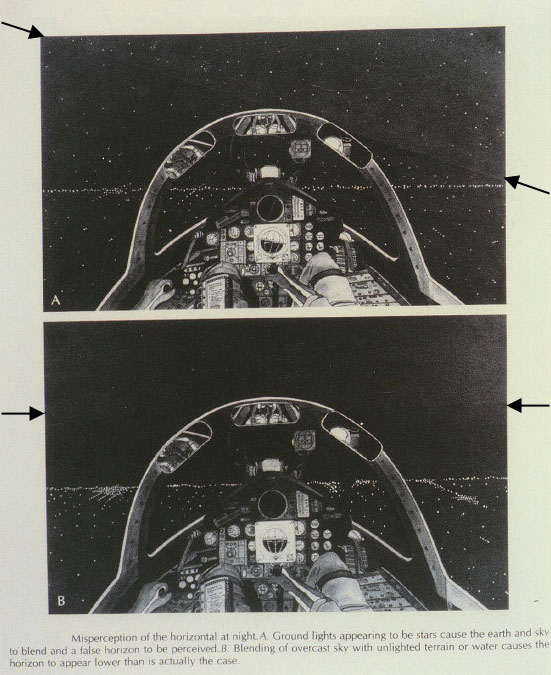
Learn about the transition. This is so common, and killed JFK, jr and his pax. You're flying along at night, lots of lights, good VFR horizon references, and you head out someplace, like over water or Alqonquin park with no lights. You will roll over into a spiral dive and die, if you don't get on the gauges. Just like whiteout. I've had plenty of students try to kill me doing this. A good lesson for them.
Remember I said night flying was a lot like IFR? You're going to need to develop many of the same skills and awareness.
As mentioned above, a night takeoff can be pretty dangerous, because often you can't see the obstacles, and you may not be aware of what the airplane is doing. Common error is to level off at an extremely hazardous low altitude. After takeoff, get on the attitude indicator and airspeed - establish and maintain a positive rate of climb until you reach a safe altitude (eg at least 500 AGL).
Know your safe altitudes. For cross-country, use the blue MEF numbers plus. Approaching an airport, use the OCC in the CFS. As a rule of thumb, do not descend below 500 AGL until you're established on the final approach track - ie extended runway centerline - and the PAPI or VASI have transitioned from red/red to red/white. Again, just like the takeoff, you may not be able to see the obstacles. A Herc learned this lesson the hard way, up in Alert a few years back. You legally don't need a PAPI or VASI but I would strongly recommend that you only use airports that have them, for now.
Be careful about the weather. Wx that you might take on during the day, avoid at night, until you get a LOT more experience. And be very aware of the dewpoint spread. Temperature drops as the night comes on, and if you've got a source of moisture, it gets pinched. When the dewpoint spread drops to 3C, get on the ground (why?)
Learn about the transition. This is so common, and killed JFK, jr and his pax. You're flying along at night, lots of lights, good VFR horizon references, and you head out someplace, like over water or Alqonquin park with no lights. You will roll over into a spiral dive and die, if you don't get on the gauges. Just like whiteout. I've had plenty of students try to kill me doing this. A good lesson for them.
Remember I said night flying was a lot like IFR? You're going to need to develop many of the same skills and awareness.

Re: Night Rating
Hedley wrote:Learn about the transition. This is so common, and killed JFK, jr and his pax. You're flying along at night, lots of lights, good VFR horizon references, and you head out someplace, like over water or Alqonquin park with no lights. You will roll over into a spiral dive and die, if you don't get on the gauges. Just like whiteout. I've had plenty of students try to kill me doing this. A good lesson for them.
http://www.jalbrecht.ca/1.php
-
. ._
- Top Poster
- Posts: 7374
- Joined: Fri Feb 20, 2004 5:50 pm
- Location: Cowering in my little room because the Water Cooler is locked.
- Contact:
Re: Night Rating
Do the rating. Have fun!
But just remember- having the rating only means that you have done it a few times in optimal conditions. You still have loads to learn.
This is what Hedley was referring to. VERY easy to do in northern Ontario with no lights on the horizon- even if you're an experienced VFR pilot.
http://www.thestar.com/news/ontario/art ... lane-crash
-istp
But just remember- having the rating only means that you have done it a few times in optimal conditions. You still have loads to learn.
This is what Hedley was referring to. VERY easy to do in northern Ontario with no lights on the horizon- even if you're an experienced VFR pilot.
http://www.thestar.com/news/ontario/art ... lane-crash
-istp
-
GoinNowhereFast
- Rank 5
- Posts: 372
- Joined: Tue Jun 02, 2009 11:35 pm
Re: Night Rating
I remember flying over Lake Superior at night with a high cloud layer. It was damn near impossible to tell the difference between the shore line and stars peeking through gaps in the clouds.
Sarcasm is the body's natural defense against stupidity


Re: Night Rating
That link was brilliant. I'm just passed my 200 hr mark so I'm trying to keep myself grounded and not get complacent. Thanks!v6g wrote:http://www.jalbrecht.ca/1.php
Re: Night Rating
Agree with probably everything said above regarding safety...
However, personally I find night flights to be some of my best flights. Usually quiet, peaceful, good air (updrafts gone, clear air, etc), nice scenery in urban areas with all those lights on the ground and sometimes lighting up the clouds when you have overcast skies. I really enjoy them.
But I would recommend you stick to areas you are familiar with in daytime. I've experienced some of the illusions discussed earlier in less then ideal conditions and I assure you they are not appreciated. And Hedley's comment about IFR, a big agreement there. In at least one of my cross country flights, I was most certainly VFR, but in how I was having to fly the plane safely, it was most definitely IFR (less the radio work). So don't even think about pushing any of your limits at night, until you have a lot of hours under your belt. Stick to areas you know and build up experience in general flying. That's my recommend.
But do go out and enjoy your night flights. Like I said they really are enjoyable.
However, personally I find night flights to be some of my best flights. Usually quiet, peaceful, good air (updrafts gone, clear air, etc), nice scenery in urban areas with all those lights on the ground and sometimes lighting up the clouds when you have overcast skies. I really enjoy them.
But I would recommend you stick to areas you are familiar with in daytime. I've experienced some of the illusions discussed earlier in less then ideal conditions and I assure you they are not appreciated. And Hedley's comment about IFR, a big agreement there. In at least one of my cross country flights, I was most certainly VFR, but in how I was having to fly the plane safely, it was most definitely IFR (less the radio work). So don't even think about pushing any of your limits at night, until you have a lot of hours under your belt. Stick to areas you know and build up experience in general flying. That's my recommend.
But do go out and enjoy your night flights. Like I said they really are enjoyable.
-
Posthumane
- Rank 7

- Posts: 651
- Joined: Sat May 09, 2009 6:16 pm
Re: Night Rating
I am in the process of doing my night rating at the moment, and concur with a lot of the things that were mentioned in the thread. My instructor has handled the training pretty much exactly as Shiny Side Up mentioned - We did most of the instrument time first, then moved on to dual circuits, followed by some solo circuit work, then a dual cross country with a few more circuits thrown in for practice, then after a few more sessions of solo circuits I just did my night cross country flight. The cross country flights were not huge trans-continent deals, but still long enough to be respectable (about 3 hours each). In total I've accumulated about 7 hours dual and 5 hours solo, and still need about half hour of instrument work to meet the time requirement, though I will probably opt to do a lot more with the instructor. This is made easier by having my own plane and an instructor who is a good friend and gives me a big discount on his time.
Most of the airports that I've flown to during the night rating have been in my local area, so I have either landed at them during the day, or in the case of a few of them have flown past them numerous times and am fairly familiar with the surroundings. While I haven't been caught out by the black hole effect, I have noticed a number of other optical illusions ("What the hell are those tall buildings ahead of us? I don't remember there being- oh wait, those are lights on the horizon past the city... Damnit!"). I've also had a radio transmit failure (while flying around an airport with ARCAL), an electrical failure (old generator system doesn't charge at low RPMs and after doing some circuits solo I power down for final and all the lights go completely dim), and have flown to airports where the ARCAL simply would not come on even though I was right over top of the airport with the radio working fine and on the right frequency (Bassano and Vauxhall). Also had to postpone a couple of flights due to finding a burn out light during the walk-around.
Night flying definitely is peaceful and enjoyable, even at this point in my training, but I agree with the previous posters about sticking to areas that you know and not getting complacent.
Most of the airports that I've flown to during the night rating have been in my local area, so I have either landed at them during the day, or in the case of a few of them have flown past them numerous times and am fairly familiar with the surroundings. While I haven't been caught out by the black hole effect, I have noticed a number of other optical illusions ("What the hell are those tall buildings ahead of us? I don't remember there being- oh wait, those are lights on the horizon past the city... Damnit!"). I've also had a radio transmit failure (while flying around an airport with ARCAL), an electrical failure (old generator system doesn't charge at low RPMs and after doing some circuits solo I power down for final and all the lights go completely dim), and have flown to airports where the ARCAL simply would not come on even though I was right over top of the airport with the radio working fine and on the right frequency (Bassano and Vauxhall). Also had to postpone a couple of flights due to finding a burn out light during the walk-around.
Night flying definitely is peaceful and enjoyable, even at this point in my training, but I agree with the previous posters about sticking to areas that you know and not getting complacent.
"People who say it cannot be done should not interrupt those who are doing it." -George Bernard Shaw

Re: Night Rating
I'll give it a try:Hedley wrote: When the dewpoint spread drops to 3C, get on the ground (why?)
Dry adiabatic lapse rate is around 3 degrees per 1000 feet, so chances are good you'll encounter clouds as low as 1000 feet AGL.
Think ahead or fall behind!
-
Shiny Side Up
- Top Poster
- Posts: 5335
- Joined: Tue Feb 17, 2004 5:02 pm
- Location: Group W bench
Re: Night Rating
Combine a little get-home-itis and the above conditions and it will unfortunately get an experienced pilot.
http://wwwapps.tc.gc.ca/Saf-Sec-Sur/2/c ... srchtype=1
Fog is nasty at night, usually because you won't be able to see it until you're in it. Lit airports are easy to see when you fly over them, perhaps even more so than in the day time. Its very tempting to make the approach. Be wary. You lose sight of the runway during these conditions, get climbing and be on those instruments. If you're going to fly at night regularly, do instrument practice regularly, don't just fill the requirements.
http://wwwapps.tc.gc.ca/Saf-Sec-Sur/2/c ... srchtype=1
Fog is nasty at night, usually because you won't be able to see it until you're in it. Lit airports are easy to see when you fly over them, perhaps even more so than in the day time. Its very tempting to make the approach. Be wary. You lose sight of the runway during these conditions, get climbing and be on those instruments. If you're going to fly at night regularly, do instrument practice regularly, don't just fill the requirements.
We can't stop here! This is BAT country!
Re: Night Rating
If it's a nice clear night with an inversion, it won't be long before fog forms on the ground, better be down there before it appears.trampbike wrote:I'll give it a try:Hedley wrote: When the dewpoint spread drops to 3C, get on the ground (why?)
Dry adiabatic lapse rate is around 3 degrees per 1000 feet, so chances are good you'll encounter clouds as low as 1000 feet AGL.
JBL
Re: Night Rating
Good point! I did not think about inversions.
Think ahead or fall behind!
Re: Night Rating
The most important lesson I have been taught happened by accident after I recieved my night rating.
The training for my rating was all done in very good visibility always 15+, my instructor and I went over things like black hole effect, taking off over a lake at night etc. etc.
I recieved my rating within a couple of weeks, and started flying at night consistantly.
Until one evening in the summer when I managed to scare the crap out of myself.
I went out in 7 miles visibility and smoggy with 15 knots of wind, over an area with very little surface lighting.
It was the first time I had ever actually been scared in an aircraft, I very quickly began to lose my cool.
Reasons being, I could no longer identify land marks, became disoriented and could not pin point my position via the map.
While I could see the ground, the effect of the wind pushing the plane sideways and the lack of a visible horizon made it feel like it was constantly turning even though it was flying straight.
Nothing in the trainign for the night rating had prepared me for that. I made it back to the airport by following a VOR radial until I recognized some towns.
I never really told anyone how close that came to being a serious emergency for me.
So two lessons, Night flying is not Day flying, and know your personal limitiations.
The training for my rating was all done in very good visibility always 15+, my instructor and I went over things like black hole effect, taking off over a lake at night etc. etc.
I recieved my rating within a couple of weeks, and started flying at night consistantly.
Until one evening in the summer when I managed to scare the crap out of myself.
I went out in 7 miles visibility and smoggy with 15 knots of wind, over an area with very little surface lighting.
It was the first time I had ever actually been scared in an aircraft, I very quickly began to lose my cool.
Reasons being, I could no longer identify land marks, became disoriented and could not pin point my position via the map.
While I could see the ground, the effect of the wind pushing the plane sideways and the lack of a visible horizon made it feel like it was constantly turning even though it was flying straight.
Nothing in the trainign for the night rating had prepared me for that. I made it back to the airport by following a VOR radial until I recognized some towns.
I never really told anyone how close that came to being a serious emergency for me.
So two lessons, Night flying is not Day flying, and know your personal limitiations.
-
Big Pistons Forever
- Top Poster
- Posts: 5959
- Joined: Wed Feb 18, 2004 7:17 pm
- Location: West Coast
Re: Night Rating
There was a study done by a US based flight safety organization. They looked at the accident rate for non instrument rated PPL's flying single engine airplanes at night.
The results were shocking. Expressed as the fatal accidents per 100,000 hrs (the usual metric for comparing accident rates), your average PPL was approximetly 25 times more likely to have a fatal accident when flying at night compared to the same trip flown during the day. IMO flight schools need to be more proactive in educating students on the actual dangers of night flight for non instrument rated pilots flying single engine aircraft at night. If asked to do a night rating I start with a ground brief that goes through a sample flight and focuses solely on the unique to night flight risks that exist at every part of the planning and execution of the flight....then I start the night rating training
The results were shocking. Expressed as the fatal accidents per 100,000 hrs (the usual metric for comparing accident rates), your average PPL was approximetly 25 times more likely to have a fatal accident when flying at night compared to the same trip flown during the day. IMO flight schools need to be more proactive in educating students on the actual dangers of night flight for non instrument rated pilots flying single engine aircraft at night. If asked to do a night rating I start with a ground brief that goes through a sample flight and focuses solely on the unique to night flight risks that exist at every part of the planning and execution of the flight....then I start the night rating training
Re: Night Rating
Until someone gets a lot more experience, I might humbly suggest the following:25 times more likely to have a fatal accident when flying at night
1) fly with MUCH better wx, at night, than you would tackle during the day. Night and bad wx is often a fatal combination for low-time (VFR-only) private pilots. As I said before, watch the dewpoint spread. When it gets down to 3 degrees, get on the ground.
2) know your safe altitudes. After takeoff, how high do you need to climb before you can turn? And, in what direction? What is a safe enroute altitude? A safe altitude in the vicinity of the airport? How to fly the circuit safely?
3) learn to fly on the gauges. Learn to quickly to transition them, and learn to trust them, not your inner ear. Night VFR can be an awful lot like IFR, IMHO.
4) have at least one GPS. Don't get lost - take your nav a bit more seriously than you might during the day. Hold a heading, have an ETA so that if your GPS (electrical) dies, you can get there with your vacuum-driven gyros and your watch.
5) Once you learn a little about the above, and about night flying, it's not big deal. It's quite nice, actually. But the problem when you are starting out is that you lack the situational awareness to realize what you are taking on.
-
Shiny Side Up
- Top Poster
- Posts: 5335
- Joined: Tue Feb 17, 2004 5:02 pm
- Location: Group W bench
Re: Night Rating
One thing not mentioned about weather as of yet is watch out when dealing with crosswinds in the dark. If you don't do it often it can be very decieving judging how strong it might be drifting you, those I've seen pull off the crab-kick method often will do it too late and make a path in the weeds. The frequency that this happens is a lot more than one would think - judging by how often we have to repair runway lights and find mysterious tracks in the snow, gravel or grass in the morning.1) fly with MUCH better wx, at night, than you would tackle during the day.
We can't stop here! This is BAT country!
Re: Night Rating
On the subject of landing in the dark ... people often have difficulty judging their height, for the flare, at night, even at their home airport. Many hard landings occur in the dark! As you might imagine, it gets worse with unfamiliar runways and illusions created by different runway width which can often cause problems judging height during the flare, even during the daytime.
People are often surprised as how well the "glassy water" landing technique works at night, which is what you do if the landing light is U/S. Don't flare - just set a little power with a gentle descent rate, enter ground effect, touch down, and reduce power.
Again, this stuff is not rocket science, it just has to be learned. Once you get some experience at it, you really won't care if you're landing or taking off during the day or night.
People are often surprised as how well the "glassy water" landing technique works at night, which is what you do if the landing light is U/S. Don't flare - just set a little power with a gentle descent rate, enter ground effect, touch down, and reduce power.
Again, this stuff is not rocket science, it just has to be learned. Once you get some experience at it, you really won't care if you're landing or taking off during the day or night.


Re: Night Rating
Hedley,
You've given some very good information. Thanks. One question though, and this I found confusing during my night training.
The definition of night is 1/2 hr after sunset. It was at this point that we were told to start the aircraft engine in order to be in true night conditions and have T/O and landings count as night T/O and landings.
If you are flying just before sunset, and return to land during the night, and do circuits, do the circuits count as Day landings or Night landings? Do you have to taxi off, shut down the engine and relight her in order to be in night conditions (by definition)?
Karl.
You've given some very good information. Thanks. One question though, and this I found confusing during my night training.
The definition of night is 1/2 hr after sunset. It was at this point that we were told to start the aircraft engine in order to be in true night conditions and have T/O and landings count as night T/O and landings.
If you are flying just before sunset, and return to land during the night, and do circuits, do the circuits count as Day landings or Night landings? Do you have to taxi off, shut down the engine and relight her in order to be in night conditions (by definition)?
Karl.

Re: Night Rating
You can log split day and night time in one flight. If you're doing circuits through the sunset time, you'll have some day take offs and landings, and some night take off and landings... if you take off during the day, land at night, that counts as one day take off, and one night landing. In the latter case, it only really matters if you need these take offs and landings for currency requirements though.kzcvtm wrote:Hedley,
You've given some very good information. Thanks. One question though, and this I found confusing during my night training.
The definition of night is 1/2 hr after sunset. It was at this point that we were told to start the aircraft engine in order to be in true night conditions and have T/O and landings count as night T/O and landings.
If you are flying just before sunset, and return to land during the night, and do circuits, do the circuits count as Day landings or Night landings? Do you have to taxi off, shut down the engine and relight her in order to be in night conditions (by definition)?
Karl.
Re: Night Rating
No kidding... I've taught a massive number of night ratings back when I was an instructor, and I'm sure that this has caused me to be a few inches shorter.Hedley wrote:On the subject of landing in the dark ... people often have difficulty judging their height, for the flare, at night, even at their home airport. Many hard landings occur in the dark! As you might imagine, it gets worse with unfamiliar runways and illusions created by different runway width which can often cause problems judging height during the flare, even during the daytime.
People are often surprised as how well the "glassy water" landing technique works at night, which is what you do if the landing light is U/S. Don't flare - just set a little power with a gentle descent rate, enter ground effect, touch down, and reduce power.
Again, this stuff is not rocket science, it just has to be learned. Once you get some experience at it, you really won't care if you're landing or taking off during the day or night.
I found that most students starting out at night, have this unstoppable tendency to stare at the little spot on the runway in front of them that is lit by the landing light, even though I tell them not to. This usually results in wheelbarrowing or a really hard landing. So I started off the first night circuits with the landing light off. It might seem more difficult at first, but it develops better habits right from the start. After a few circuits when the student can get the plane on the ground relatively smoothly with the landing light off, they would graduate to using the landing light to light up a spot on the runway for *reference*, rather than getting fixated on it. As you're doing your solos, and once you have your night rating, it's good to keep practicing things like landing with no landing lights, or no lights in the cockpit.

Re: Night Rating
Night flying can be quite enjoyable, but also quite dangerous if you're not fully prepared for it.
-Fatigue is a major item that you need to be aware of and manage (ie. if you're tired, not a good time for a flight). Since most people sleep at night, they tend to be tired unless it's: a) early evening; b) they work night shifts; or c) they're night hawks (like myself). It never ceases to surprise students of mine how much fatigue affects their performance.
-I also like to take my night students up to an area around our home airport where there are NO lights and show them what it's like. I'll get them to fly up that direction with the hood on and then have them pop it off when we get over the area so that they can see the complete lack of visual reference. If there is a thick enough cloud layer above to obscure the stars/moon, it is exactly the same as flying in IMC. It can be a bit of an eye-opener.
-Clouds are a tough one to spot, but there are some tell-tail signs of them approaching at night. Even for a pilot who does a bit of night flying, they can still sneak up on you. If you're looking ahead, navigating, and the lights on the ground in front of you are gradually disappearing, you're approaching cloud with a base that is lower than your current altitude. Either turn around or descend to you minimum safe altitude for the area. DO NOT GO BELOW IT!!! If you have to choose between one of those items, turn around. If you're climbing, and things start to get fuzzy looking, you're skimming the base of the cloud. Return to your previous safe position. If that was the airport, then that might be the best place for you for the night. If you're unsure of your position, ask for assistance from ATC or ATS that has RADAR.
-It's amazing how fast clouds can form after the sun sets. I had a good reminder of that myself this evening. Working around the same general altitude and area for the past 45 minutes, I had been watching the clouds and noted that there was no change in their position (at least 1000ft above). Just as we're heading back to the airport (at 4000'), we're listening to the ATIS. It states that there are FEW at 4000. I though that was interesting, given that I had observed zero cloud in the last 45 mins at 4000', or even close to it (during the day, now night). Within a few seconds of hearing that (I really mean 3-4 seconds after!), I start seeing lights ahead disappearing. Realizing that we were approaching a cloud layer, I immediately took control (student under the hood, and VFR) and descended to 3500', knowing that my min safe for the area was around 1200-1500' ASL. Now below the cloud layer that we were approaching, we continued to the airport for an uneventful landing. In under 15-20 mins it went from 0 cloud at our altitude, to a full on overcast. Be vigilant!
-Fatigue is a major item that you need to be aware of and manage (ie. if you're tired, not a good time for a flight). Since most people sleep at night, they tend to be tired unless it's: a) early evening; b) they work night shifts; or c) they're night hawks (like myself). It never ceases to surprise students of mine how much fatigue affects their performance.
-I also like to take my night students up to an area around our home airport where there are NO lights and show them what it's like. I'll get them to fly up that direction with the hood on and then have them pop it off when we get over the area so that they can see the complete lack of visual reference. If there is a thick enough cloud layer above to obscure the stars/moon, it is exactly the same as flying in IMC. It can be a bit of an eye-opener.
-Clouds are a tough one to spot, but there are some tell-tail signs of them approaching at night. Even for a pilot who does a bit of night flying, they can still sneak up on you. If you're looking ahead, navigating, and the lights on the ground in front of you are gradually disappearing, you're approaching cloud with a base that is lower than your current altitude. Either turn around or descend to you minimum safe altitude for the area. DO NOT GO BELOW IT!!! If you have to choose between one of those items, turn around. If you're climbing, and things start to get fuzzy looking, you're skimming the base of the cloud. Return to your previous safe position. If that was the airport, then that might be the best place for you for the night. If you're unsure of your position, ask for assistance from ATC or ATS that has RADAR.
-It's amazing how fast clouds can form after the sun sets. I had a good reminder of that myself this evening. Working around the same general altitude and area for the past 45 minutes, I had been watching the clouds and noted that there was no change in their position (at least 1000ft above). Just as we're heading back to the airport (at 4000'), we're listening to the ATIS. It states that there are FEW at 4000. I though that was interesting, given that I had observed zero cloud in the last 45 mins at 4000', or even close to it (during the day, now night). Within a few seconds of hearing that (I really mean 3-4 seconds after!), I start seeing lights ahead disappearing. Realizing that we were approaching a cloud layer, I immediately took control (student under the hood, and VFR) and descended to 3500', knowing that my min safe for the area was around 1200-1500' ASL. Now below the cloud layer that we were approaching, we continued to the airport for an uneventful landing. In under 15-20 mins it went from 0 cloud at our altitude, to a full on overcast. Be vigilant!
Gravity lands us, we just make it look good.
Re: Night Rating
Wow, some really excellent tips in here, I have my notepad out!
US pilots get night privileges with their PPL and no extra training correct? Are the stats as bad for Canadian pilots (who have to take a separate course)
US pilots get night privileges with their PPL and no extra training correct? Are the stats as bad for Canadian pilots (who have to take a separate course)


