
According to their respective POHs, the old 152's have a best glide ratio of 8:1, losing about 750ft of altitude to glide 1nm, at the best glide speed of 60kts (max gross weight).
The older 172's have a best glide ratio of 9:1, losing about 670-ish feet of altitude to glide 1nm, at the best glide speed of 65kt at max gross).
An older 182 has a best glide ratio of 10:1, losing about 600 feet of altitude to glide 1nm, at a best glide speed of 70kts (at max gross).
You might have thought the lighter aircraft would go further, but it's the other way around.
And according to various sources, the best glide ratio of the 767 (Gimli Glider) is about 12:1.
Maybe that might help in the wisp-catching.
Interesting factoid about Cessna trainers
Moderators: Sulako, Right Seat Captain, lilfssister, North Shore, sky's the limit, sepia

Re: Interesting factoid about Cessna trainers
Interesting. However, glide ratios have nothing to do with weight and everything to do with the lift/drag ratio of the aircraft.
-
iflyforpie
- Top Poster

- Posts: 8132
- Joined: Tue Apr 15, 2008 12:25 pm
- Location: Winterfell...
Re: Interesting factoid about Cessna trainers
Most likely it was because Cessna changed their airfoils in the mid-70s to have a STOL cuff.
Re: Interesting factoid about Cessna trainers
Right. But isn't it curious that of the three similar-looking Cessna singles, the heaviest has the best l/d ratio?Bede wrote:Interesting. However, glide ratios have nothing to do with weight and everything to do with the lift/drag ratio of the aircraft.
Does anyone have a 206 POH?
-
Colonel Sanders

- Top Poster
- Posts: 7512
- Joined: Sun Jun 14, 2009 5:17 pm
- Location: Over Macho Grande
Re: Interesting factoid about Cessna trainers
Retractable gear makes a HUGE difference.
Less drag, farther glide.
Cessnas also have struts hanging out. Don't
see that on Boeings and Airbuses, which are
designed to be very slippery indeed.
Less drag, farther glide.
Cessnas also have struts hanging out. Don't
see that on Boeings and Airbuses, which are
designed to be very slippery indeed.
Re: Interesting factoid about Cessna trainers
Wheel pants too, I suspect. 150's don't have them, but they're standard equipment on a 172 so all the book performance figures include them. I think you get a lot of drag off an unfaired tire. As an aside I think a lot of the complaints about the poor performance of old 172s compared to book is because they're being flown without the wheel pants.
-
Liquid Charlie
- Rank (9)

- Posts: 1461
- Joined: Thu Oct 25, 2007 7:40 am
- Location: YXL
- Contact:
Re: Interesting factoid about Cessna trainers
It's physics -- everything else the same -- heavier airplane has more potential energy and will glide farther -- any jet pilot knows this -- 
-
Instructor_Mike
- Rank 3

- Posts: 157
- Joined: Sun Aug 12, 2012 2:40 pm
- Location: Manitoba
Re: Interesting factoid about Cessna trainers
CF-104 anyone? AKA the flying lawndartLiquid Charlie wrote:It's physics -- everything else the same -- heavier airplane has more potential energy and will glide farther -- any jet pilot knows this --


-
frozen solid
- Rank 7

- Posts: 527
- Joined: Fri Feb 22, 2008 6:29 pm
Re: Interesting factoid about Cessna trainers
Competitive sailplanes carry water ballast... I think it's in order to zoom around looking for thermals and then when they find one they drop the weight. I've always intended to go and get some training in sailplanes, it sounds fascinating.
-
Colonel Sanders
- Top Poster
- Posts: 7512
- Joined: Sun Jun 14, 2009 5:17 pm
- Location: Over Macho Grande
Re: Interesting factoid about Cessna trainers
Sigh.
PS F-104 high key was 20,000 feet.
PS F-104 high key was 20,000 feet.
-
Schooner69A
- Rank 7
- Posts: 639
- Joined: Thu Nov 06, 2008 5:17 pm
- Location: The Okanagan
Re: Interesting factoid about Cessna trainers
That was one thing about being on the CF-5... Didn't have to practice forced landings!
John
John
Re: Interesting factoid about Cessna trainers
Photofly,
At a best glide of 75 KIAS the 1979 U206G has a glide ratio of about 8.8 to 1, losing 700 feet per nautical mile.
At a best glide of 75 KIAS the 1979 U206G has a glide ratio of about 8.8 to 1, losing 700 feet per nautical mile.

Re: Interesting factoid about Cessna trainers
I think the jet ranger had about 4:1. Slightly better than a brick.
Check out this thing and notice the aggressive flare needed to arrest the rate of descent. It probably has a much worse glide ratio.
http://www.youtube.com/watch?v=4JqmoWAhv5g
Check out this thing and notice the aggressive flare needed to arrest the rate of descent. It probably has a much worse glide ratio.
http://www.youtube.com/watch?v=4JqmoWAhv5g

Re: Interesting factoid about Cessna trainers
As already stated above: weight has a large effect on the best glide speed but very little effect on the best glide ratio.
Water ballast in gliders is used to improve the speed by flying faster between thermals. If you dumped your water every time you found a thermal, how would you get the water back in at the top of the thermal?
Water ballast in gliders is used to improve the speed by flying faster between thermals. If you dumped your water every time you found a thermal, how would you get the water back in at the top of the thermal?
Re: Interesting factoid about Cessna trainers
A big funnel, and fly under another glider dumping ballast.
-
iflyforpie
- Top Poster
- Posts: 8132
- Joined: Tue Apr 15, 2008 12:25 pm
- Location: Winterfell...
Re: Interesting factoid about Cessna trainers
Don't be silly.... they have on-board condensers. 
Re: Interesting factoid about Cessna trainers
Yes.Does anyone have a 206 POH
1979 U206G POH states 15 miles from 10,500, so 7.5:1 (GW 3600 lbs, WL 20.7 PSF)
I chose 10,500 as two miles, 'cause it was easier to read off the chart directly with some accuracy.
Speaking from first hand experience, I once did "glide" a U206G, with the engine running at complete idle the whole way, 35 miles, through 12,700 feet of altitude loss, but I expect that a favourable tailwind, and a few thermals (Oh, look! wisps!!) helped me not need to sneak in some power, from a very suspect engine. As that works out to a 14.6:1 "glide" I know it was not a real one, but it was just as scary!
Also....
1966 150 POH states 17 miles from 10,500, so 8.5:1 (GW 1600 lbs, WL 10 PSF)
My 1975 150M POH states 17 miles from 10,500, so 8.5:1 (GW 1600 lbs, WL 10 PSF)
1982 172P POH states 16 miles from 10,500, so 8:1 (GW 2400 lbs, WL 13.8 PSF)
1982 172RG POH states 18 miles from 10,500, so 9:1 (GW 2650 lbs, WL 15.2 PSF)
1976 177RG POH states 17 miles from 10,500, so 8.5:1 (GW 2800 lbs, WL 16.1 PSF)
1966 182 POH states 19 miles from 10,500, so 9.5:1 (GW 2800 lbs, WL 16.1 PSF)
1975 182 POH states 19 miles from 10,500, so 9.5:1 (GW 2950 lbs, WL 16.9 PSF)
1982 182R POH states 15 miles from 10,500, so 7.5:1 (GW 3100 lbs, WL 17.8 PSF)
1979 182RG POH states 17.5 miles from 10,500, so 8.75:1 (GW 3100 lbs, WL 17.8 PSF)
1966 185 POH states 16 miles from 10,500, so 8:1 (GW 3300 lbs, WL 18.9 PSF)
1976 210L POH states 16 miles from 10,500, so 8:1 (GW 3800 lbs, WL 21.7 PSF)
2005 208B POH states 23 miles from 10,500, so 11.5:1 (but it's props is feathered, and that makes a heck of a difference!) (GW 8750 lbs, WL 31.3 PSF)
...and all that from a wisp guy!
I have many other flight manuals too, though they do not all provide equivalent data. Perhaps the foregoing is worth a plot? There seem to be inconsistencies or at least vagaries...
The changed airfoil really does little to improve a glide for best distance. It's benefits appear at speed slower than best glide. Yes, they can be glid(?) at speeds slower than glide for best distance, but doing so will result in a very dramatic arrival after a failed flare.Most likely it was because Cessna changed their airfoils in the mid-70s to have a STOL cuff
-
iflyforpie
- Top Poster
- Posts: 8132
- Joined: Tue Apr 15, 2008 12:25 pm
- Location: Winterfell...
Re: Interesting factoid about Cessna trainers
I was referring to the older 'lighter' ones being able to glide better than the new ones. Yes, I certainly wouldn't think a STOL cuff would be detrimental to gliding performance.PilotDAR wrote:The changed airfoil really does little to improve a glide for best distance. It's benefits appear at speed slower than best glide. Yes, they can be glid(?) at speeds slower than glide for best distance, but doing so will result in a very dramatic arrival after a failed flare.Most likely it was because Cessna changed their airfoils in the mid-70s to have a STOL cuff
IIRC, best distance is what we glide at (best glide). Slower is minimum sink which is good for stretching a glide with a tail wind. We can also glide faster than best glide into a headwind for best penetration, which again IIRC is about 1/4 of the wind speed added onto best glide.
My 206 POH does not have a glide chart.
Re: Interesting factoid about Cessna trainers
Some of my older Cessna POH's had the glide chart way in back, behind the performance section, though I agree that the oldest POH's (late '50's) had no chart - the chart started sometime in the early '60's in the POH.My 206 POH does not have a glide chart.
John Farley's excellent book, "A View From the Hover" presents so different thinking about gliding in the forced approach sense. I quite agree with what John has presented, and look forward to meeting to discuss it with him in person next month.
I quote in part from page 354 of John's book:
"We have now arrived at one of the enduring myths of aviation. Aircraft that glide down at a 30 or 40 [degree] angle must be awful to land. Wrong. Totally wrong. They are the easiest of them all so far as the final approach and landing goes. Only when I started practicing glide approach and landings for aircraft of that type [jet fighters] did I start to get a 100% success rate with smooth touchdowns, just after the runway numbers, and at the correct speed.
Because of the steep glide angles, it is necessary to be pretty close to a suitable runway when the engine stops. The difficulty that had previously dogged me of looking out the window in order to judge the shallow glidepath and so how to fly round the circuit, just vanished. With the nose apparently pointing straight down at the ground you can see exactly where you will impact if you do nothing. Wind is not an issue, and there is nothing to judge. All you do is to throw down the gear and flaps, dive at the flap limit speed, and point the thing ..... just short of the runway.... Then pull out of the dive at the last moment, and fly level, as low as you dare, until the speed bleeds to the one you want for touchdown."
Now, this may seem like an oversimplification of a difficult to judge maneuver, but I have done it in several types, particularly poor gliding ones, and it works well (particularly if you have been trained in helicopter autorotations!).
Before you brand John a heretic, he was a prime test pilot for the Hawker Harrier, and to read his book, became proficient at power off landings in them - yeah, those little jets with a lot more engine than wings.
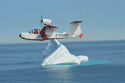
We glide for distance if we would like to get to a suitable landing area (like shore), or time, if we think we can fix the problem, and get it running again. But, if I going to land, and a suitable area is mostly under me, I'm doing it John's way, forget trimming for a glide, point it down, and get rid of the excess energy very close to the ground, in an extended flare. For my experience, this will be the only successful way to do it in a draggy amphibian. If you glide at best distance speed, and arrive to the flare at that speed, you'll either going to have to judge the flare perfectly the first time, or it's going to end up badly, because the plane will have to stop descending AND slow down at the same time - double the pilot workload, twice the opportunity for misjudgement. If you're down on the deck, and flying parallel fast, you're no longer worried about arresting descent, you have already succeeded at that, now you just bleed off the speed as you need, and touch down where you want to. Worst is you got it wrong, and it's early. Much less getting it wrong, is you could not bleed off all of the speed, and you overran - but you bled off most of it, and went into the hedge with only a little excess energy, rather then blasting through the threshold obstruction at flying speed.
-
willow burner
- Rank 2

- Posts: 75
- Joined: Wed Jan 02, 2013 11:06 am
Re: Interesting factoid about Cessna trainers
What he said. If the purpose of the forced apprch is to land, the quicker it happens the better. Aim where you want to go, then manage speed.
-
frozen solid
- Rank 7
- Posts: 527
- Joined: Fri Feb 22, 2008 6:29 pm
Re: Interesting factoid about Cessna trainers
ahramin wrote:As already stated above: weight has a large effect on the best glide speed but very little effect on the best glide ratio.
Water ballast in gliders is used to improve the speed by flying faster between thermals. If you dumped your water every time you found a thermal, how would you get the water back in at the top of the thermal?
photofly wrote:A big funnel, and fly under another glider dumping ballast.
How the hell should I know? I already said, I don't glide. Maybe they keep the ballast on board for the whole flight; maybe they dump it just before they land to allow a lower speed. I just commented that I know they carry water ballast to zip around faster; I imagined they would drop it at some point. A heavy plane burns more gas than a light one. Even if your "gas" comes from thermals I figured there would be a point in the flight where the pilot would want to lose the weight before landing.iflyforpie wrote:Don't be silly.... they have on-board condensers.
Why does every thread on AvCanada culminate with people trying to make someone feel stupid? God.
-
shimmydampner
- Rank (9)
- Posts: 1764
- Joined: Sat Feb 21, 2004 3:59 pm
Re: Interesting factoid about Cessna trainers
Poor social skills and smug douchebaggery get amplified online because the threat of a punch in the nose is not present.
Re: Interesting factoid about Cessna trainers
Unless the day really isn't panning out the way it was supposed to, the water gets dumped after getting back to the field and before landing.
-
Old Dog Flying
- Rank (9)
- Posts: 1259
- Joined: Sun Jul 27, 2008 5:18 pm
Re: Interesting factoid about Cessna trainers
And if I recall correctly, a glide speed of 285 ktsColonel Sanders wrote:Sigh.
PS F-104 high key was 20,000 feet.
Barney
-
iflyforpie
- Top Poster
- Posts: 8132
- Joined: Tue Apr 15, 2008 12:25 pm
- Location: Winterfell...
Re: Interesting factoid about Cessna trainers
Only because you are reacting to absolutely nothing.frozen solid wrote: Why does every thread on AvCanada culminate with people trying to make someone feel stupid? God.
You made a statement about water ballast in gliders. Ahramin simply stated why they used ballast and then asked a general developmental question to get your brain thinking about how they would get the water back if they had to dump it for every thermal. Photofly and I made smart remarks in general about how you could get the water back.... that's what this
means. I didn't even read what you wrote when I posted that.... so either calm down or go elsewhere.

